
The financial industry is experiencing one of the biggest technological revolutions in its history. From banking and investment management to insurance, accounting, wealth management, and financial planning, artificial intelligence is transforming how financial institutions operate and serve customers. The growing adoption of AI Tools for Finance is helping businesses improve efficiency, reduce operational costs, strengthen security, enhance decision-making, and deliver better customer experiences.
Traditionally, financial services relied heavily on manual processes, extensive paperwork, and human analysis. While expertise remains essential, the sheer volume of financial data generated today makes it increasingly difficult for organizations to process information efficiently without technological support. Artificial intelligence helps solve this challenge by analyzing large datasets, identifying patterns, detecting anomalies, and automating repetitive tasks.
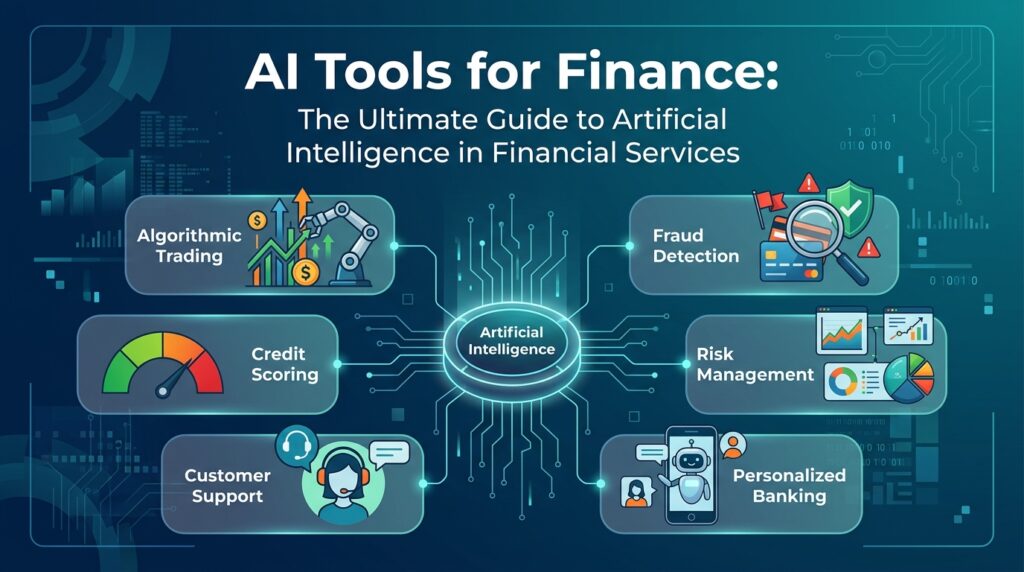
Financial institutions are using AI to improve fraud detection, automate customer support, forecast market trends, streamline compliance processes, optimize investment strategies, and personalize financial advice. Small businesses, independent financial advisors, accounting firms, banks, and multinational financial organizations are all finding value in AI-powered solutions.
As digital transformation continues across the financial sector, understanding the best AI Tools for Finance, their applications, benefits, challenges, and future potential has become increasingly important. This comprehensive guide explores how AI is reshaping finance and highlights the leading tools driving this transformation.
What Are AI Tools for Finance?

AI tools for finance are software platforms that use artificial intelligence, machine learning, predictive analytics, natural language processing, and automation technologies to support financial operations and decision-making.
These tools can process large volumes of financial data, identify trends, automate workflows, generate insights, detect fraud, forecast outcomes, and assist professionals in making more informed decisions.
Unlike traditional financial software that follows predefined rules, AI-powered systems can learn from historical data and improve performance over time. This capability allows them to adapt to changing market conditions and evolving customer needs.
Common applications include:
- Financial forecasting
- Fraud detection
- Risk management
- Portfolio optimization
- Accounting automation
- Customer service
- Compliance monitoring
- Investment research
- Expense management
- Financial reporting
These capabilities make AI one of the most influential technologies in modern finance.
Why AI Is Important in the Financial Industry

The financial sector handles enormous amounts of sensitive information daily. Processing this data accurately and efficiently is critical for maintaining trust, ensuring compliance, and making sound business decisions.
AI offers several advantages that make it particularly valuable in finance. First, it significantly reduces the time required to analyze complex datasets. Tasks that once took hours or days can now be completed in minutes.
Second, AI improves accuracy by identifying patterns and anomalies that may be difficult for humans to detect. This is especially useful in fraud detection, risk assessment, and compliance monitoring.
Third, AI enhances customer experiences by enabling personalized recommendations, faster service, and automated support systems.
Finally, AI helps organizations reduce costs through automation, allowing employees to focus on higher-value activities that require human expertise.
Current Industry Adoption and Market Trends
The financial industry is among the largest investors in artificial intelligence technology. Banks, insurance companies, fintech startups, accounting firms, and investment organizations are increasingly incorporating AI into their operations.
Several major trends are driving this adoption:
| Trend | Impact on Finance |
|---|---|
| Digital Banking Growth | Increased demand for automation |
| Fintech Expansion | More AI-powered financial solutions |
| Regulatory Complexity | Greater need for compliance tools |
| Fraud Prevention | Advanced security systems |
| Personalized Financial Services | Improved customer experiences |
| Data-Driven Investing | Enhanced decision-making |
These trends indicate that AI will continue to play a growing role in shaping the future of financial services.
Benefits of Using AI Tools for Finance
Financial organizations implement AI because of its ability to deliver measurable business value.
One of the most significant benefits is operational efficiency. AI automates repetitive tasks such as data entry, report generation, transaction monitoring, and customer support.
Another important advantage is improved risk management. AI systems can analyze historical and real-time data to identify potential risks and recommend mitigation strategies.
Customer service also benefits from AI-powered chatbots and virtual assistants that provide instant support and personalized guidance.
Additionally, AI helps organizations improve forecasting accuracy, detect fraudulent activities more effectively, and optimize investment strategies based on data-driven insights.
ChatGPT for Financial Content and Client Communication
ChatGPT has become one of the most versatile AI tools in the finance industry. Financial professionals use it for content creation, client communication, research assistance, report drafting, and educational materials.
Financial advisors can create newsletters, market updates, investment summaries, and client communications more efficiently using ChatGPT.
Key Features
| Feature | Benefit |
|---|---|
| Content Creation | Faster report and article production |
| Client Communication | Improved engagement |
| Research Assistance | Quick information gathering |
| Educational Content | Better financial literacy materials |
Pros
- Easy to use
- Supports multiple business functions
- Cost-effective
Cons
- Requires fact-checking
- Not suitable for regulated financial advice without review
Bloomberg Terminal AI Features
Bloomberg Terminal remains one of the most powerful financial intelligence platforms available.
The platform incorporates advanced analytics and AI capabilities to provide real-time market data, financial news, economic indicators, and investment research.
Key Features
- Market analysis
- Real-time financial data
- Economic forecasting
- Investment research
Pros
- Comprehensive financial information
- Trusted by professionals
- Extensive data coverage
Cons
- High cost
- Designed primarily for professional users
AlphaSense for Financial Research
AlphaSense uses artificial intelligence to help financial professionals search and analyze large amounts of business and market information.
The platform can quickly identify relevant insights from earnings calls, reports, filings, and research documents.
Key Features
- AI-powered search
- Market intelligence
- Financial research
- Document analysis
Pros
- Saves research time
- Improves information discovery
Cons
- Subscription costs
- Requires familiarity with financial research
Kavout for Investment Analysis
Kavout uses machine learning to evaluate stocks and generate investment insights.
The platform analyzes financial data, market activity, and company performance indicators to support investment decisions.
Key Features
- Stock analysis
- AI scoring models
- Market insights
- Investment screening
Pros
- Data-driven investing
- Automated analysis
Cons
- Market predictions are not guaranteed
- Requires investment knowledge
Kensho for Financial Analytics
Kensho Technologies specializes in analytics and data intelligence for financial institutions.
The platform helps organizations analyze market events, economic trends, and investment opportunities.
Key Features
- Data analytics
- Market intelligence
- Event analysis
- Financial insights
Pros
- Strong analytical capabilities
- Useful for institutional finance
Cons
- Primarily designed for enterprise users
Upstart for AI-Powered Lending
Upstart uses artificial intelligence to improve lending decisions.
Instead of relying solely on traditional credit scores, the platform evaluates additional factors to assess borrower risk.
Key Features
- Credit evaluation
- Lending automation
- Risk assessment
- Loan decision support
Pros
- Improved risk analysis
- Faster loan processing
Cons
- Dependent on data quality
- Regulatory considerations
Zest AI for Credit Risk Assessment
Zest AI helps lenders make more accurate credit decisions through machine learning models.
The platform analyzes extensive borrower data to improve approval processes and reduce risk.
Key Features
- Credit risk modeling
- Loan analytics
- Decision automation
- Compliance support
Pros
- Better lending decisions
- Enhanced risk management
Cons
- Requires integration with lending systems
Kasisto for Banking Customer Service
Kasisto provides AI-powered conversational banking solutions.
Financial institutions use Kasisto to offer virtual assistants that help customers manage accounts, access information, and complete transactions.
Key Features
- Virtual banking assistant
- Customer support
- Account management
- Personalized interactions
Pros
- Improved customer experience
- Reduced support costs
Cons
- Limited for complex inquiries
DataRobot for Financial Forecasting
DataRobot provides machine learning tools that help financial organizations build predictive models.
Applications include forecasting revenue, predicting risks, and optimizing business strategies.
Key Features
- Predictive analytics
- Forecasting models
- Data analysis
- Business intelligence
Pros
- Strong forecasting capabilities
- Enterprise-grade analytics
Cons
- Complex implementation
QuickBooks AI Features
QuickBooks incorporates AI-driven automation into accounting and financial management processes.
Businesses use QuickBooks to manage expenses, invoices, payroll, and financial reporting.
Key Features
- Expense tracking
- Invoice management
- Financial reporting
- Accounting automation
Pros
- User-friendly
- Suitable for small businesses
Cons
- Limited advanced analytics compared to enterprise tools
Pricing Overview Table
| Tool | Pricing Level |
|---|---|
| ChatGPT | Low to Medium |
| QuickBooks | Low to Medium |
| Kasisto | Medium |
| AlphaSense | Medium to High |
| Kavout | Medium |
| DataRobot | High |
| Bloomberg Terminal | High |
| Kensho | High |
| Upstart | Enterprise |
| Zest AI | Enterprise |
Comparison Table of Top Finance AI Tools
| Tool | Primary Use | Best For |
|---|---|---|
| ChatGPT | Communication & Content | Financial Advisors |
| Bloomberg Terminal | Market Intelligence | Investment Firms |
| AlphaSense | Research | Analysts |
| Kavout | Investing | Investors |
| Kensho | Analytics | Institutions |
| Upstart | Lending | Banks |
| Zest AI | Credit Risk | Lenders |
| Kasisto | Customer Service | Banks |
| DataRobot | Forecasting | Enterprises |
| QuickBooks | Accounting | Small Businesses |
Real-World Use Cases of AI in Finance
A financial advisor can use ChatGPT to create weekly market updates and educational content for clients, saving hours of manual work each month.
A bank can implement Kasisto to provide 24/7 customer support, reducing call center workloads while improving customer satisfaction.
A lending institution can use Zest AI to evaluate loan applications more accurately and consistently.
An investment firm may use Bloomberg Terminal and AlphaSense to analyze market trends and identify investment opportunities faster.
These examples demonstrate how AI can improve efficiency and decision-making across different financial sectors.
Industry-Specific Applications
Banking
Banks use AI for fraud detection, customer support, risk management, and compliance monitoring.
Investment Management
Investment firms leverage AI for portfolio optimization, market analysis, and predictive forecasting.
Insurance
Insurance providers use AI to assess claims, detect fraud, and improve customer service.
Accounting
Accounting firms automate bookkeeping, expense tracking, and financial reporting.
Fintech
Fintech companies build AI-powered products that improve financial accessibility and customer experiences.
Step-by-Step Guide to Implementing AI in Finance
Organizations should approach AI adoption systematically.
- Identify key challenges.
- Define measurable goals.
- Evaluate available solutions.
- Ensure regulatory compliance.
- Train employees.
- Monitor performance metrics.
- Scale implementation gradually.
This approach helps maximize value while minimizing risk.
Common Mistakes to Avoid
Many organizations adopt AI without a clear strategy. This can lead to poor results and wasted resources.
Another common mistake is relying entirely on automation without human oversight. Financial decisions often require expert judgment and regulatory compliance.
Data quality is also critical. AI systems perform best when provided with accurate and complete information.
Finally, organizations should avoid implementing too many tools simultaneously, which can create unnecessary complexity.
Best Practices for Finance AI Adoption
Successful organizations focus on solving specific problems rather than adopting technology for its own sake.
Maintaining strong data governance, ensuring compliance, and continuously evaluating performance are essential.
Human oversight should remain part of critical financial decision-making processes.
Regular employee training also helps maximize the value of AI investments.
ROI and Business Impact of AI in Finance
The return on investment from AI often comes through increased efficiency, reduced costs, improved customer satisfaction, and better decision-making.
Automation reduces manual workloads, allowing employees to focus on strategic activities.
Fraud detection systems can prevent significant financial losses.
Improved forecasting and analytics support smarter business planning and investment decisions.
Customer service automation can reduce support costs while enhancing client experiences.
Future Trends in AI for Finance
The future of finance will likely involve even greater integration of artificial intelligence.
Hyper-Personalized Financial Services
AI will deliver increasingly customized recommendations and experiences.
Advanced Fraud Detection
Machine learning models will become more effective at identifying suspicious activity.
Autonomous Financial Analysis
AI systems may handle more complex analytical tasks with minimal human intervention.
AI-Powered Wealth Management
Investment advice and portfolio management will become more data-driven.
Integrated Financial Ecosystems
Organizations will adopt unified platforms that combine analytics, compliance, customer service, and forecasting.
These developments are expected to reshape the financial industry over the coming decade.
Expert Recommendations
Businesses new to AI should start with practical applications that offer immediate value, such as accounting automation, customer service, or financial reporting.
Small businesses often benefit from tools like QuickBooks and ChatGPT, while larger institutions may find greater value in Bloomberg Terminal, AlphaSense, DataRobot, and Kensho.
Successful adoption requires clear objectives, strong governance, and ongoing performance evaluation.
Comprehensive Conclusion
The adoption of AI Tools for Finance is transforming the financial industry by improving efficiency, enhancing decision-making, strengthening security, and delivering better customer experiences. Artificial intelligence is helping organizations automate routine tasks, analyze complex datasets, optimize investments, and improve risk management.
Leading Finance AI Tools such as ChatGPT, Bloomberg Terminal, AlphaSense, Kavout, Kensho, Upstart, Zest AI, Kasisto, DataRobot, and QuickBooks demonstrate the broad range of applications available today. These platforms support financial professionals across banking, investment management, accounting, insurance, and fintech sectors.
As technology continues to advance, AI will play an even larger role in shaping the future of finance. Organizations that strategically adopt AI while maintaining strong governance and human oversight are likely to gain significant advantages in efficiency, profitability, and customer satisfaction.