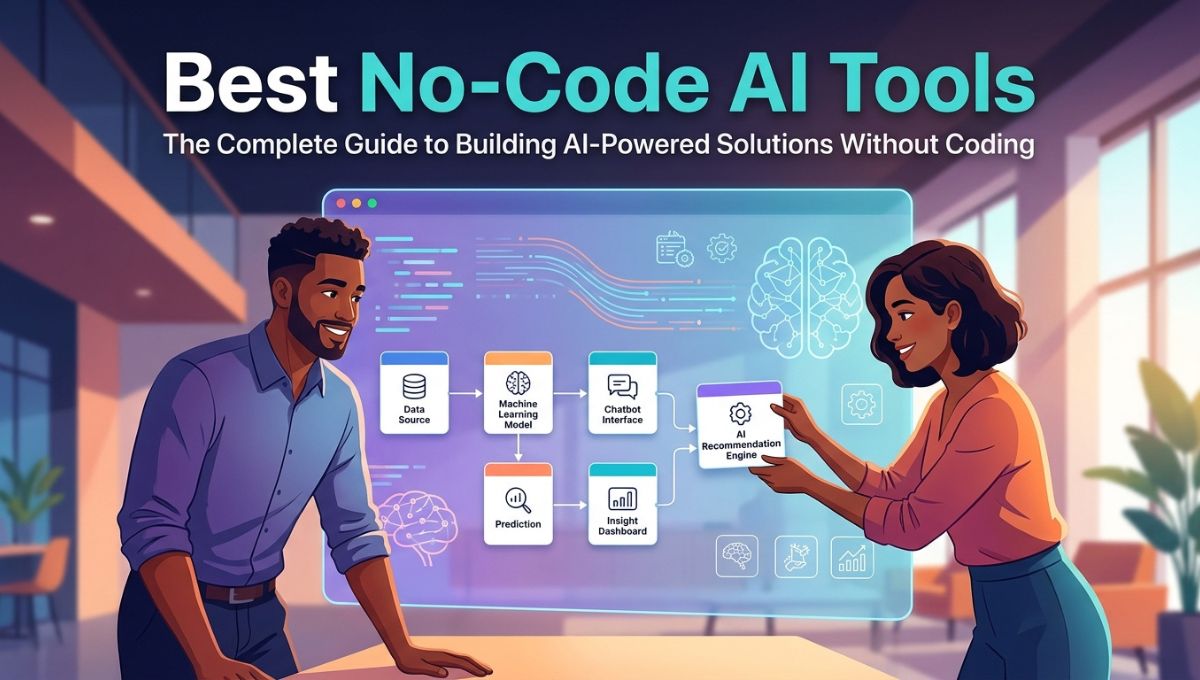
Artificial Intelligence (AI) is no longer limited to software developers and data scientists. Thanks to the rise of no-code platforms, anyone can now build AI-powered applications, automate workflows, create chatbots, generate content, analyze data, and develop business solutions without writing a single line of code. Entrepreneurs, marketers, business owners, educators, freelancers, consultants, students, and creators are increasingly adopting no-code AI platforms to improve productivity and launch innovative projects quickly.
The popularity of Best No-Code AI Tools has grown rapidly because these platforms eliminate the technical barriers traditionally associated with AI development. Instead of learning programming languages like Python or JavaScript, users can simply drag and drop components, connect different applications, write natural language prompts, and configure workflows using visual interfaces.
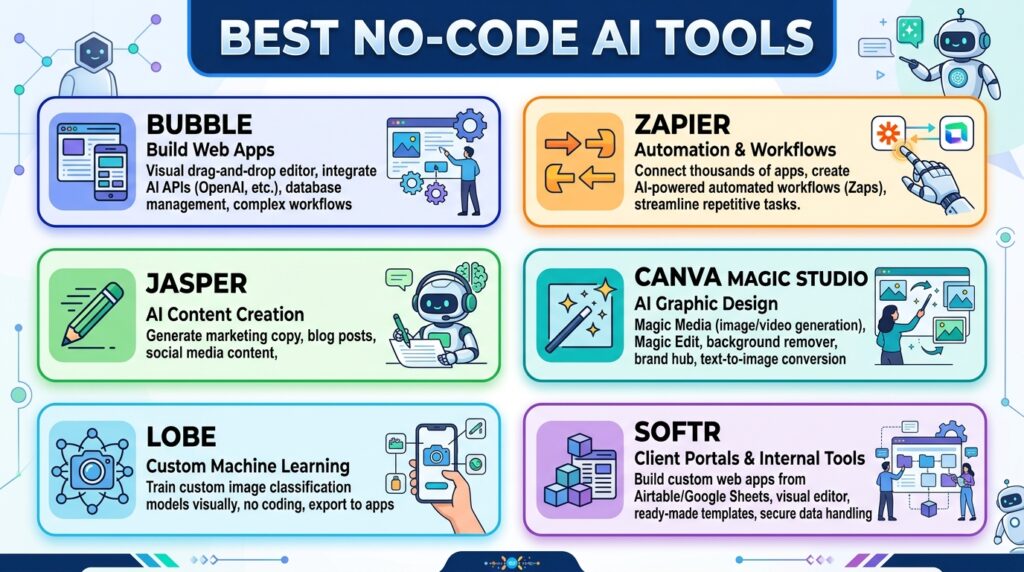
No-code AI tools help businesses save time, reduce development costs, and bring ideas to life much faster than traditional software development. Whether you want to build an AI chatbot, automate customer support, create marketing content, generate images, develop internal business tools, or analyze business data, no-code AI platforms provide powerful capabilities that require little or no technical knowledge.
As artificial intelligence becomes increasingly accessible, understanding the best no-code AI tools available today can help individuals and organizations improve efficiency while staying competitive in an evolving digital landscape.
What Are No-Code AI Tools?

Best No-Code AI Tools are software platforms that allow users to build, customize, and deploy AI-powered applications and automation workflows without writing programming code. These tools combine artificial intelligence with visual development environments, making advanced technologies accessible to non-technical users.
Unlike traditional software development, where developers manually write code for every feature, no-code platforms use drag-and-drop interfaces, templates, visual workflows, and natural language prompts to simplify development.
Users can create chatbots, automate repetitive tasks, process documents, build websites, generate images, develop customer support systems, analyze data, and integrate multiple applications using simple visual interfaces.
These platforms are widely used by startups, small businesses, enterprises, freelancers, consultants, marketing agencies, educational institutions, healthcare organizations, and nonprofit organizations.
Why No-Code AI Is Becoming Popular
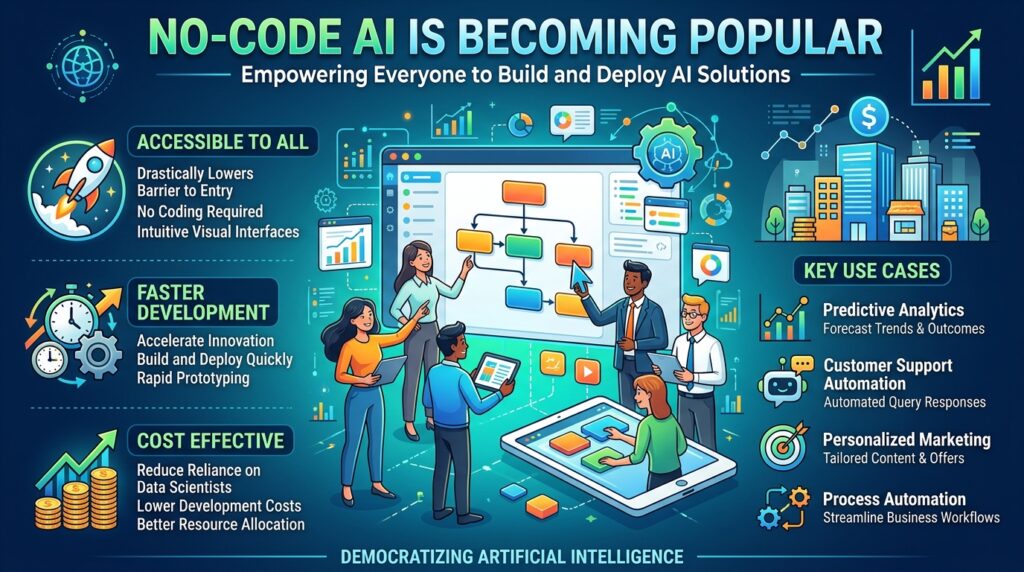
Building AI applications traditionally required programming knowledge, machine learning expertise, cloud infrastructure, and software development experience. This made AI inaccessible for many individuals and small businesses.
No-code AI platforms remove these barriers by allowing users to build sophisticated solutions through intuitive interfaces. Entrepreneurs can launch products faster, marketers can automate campaigns, HR teams can streamline recruitment, educators can build learning assistants, and customer support teams can deploy AI chatbots—all without hiring software developers.
The growing demand for digital transformation, workflow automation, and cost-effective business solutions has made no-code AI one of the fastest-growing technology trends.
How No-Code AI Platforms Work
No-code AI platforms provide pre-built components that users connect using visual workflows. Instead of writing code, users select AI models, configure triggers, define actions, and integrate external services through graphical interfaces.
For example, a business owner can create a workflow that automatically receives customer inquiries, generates AI-powered responses, updates a CRM system, sends follow-up emails, and notifies the sales team—all using drag-and-drop automation.
Most platforms also provide templates that simplify common business use cases such as customer support, content generation, lead management, appointment scheduling, invoice processing, and internal documentation.
Key Features of No-Code AI Tools
Most no-code AI platforms offer a wide range of features designed to simplify development.
| Feature | Purpose |
|---|---|
| Drag-and-Drop Builder | Create applications visually |
| AI Chatbot Builder | Develop conversational assistants |
| Workflow Automation | Automate repetitive business tasks |
| Document Processing | Extract and organize information |
| Image Generation | Create AI-generated visuals |
| Content Generation | Produce articles, emails, and marketing content |
| API Integration | Connect external applications |
| Data Analysis | Generate insights from business data |
| Templates | Accelerate project development |
| Collaboration Tools | Enable team-based development |
These features make AI accessible to users with little or no programming experience.
Best No-Code AI Tools in 2026
Many AI platforms now offer powerful no-code capabilities suitable for different business needs.
| Tool | Primary Purpose | Best For |
|---|---|---|
| Bubble | No-code web application development | Startups and SaaS products |
| Zapier AI | Workflow automation | Business automation |
| Make | Advanced automation workflows | Process integration |
| Glide | Mobile app builder | Internal business apps |
| Softr | Business portals and websites | Client portals |
| Airtable AI | Database automation | Business operations |
| Notion AI | Documentation and knowledge management | Teams and businesses |
| Microsoft Power Apps | Enterprise app development | Corporate organizations |
| Voiceflow | AI chatbot development | Customer support |
| Botpress | Conversational AI | AI assistants |
| Flowise AI | Visual AI workflow builder | LLM applications |
| Langflow | Visual AI pipelines | AI experimentation |
| Relevance AI | AI agents and automation | Business workflows |
| Pipedream AI | API automation | Developers and businesses |
| Canva AI | Graphic design | Marketing and creatives |
| Gamma | AI presentations | Business presentations |
| ChatGPT | Content generation and assistance | General productivity |
| Claude | Long-form writing and document analysis | Research and documentation |
| Google Gemini | AI productivity | Business and education |
| Perplexity AI | AI-powered research | Research and learning |
Different tools specialize in different use cases, so organizations often combine multiple platforms to create complete AI-powered workflows.
No-Code AI for Business Automation
Businesses use no-code AI to automate customer onboarding, invoice approvals, document processing, employee requests, marketing campaigns, customer support, lead generation, and reporting.
Instead of manually performing repetitive tasks, organizations create intelligent workflows that automatically process information, trigger actions, and notify relevant team members.
Business automation reduces operational costs while improving consistency and efficiency.
No-Code AI for Content Creation
Content creators, bloggers, marketers, and agencies use no-code AI tools to generate blog posts, social media captions, newsletters, product descriptions, advertising copy, scripts, and email campaigns.
AI writing assistants also improve grammar, optimize SEO, generate content ideas, summarize research, and personalize marketing messages.
Although AI accelerates content production, human editing remains essential for maintaining originality, accuracy, and brand voice.
No-Code AI for Customer Support
Customer support teams use AI chatbot builders to answer frequently asked questions, schedule appointments, collect customer information, and resolve common issues automatically.
When conversations become more complex, AI can transfer customers to human support agents while providing conversation history.
This improves customer satisfaction while reducing response times and operational costs.
No-Code AI for Marketing
Marketing professionals use no-code AI platforms to automate social media scheduling, email marketing, lead nurturing, campaign analysis, audience segmentation, and personalized customer engagement.
AI also helps generate marketing copy, optimize advertisements, recommend keywords, and analyze campaign performance.
Automation enables marketing teams to manage larger campaigns with fewer manual tasks.
No-Code AI for Education
Educational institutions and independent educators use no-code AI to build learning assistants, automate student communication, generate educational content, organize assignments, and personalize learning experiences.
Students also benefit from AI-powered study assistants, research tools, and knowledge management platforms.
No-Code AI for Human Resources
HR departments automate recruitment, resume screening, interview scheduling, employee onboarding, attendance management, and internal communication using no-code AI platforms.
These automations reduce administrative work while improving employee experiences throughout the hiring process.
Benefits of Using No-Code AI Tools
No-code AI platforms provide numerous advantages for individuals and organizations.
- No programming knowledge required
- Faster application development
- Lower software development costs
- Improved productivity
- Easy workflow automation
- Rapid business innovation
- Faster project deployment
- Better collaboration
- Reduced dependence on developers
- Scalable business solutions
- Easy integration with existing software
- Improved operational efficiency
These benefits allow businesses to innovate more quickly while making AI accessible to a broader audience.
Challenges and Limitations
Despite their advantages, no-code AI platforms also have limitations. Highly specialized applications may still require custom programming. Some platforms limit advanced customization, scalability, or integration capabilities.
Organizations should also consider subscription costs, vendor lock-in, data privacy, and security when selecting no-code AI solutions.
Careful planning helps ensure the chosen platform meets long-term business requirements.
Best Practices for Choosing a No-Code AI Tool
Selecting the right no-code AI platform depends on business goals and technical requirements.
- Identify the specific problem you want to solve.
- Choose tools that integrate with your existing software.
- Evaluate pricing and scalability.
- Prioritize strong security and compliance features.
- Test free versions before purchasing.
- Ensure the platform provides reliable customer support.
- Select solutions with active user communities and documentation.
These practices improve long-term success when implementing no-code AI technologies.
Future of No-Code AI
The future of no-code AI is expected to include more intelligent automation, autonomous AI agents, advanced multimodal capabilities, real-time collaboration, voice-driven application development, and deeper integration with enterprise software.
As AI technology continues evolving, no-code platforms will make advanced artificial intelligence even more accessible to businesses, entrepreneurs, educators, and creators worldwide.
Organizations adopting no-code AI today will be better positioned to innovate quickly, improve operational efficiency, and respond to changing customer expectations.
Conclusion
No-code AI platforms are making artificial intelligence accessible to everyone, regardless of technical background. From workflow automation and customer support to content creation, marketing, education, and business operations, Best No-Code AI Tools enable users to build powerful AI-powered solutions without writing code.
The increasing adoption of No-Code AI Platforms demonstrates that software development is becoming more accessible, efficient, and collaborative. By choosing the right tools and implementing them thoughtfully, individuals and organizations can automate repetitive tasks, accelerate innovation, and unlock new opportunities in today’s AI-driven digital economy.