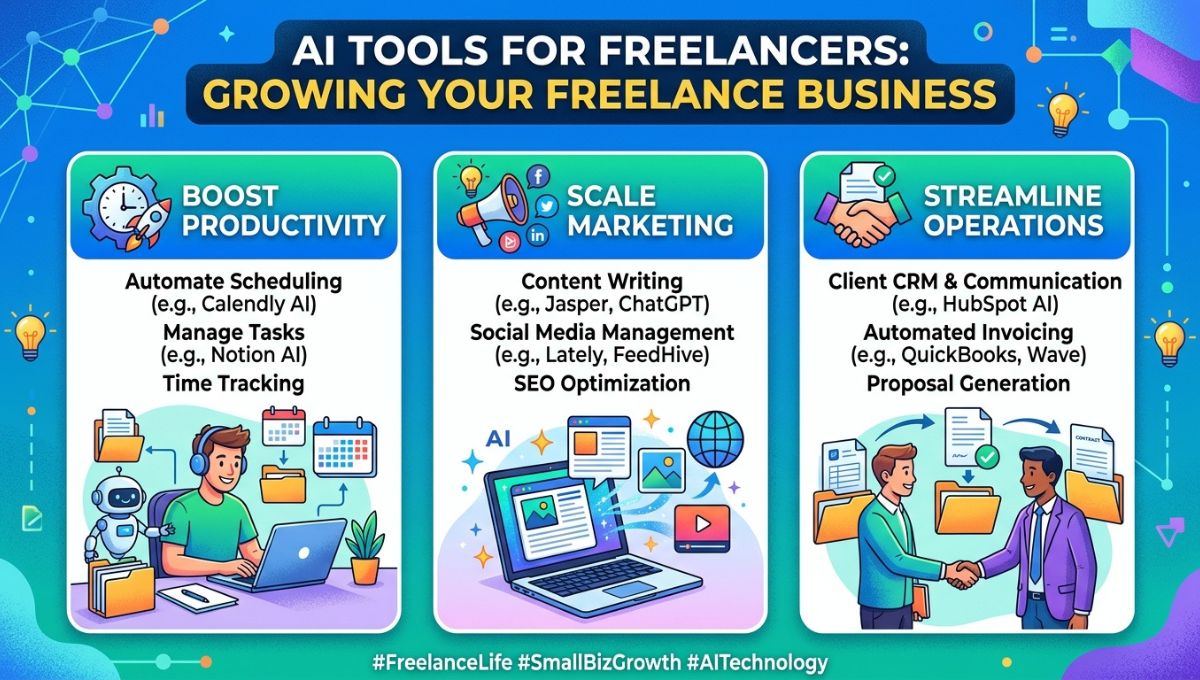
Freelancing has become one of the fastest-growing career choices worldwide. Millions of professionals now work independently as writers, graphic designers, web developers, video editors, digital marketers, consultants, virtual assistants, translators, photographers, social media managers, and software developers. While freelancing offers flexibility and independence, it also comes with challenges such as finding clients, managing multiple projects, meeting deadlines, handling invoices, communicating with clients, and maintaining consistent productivity.

Artificial Intelligence (AI) is helping freelancers overcome these challenges by automating repetitive tasks, improving workflow efficiency, and reducing the time spent on administrative work. Instead of manually organizing projects, writing emails, creating invoices, researching information, or generating content from scratch, freelancers can use AI-powered tools to complete these activities much faster while maintaining professional quality.
Today, AI Tools for Freelancers have become an essential part of modern freelance businesses. These tools support project management, content creation, graphic design, coding, communication, scheduling, invoicing, marketing, and business development. Rather than replacing freelancers, AI acts as a digital assistant that helps them deliver better results, manage more clients, and increase their earning potential.
Whether you are just starting your freelance journey or managing a successful independent business, understanding how AI can improve your workflow is becoming increasingly important in today’s competitive digital economy.
What Are AI Tools for Freelancers?
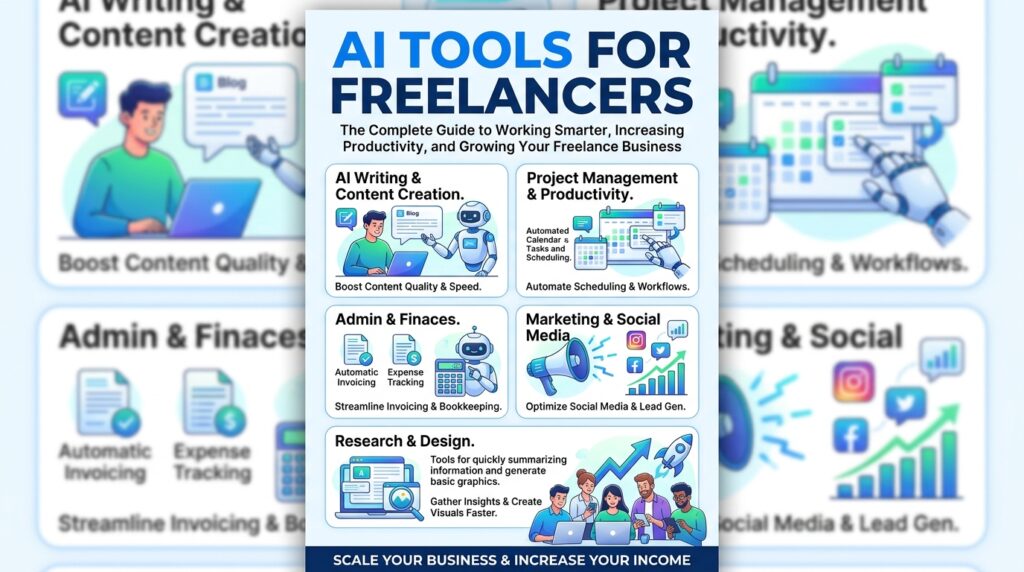
AI Tools for Freelancers are software applications powered by artificial intelligence, machine learning, and natural language processing that assist independent professionals in completing business and creative tasks more efficiently. These tools analyze information, understand natural language instructions, automate repetitive work, generate content, organize projects, and simplify client communication.
Unlike traditional software that depends entirely on manual input, AI-powered platforms can create reports, summarize documents, write emails, generate images, prepare invoices, schedule meetings, edit videos, analyze business performance, and provide intelligent recommendations based on user requirements.
Freelancers from nearly every profession—including writers, designers, developers, marketers, consultants, accountants, educators, photographers, and business coaches—can benefit from integrating AI into their daily workflow.
Why AI Is Becoming Essential for Freelancers
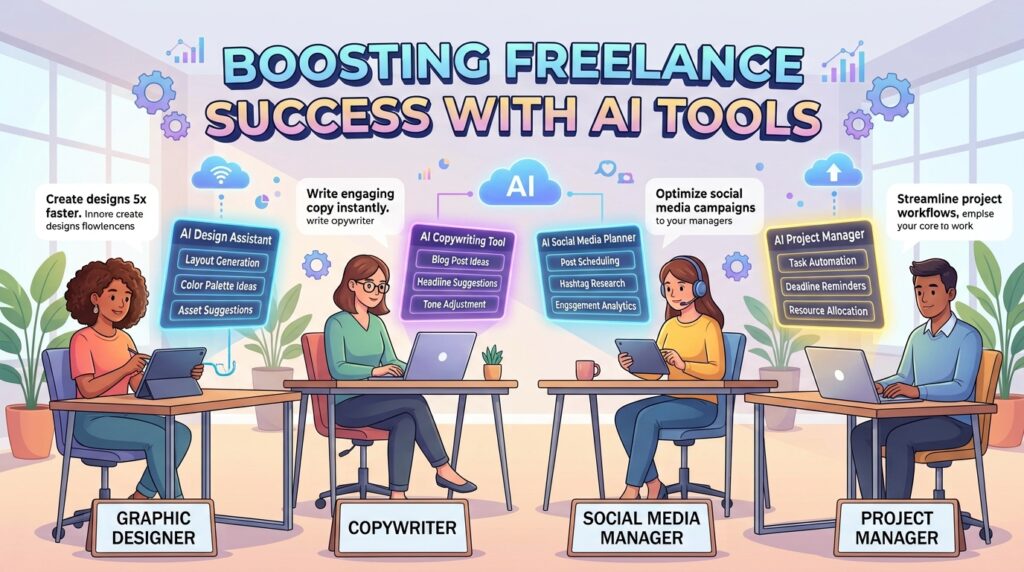
Running a freelance business involves much more than completing client work. Freelancers must also market their services, prepare proposals, negotiate contracts, track expenses, send invoices, respond to emails, maintain portfolios, schedule meetings, and manage deadlines. Performing all these responsibilities manually consumes valuable time that could otherwise be spent on billable work.
AI simplifies these activities by automating repetitive administrative tasks while improving productivity. Freelancers can use AI to draft emails, generate proposals, organize calendars, create presentations, conduct research, edit content, and automate routine business operations.
As competition continues to increase across freelance marketplaces and independent businesses, AI provides freelancers with an opportunity to deliver high-quality work faster while improving client satisfaction.
How AI Is Transforming Freelancing
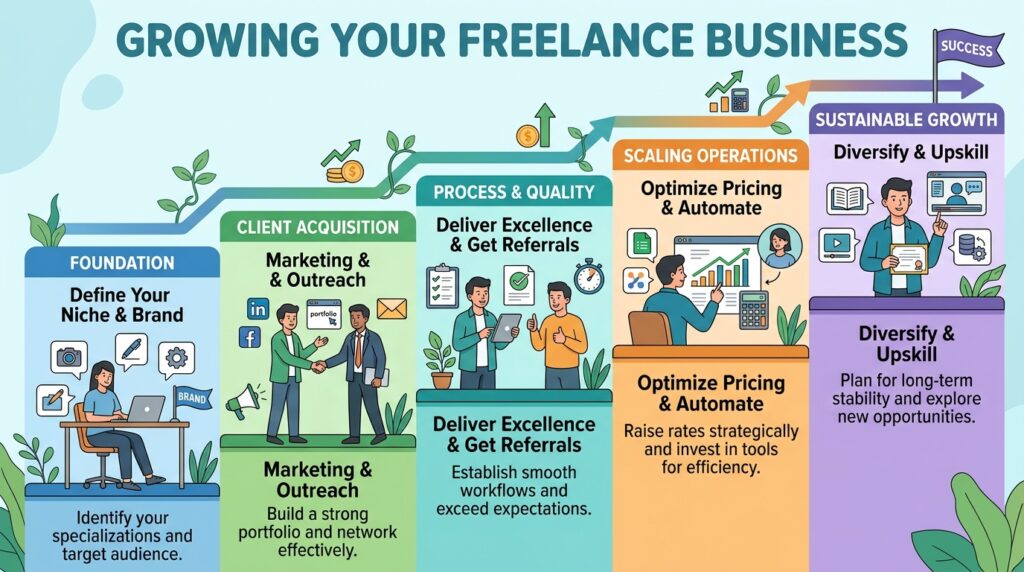
Artificial intelligence is changing almost every aspect of freelance work. Content writers can generate outlines and edit articles more efficiently. Graphic designers can create concepts, remove image backgrounds, and generate creative assets. Developers receive coding assistance and debugging support. Video editors automate subtitles, scene detection, and editing tasks.
Freelancers also benefit from AI-powered scheduling assistants, accounting tools, CRM platforms, proposal generators, and customer communication software. These technologies reduce administrative workload while allowing independent professionals to focus on delivering excellent services.
Instead of replacing creativity or expertise, AI supports freelancers by handling routine tasks and increasing overall efficiency.
Major Categories of AI Tools for Freelancers
Different AI tools serve different business functions. Many freelancers combine multiple AI platforms to create a complete productivity system.
| AI Tool Category | Primary Purpose |
|---|---|
| Writing Tools | Content creation, editing, proofreading |
| Graphic Design | Logos, social media posts, marketing visuals |
| Video Editing | Editing, subtitles, voice enhancement |
| Coding Assistants | Programming, debugging, code suggestions |
| Project Management | Task organization and collaboration |
| Proposal Writing | Client proposals and quotations |
| Invoice Management | Billing and payment tracking |
| Meeting Assistants | Recording and summarizing meetings |
| Email Assistants | Drafting professional emails |
| Research Tools | Information gathering and summarization |
| Marketing Tools | SEO, social media, advertising |
| Scheduling Tools | Calendar management and appointments |
Using the right combination of AI solutions allows freelancers to build efficient workflows while improving client service.
AI for Content Creation
Many freelancers work as writers, bloggers, copywriters, editors, scriptwriters, and content marketers. AI-powered writing assistants help generate article ideas, create outlines, improve grammar, rewrite paragraphs, summarize research, and optimize content for readability.
These tools also assist with SEO by suggesting keywords, improving headings, generating meta descriptions, and organizing content for search engines.
Although AI accelerates content creation, freelancers should always review and personalize the final work to maintain originality and meet client expectations.
AI for Graphic Designers
Graphic designers use AI to create social media graphics, posters, presentations, logos, banners, illustrations, and marketing materials. AI simplifies repetitive editing tasks such as background removal, image enhancement, resizing, and object replacement.
Designers can quickly generate creative concepts while maintaining full control over the final design. This allows them to complete projects more efficiently and handle larger workloads.
AI for Developers
Freelance software developers use AI-powered coding assistants to generate code snippets, explain programming concepts, identify bugs, optimize code, and automate documentation.
AI also helps developers create APIs, write unit tests, improve code quality, and accelerate software development while reducing repetitive programming tasks.
Developers remain responsible for reviewing and validating AI-generated code before deployment.
AI for Video Editors
Video editing can be time-consuming, especially when working with long recordings. AI-powered editing software automates subtitles, removes background noise, enhances audio, identifies important scenes, and simplifies editing workflows.
Freelance video creators, YouTubers, educators, and digital marketers use AI to produce professional-quality videos more efficiently while reducing editing time.
AI for Proposal Writing
Winning freelance projects often begins with a well-written proposal. AI helps generate professional proposals, project summaries, quotations, cover letters, and client presentations based on project requirements.
Freelancers can customize these drafts to match their expertise, pricing, and communication style, allowing them to submit proposals more quickly without sacrificing quality.
AI for Client Communication
Maintaining strong communication is essential for freelance success. AI assists by drafting emails, generating meeting agendas, creating follow-up messages, and organizing client conversations.
Some AI platforms also provide intelligent scheduling, appointment booking, and automated reminders, helping freelancers stay organized while delivering a professional client experience.
AI for Project Management
Freelancers often manage several projects simultaneously. AI-powered project management platforms organize tasks, monitor deadlines, prioritize work, track progress, and automate reminders.
These systems improve workflow organization and reduce the risk of missed deadlines, ensuring projects are delivered on time.
AI for Financial Management
Managing finances is an important part of running a freelance business. AI-powered accounting tools help create invoices, monitor payments, track expenses, estimate taxes, and generate financial reports.
Automating these administrative activities reduces paperwork while improving financial organization and transparency.
AI for Research
Many freelance assignments require research before work begins. AI research tools summarize articles, analyze documents, organize information, and identify important insights from large volumes of content.
This allows freelancers to gather information more efficiently while spending more time creating value for clients.
AI for Marketing and Personal Branding
Freelancers must continuously promote their services to attract new clients. AI assists by generating social media content, writing blog posts, creating advertisements, optimizing websites for search engines, and planning marketing campaigns.
AI also helps build consistent branding across websites, portfolios, newsletters, and social media platforms.
Effective marketing supported by AI allows freelancers to increase visibility and generate more business opportunities.
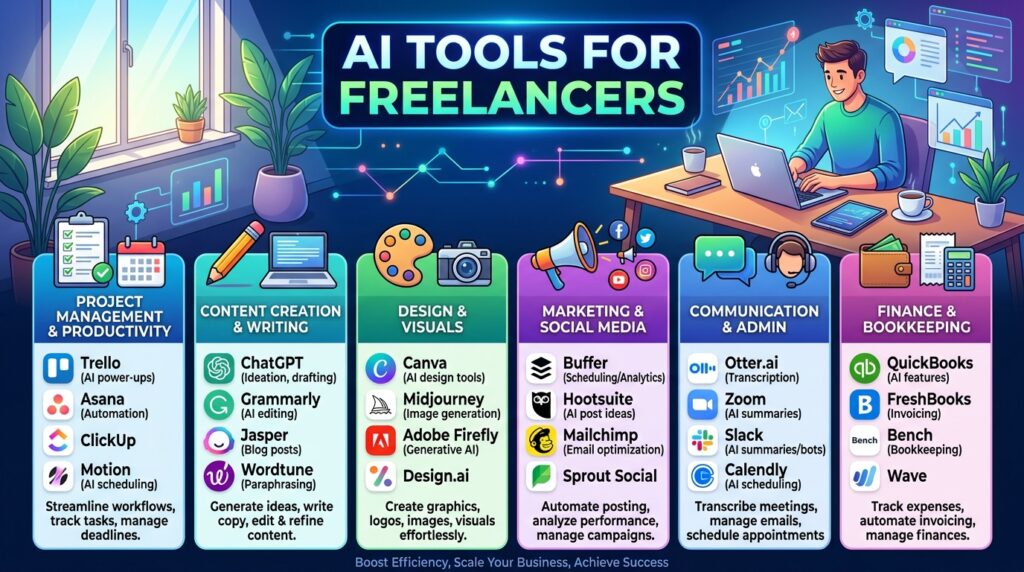
Popular AI Tools Used by Freelancers
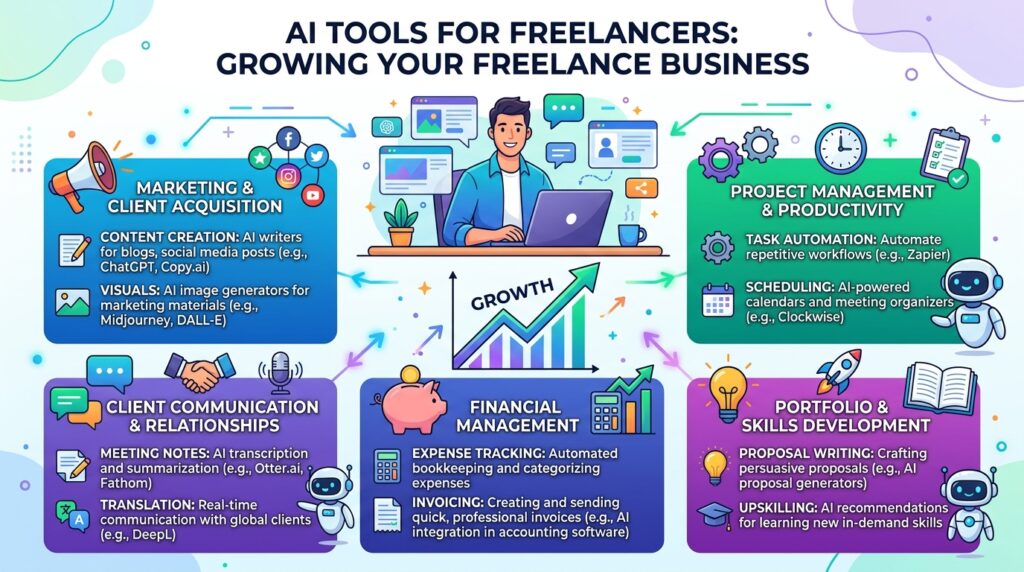
Many AI platforms have become valuable resources for freelancers working across different industries.
| AI Platform | Primary Use |
|---|---|
| ChatGPT | Writing, research, brainstorming, business tasks |
| Claude | Long-form writing and document analysis |
| Google Gemini | Research and productivity |
| Grammarly | Grammar and writing improvement |
| Canva AI | Graphic design and presentations |
| Adobe Firefly | AI image generation and editing |
| Notion AI | Documentation and project organization |
| ClickUp AI | Task and project management |
| Trello AI | Workflow organization |
| Otter.ai | Meeting transcription |
| Fireflies.ai | Meeting summaries |
| Perplexity AI | Research with source references |
| Jasper | Marketing content |
| Midjourney | Creative image generation |
| GitHub Copilot | Programming assistance |
| Zapier AI | Workflow automation |
| QuickBooks AI | Accounting and invoicing |
| Calendly AI | Appointment scheduling |
Freelancers often select tools based on their profession, budget, client requirements, and preferred workflow.
Benefits of Using AI Tools for Freelancers
AI offers numerous advantages for independent professionals:
- Faster project completion
- Improved productivity
- Better client communication
- Efficient project management
- Higher-quality content creation
- Faster proposal writing
- Improved financial organization
- Better research capabilities
- Reduced repetitive work
- Increased earning potential
- Improved work-life balance
- Enhanced marketing efficiency
- Better time management
These advantages help freelancers manage larger workloads while maintaining consistent quality and professionalism.
Challenges and Limitations
Despite its many benefits, AI also has limitations. AI-generated content may require editing, fact-checking, and customization before delivery. Freelancers should never submit AI-generated work without reviewing it carefully.
Data privacy is another important consideration, especially when handling confidential client information. Sensitive documents should only be processed using secure AI platforms that comply with privacy standards.
Creativity, communication skills, critical thinking, industry expertise, and client relationship management remain essential qualities that AI cannot replace.
Best Practices for Using AI in Freelancing
Freelancers can maximize the benefits of AI by following these best practices:
- Always review AI-generated work before sharing it with clients.
- Protect confidential client information.
- Customize AI-generated content to maintain originality.
- Use AI to improve productivity rather than replace professional expertise.
- Continue learning new AI technologies relevant to your industry.
- Maintain clear communication with clients regarding deliverables and expectations.
- Combine AI efficiency with creativity and strategic thinking.
Responsible use ensures AI supports long-term freelance success while maintaining professional standards.
Future of AI in Freelancing
Artificial intelligence will continue to play an increasingly important role in the freelance economy. Future AI systems are expected to provide more advanced project management, personalized business recommendations, predictive scheduling, intelligent client matching, multilingual communication, automated business analytics, and deeper workflow automation.
Freelancers who embrace AI while continuously improving their professional skills will be better positioned to grow their businesses, attract more clients, and remain competitive in an evolving digital marketplace.
Conclusion
Artificial intelligence is reshaping the freelance industry by helping professionals manage projects, communicate with clients, create content, organize finances, conduct research, and automate routine tasks. AI Tools for Freelancers allow independent professionals to improve efficiency while focusing on delivering exceptional client work.
The growing adoption of Freelance AI Software demonstrates that AI is becoming an essential productivity partner for freelancers across every industry. By combining AI-powered automation with creativity, expertise, and strong client relationships, freelancers can build more successful, scalable, and profitable businesses.