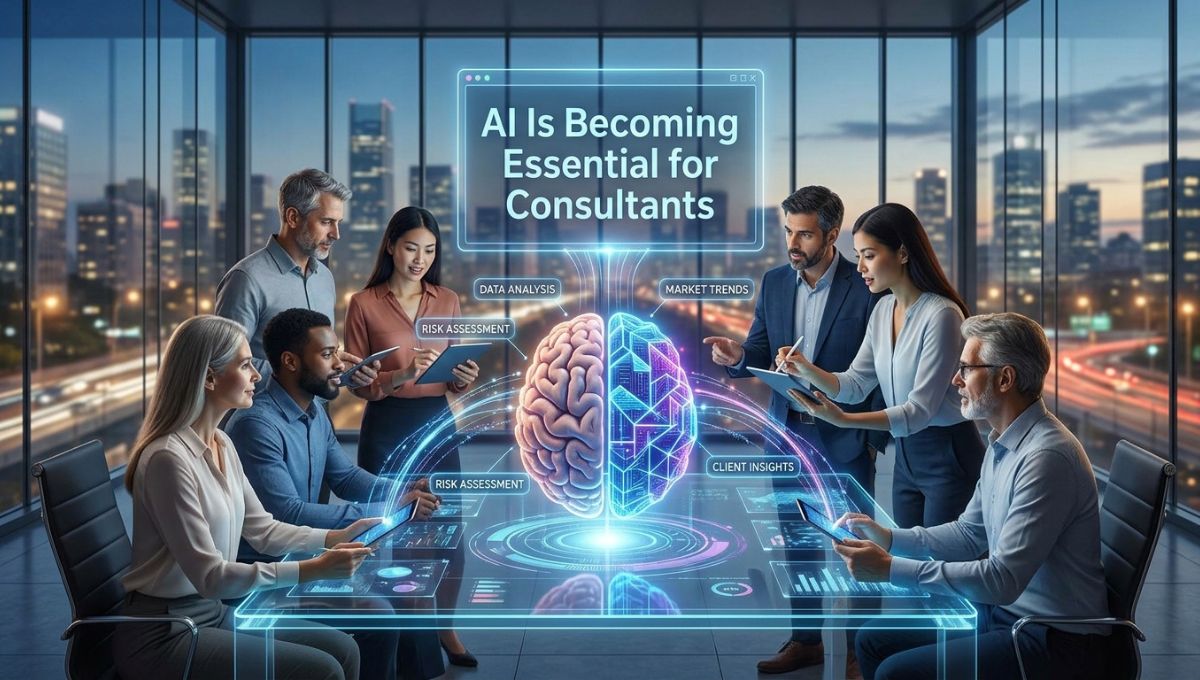
The consulting industry has always been built on expertise, problem-solving, strategic thinking, and the ability to deliver valuable insights to clients. Whether working as a management consultant, business advisor, financial consultant, IT consultant, HR specialist, marketing consultant, or independent freelancer, professionals are expected to analyze complex data, prepare detailed reports, create presentations, develop business strategies, and help organizations make informed decisions. As client expectations continue to grow, consultants are expected to deliver faster results without compromising quality.
Artificial Intelligence (AI) is changing how consultants work by automating repetitive tasks, organizing information, generating reports, analyzing large datasets, and supporting decision-making. Instead of spending countless hours collecting information or preparing routine documents, consultants can use AI to complete these tasks much more efficiently. This allows them to focus on solving business problems, building client relationships, and delivering strategic recommendations.
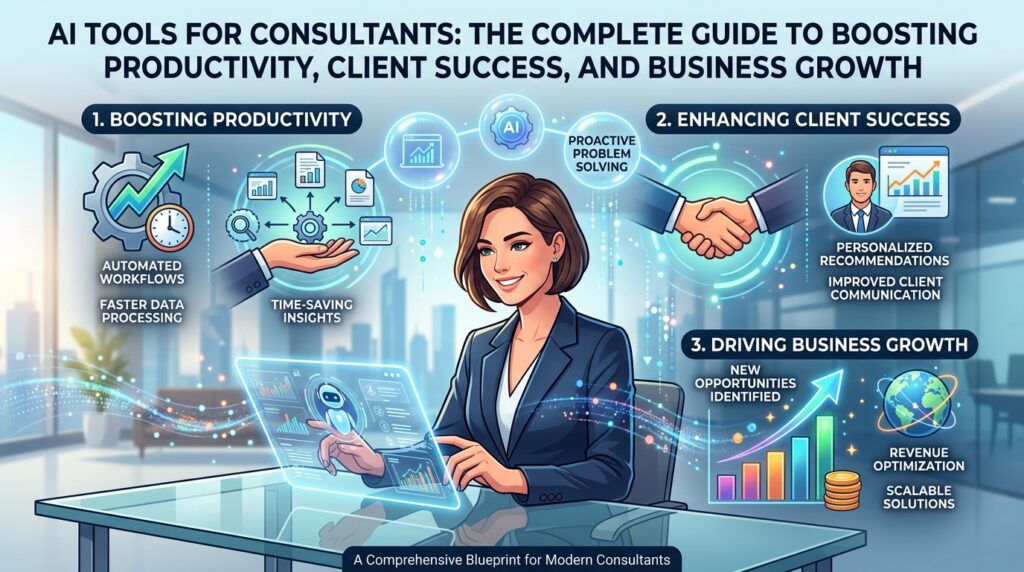
Today, AI Tools for Consultants are becoming an essential part of modern consulting practices. They help professionals improve productivity, manage projects more effectively, create better presentations, conduct deeper research, and streamline daily operations. Rather than replacing consultants, AI acts as a powerful assistant that enhances efficiency while allowing human expertise and critical thinking to remain at the center of every client engagement.
What Are AI Tools for Consultants?

AI Tools for Consultants are software applications powered by artificial intelligence, machine learning, and natural language processing that assist consultants in handling research, data analysis, project planning, document creation, client communication, meeting summaries, presentation design, workflow automation, and business reporting.
Unlike traditional business software, AI-powered consulting tools understand natural language instructions, analyze business information, summarize lengthy documents, generate strategic reports, recommend improvements, and automate repetitive administrative work.
Consultants working across industries such as management consulting, finance, healthcare, information technology, education, real estate, human resources, legal consulting, digital marketing, and operations management can all benefit from AI-assisted workflows.
These tools do not replace professional expertise. Instead, they reduce routine workloads so consultants can dedicate more time to strategic thinking, client engagement, innovation, and problem-solving.
Why AI Is Becoming Essential for Consultants
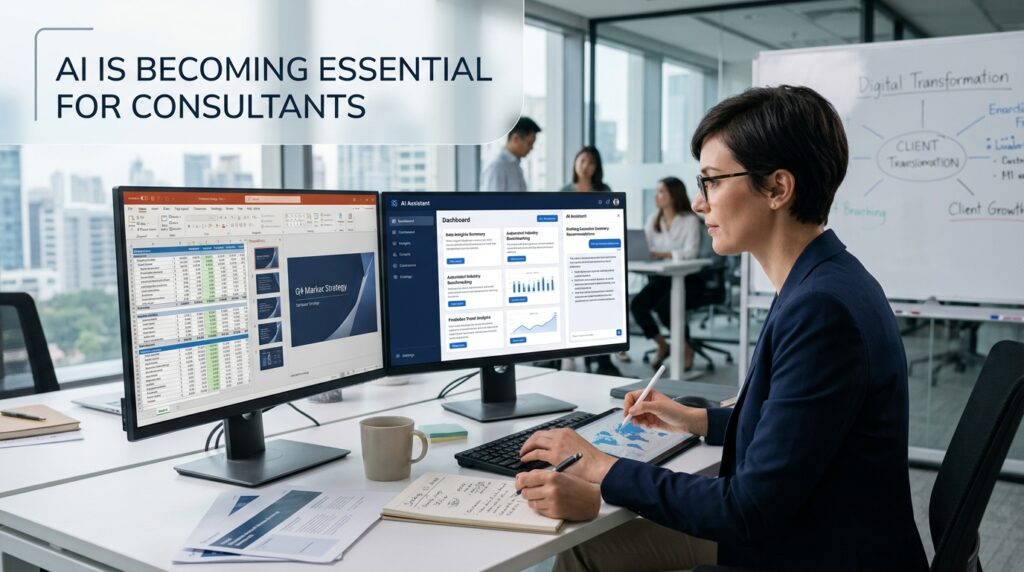
Consulting projects often involve large amounts of information. Consultants collect client data, conduct market research, analyze financial performance, prepare recommendations, create presentations, write proposals, and manage project timelines. Completing these tasks manually can consume significant time and increase the possibility of errors.
AI helps simplify these activities by processing information quickly, identifying important trends, summarizing documents, creating first drafts of reports, organizing project data, and automating repetitive work. Instead of spending hours formatting presentations or reviewing spreadsheets, consultants can focus on understanding client challenges and developing practical solutions.
The growing demand for faster project delivery, data-driven insights, and personalized consulting services has made AI an increasingly valuable resource for consulting professionals of all sizes.
How AI Is Transforming the Consulting Industry
Artificial intelligence is improving almost every stage of the consulting process. During project planning, AI helps organize project requirements, define objectives, and build implementation roadmaps. During research, AI analyzes articles, reports, financial data, industry trends, and competitor information within minutes.
When preparing recommendations, AI can summarize findings, generate presentation outlines, create business reports, and highlight key performance indicators. During project management, AI assists with scheduling, task tracking, meeting documentation, and collaboration among consulting teams.
Client communication has also become more efficient through AI-powered email drafting, meeting summaries, automated follow-ups, and intelligent chat assistants. These improvements allow consultants to spend less time on administrative work and more time delivering value to clients.
Major Categories of AI Tools for Consultants
AI consulting tools are designed to support different business functions. Some focus on research and analysis, while others specialize in project management, presentations, automation, or communication.
| AI Tool Category | Primary Purpose |
|---|---|
| Research Tools | Collect and summarize business information |
| Data Analysis | Analyze spreadsheets and business metrics |
| Report Writing | Generate reports and documentation |
| Presentation Design | Create professional business presentations |
| Project Management | Organize tasks, timelines, and collaboration |
| Meeting Assistants | Record, transcribe, and summarize meetings |
| Workflow Automation | Automate repetitive business processes |
| CRM Assistance | Manage client relationships and communication |
| Proposal Generation | Draft consulting proposals and agreements |
| Knowledge Management | Organize internal business knowledge |
Combining multiple AI tools helps consultants build a faster, more organized, and more efficient workflow.
AI for Business Research
Research is one of the most important responsibilities in consulting. Consultants regularly analyze industries, competitors, customer behavior, regulations, financial performance, and emerging market trends.
AI-powered research tools can gather information from multiple sources, summarize lengthy reports, identify key findings, and organize research into structured insights. This significantly reduces the time required for manual information collection while helping consultants focus on interpreting results.
Although AI accelerates research, consultants should always verify important facts using reliable sources before presenting recommendations to clients.
AI for Data Analysis
Many consulting projects involve working with spreadsheets, financial statements, survey results, operational data, and business performance metrics.
AI-powered analytics platforms simplify this process by identifying patterns, generating charts, forecasting trends, and highlighting unusual data points. Consultants can quickly understand large datasets without manually reviewing thousands of rows of information.
These capabilities improve reporting accuracy and support better business decision-making.
AI for Report Writing
Preparing detailed business reports often requires significant time. AI can generate first drafts, summarize research findings, organize content into logical sections, improve grammar, and suggest professional business language.
Consultants still review and refine every report to ensure accuracy, but AI dramatically reduces the time spent preparing documentation.
This enables consulting firms to deliver reports more quickly while maintaining professional quality.
AI for Presentation Design
Presentations are central to consulting work. Consultants frequently create strategy presentations, business proposals, project updates, investor decks, executive summaries, and workshop materials.
AI-powered presentation tools automatically organize slides, recommend layouts, generate visuals, suggest icons, and improve formatting. Instead of manually designing every slide, consultants can concentrate on delivering meaningful insights and compelling recommendations.
Well-designed presentations also improve client communication and stakeholder engagement.
AI for Meeting Management
Consultants attend numerous client meetings, workshops, interviews, and brainstorming sessions. Taking notes manually can distract participants from important discussions.
AI meeting assistants automatically record conversations, generate transcripts, summarize action points, identify key decisions, and prepare follow-up notes.
This improves documentation while allowing consultants to remain fully engaged during client meetings.
AI for Project Management
Managing consulting engagements requires careful coordination of deadlines, deliverables, resources, budgets, and communication.
AI-powered project management systems help consultants organize tasks, prioritize activities, monitor progress, identify delays, and automate reminders.
These platforms improve collaboration across consulting teams while ensuring projects remain on schedule.
AI for Client Communication
Effective communication is essential for successful consulting engagements. AI assists by drafting emails, generating meeting agendas, preparing follow-up messages, and organizing client interactions.
Some AI platforms also provide intelligent scheduling assistance and automate routine client updates, reducing administrative workload while maintaining professional communication.
This enables consultants to spend more time building relationships and addressing client needs.
AI for Proposal Generation
Winning consulting projects often begins with preparing persuasive proposals. AI helps create proposal drafts, executive summaries, pricing documents, implementation plans, and project timelines based on client requirements.
Consultants can then customize these drafts to reflect their expertise, industry knowledge, and unique approach.
This shortens proposal preparation time while maintaining consistency across business development efforts.
AI for Knowledge Management
Consulting firms generate valuable knowledge through previous projects, research reports, client engagements, and industry analyses.
AI-powered knowledge management platforms organize this information, making it easier for consultants to locate previous case studies, methodologies, templates, and best practices.
Improved knowledge sharing helps consulting teams work more efficiently and maintain consistency across projects.
Popular AI Tools Used by Consultants
Many AI platforms have become valuable resources for consultants across different industries.
| AI Platform | Primary Use |
|---|---|
| ChatGPT | Research, writing, brainstorming, reports |
| Claude | Long-form document analysis and writing |
| Microsoft Copilot | Productivity within Microsoft 365 |
| Google Gemini | Research and business content generation |
| Notion AI | Documentation and knowledge management |
| Perplexity AI | Research and source-based answers |
| Gamma | AI-powered presentations |
| Tome | Interactive business presentations |
| Otter.ai | Meeting transcription and summaries |
| Fireflies.ai | Meeting recording and collaboration |
| ClickUp AI | Project management and task automation |
| Asana Intelligence | Workflow management |
| Zapier AI | Business process automation |
| Canva AI | Presentation and graphic creation |
| Power BI Copilot | Business intelligence and reporting |
Organizations often choose tools based on their consulting specialization, team size, security requirements, and existing software ecosystem.
Benefits of Using AI Tools for Consultants
AI offers numerous advantages for consulting professionals:
- Faster business research
- Improved report preparation
- Better presentation quality
- Efficient meeting documentation
- Automated administrative tasks
- Improved project management
- Faster proposal creation
- Better client communication
- More accurate data analysis
- Improved collaboration among consulting teams
- Increased productivity
- Reduced operational costs
- Better knowledge management
- More time for strategic consulting
These benefits allow consultants to deliver higher-value services while managing multiple client engagements more effectively.
Challenges and Limitations
Despite its many advantages, AI has limitations. AI-generated content may occasionally contain inaccurate information, incomplete analysis, or recommendations that require professional review.
Consultants should never rely solely on AI for strategic business decisions. Confidential client information should be protected using secure AI platforms that comply with organizational privacy policies.
Professional judgment, industry expertise, ethical decision-making, and client relationship management remain responsibilities that require human experience and critical thinking.
Best Practices for Using AI in Consulting
Consultants can maximize the benefits of AI by following responsible practices:
- Verify AI-generated information before sharing it with clients.
- Use AI to support—not replace—strategic thinking.
- Protect confidential business information.
- Customize AI-generated reports to reflect client needs.
- Combine AI insights with industry expertise.
- Continue developing consulting skills alongside AI knowledge.
- Maintain transparency and professional ethics in every engagement.
These practices help ensure AI enhances consulting quality while preserving trust and professional standards.
Future of AI in Consulting
Artificial intelligence is expected to become even more integrated into consulting workflows. Future AI systems may provide deeper predictive analytics, automated business diagnostics, advanced market forecasting, intelligent strategy recommendations, personalized client insights, and enhanced collaboration capabilities.
As consulting firms continue adopting AI technologies, professionals who combine technological skills with strong business expertise will be well-positioned to deliver greater value in an increasingly competitive market.
Conclusion
Artificial intelligence is reshaping the consulting industry by helping professionals conduct research, analyze data, prepare reports, manage projects, and communicate with clients more efficiently. AI Tools for Consultants enable consultants to reduce repetitive work while focusing on strategic planning, innovation, and delivering measurable business outcomes.
The growing adoption of AI Consulting Software demonstrates that AI is becoming an essential productivity partner for modern consultants. By using AI responsibly and combining it with professional expertise, consultants can improve efficiency, strengthen client relationships, and deliver high-quality consulting services in a rapidly evolving business environment.