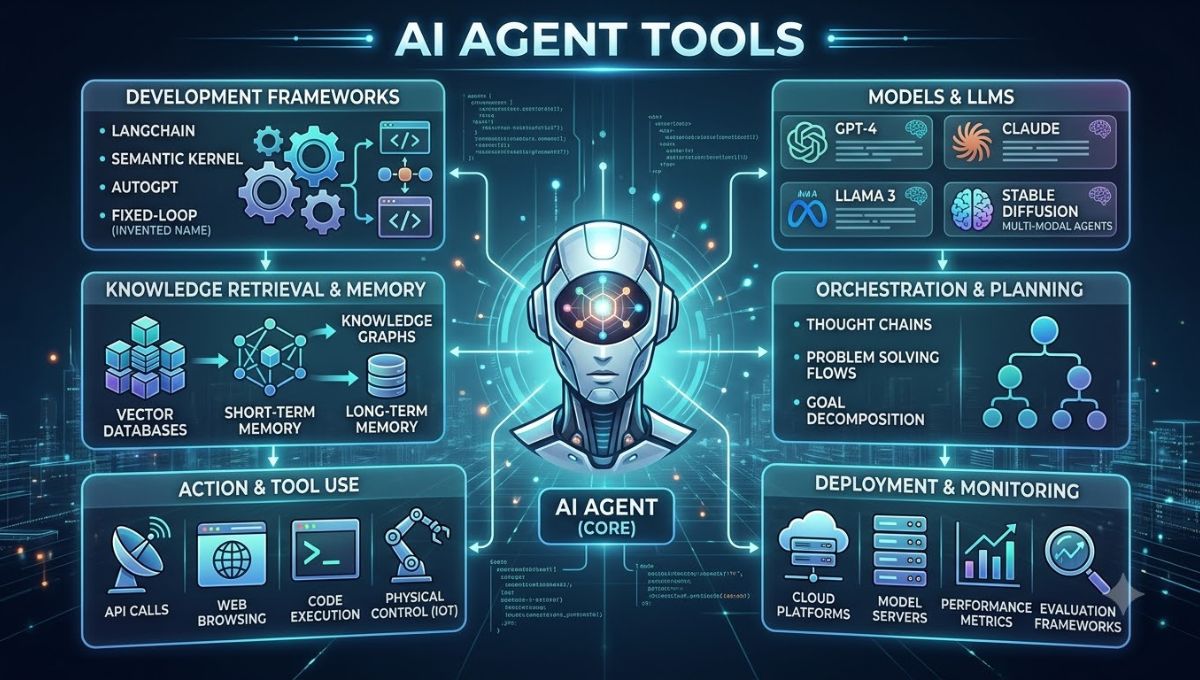
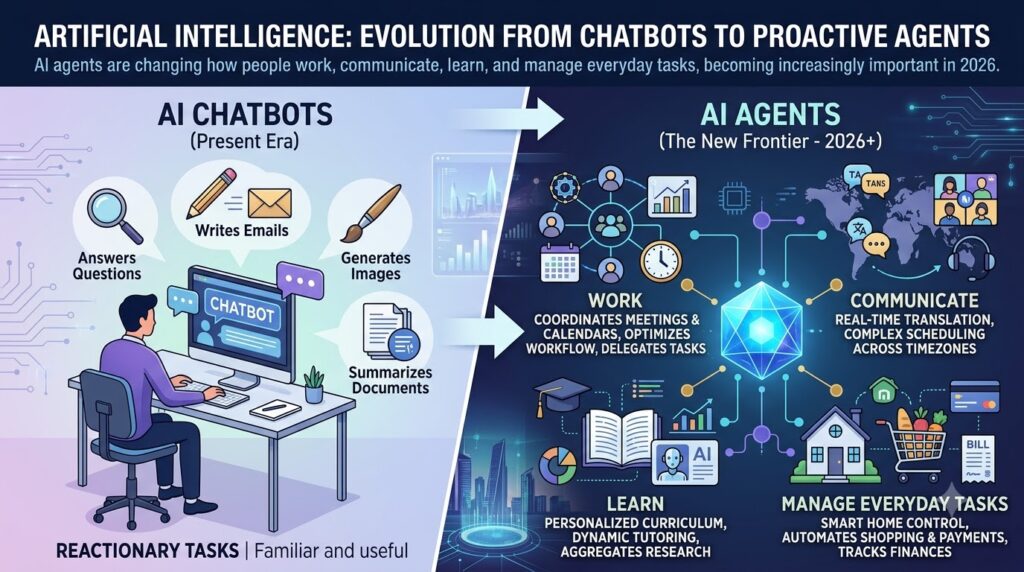
Artificial intelligence is changing the way people work, communicate, learn, and manage everyday tasks. Many people are already familiar with AI chatbots that answer questions, write emails, generate images, or summarize documents. However, a newer and more powerful concept is becoming increasingly important in 2026: AI agents.
An AI agent is not just a chatbot that responds to a message. It is a system designed to understand a goal, gather information, make decisions, and take actions to achieve that goal. This ability makes AI agents useful for businesses, freelancers, students, content creators, and anyone who wants to automate repetitive work.
Imagine having a digital assistant that can schedule meetings, organize tasks, follow up with customers, prepare reports, and coordinate multiple tools without requiring constant supervision. That is the core idea behind AI agents. They combine conversation, reasoning, and automation to help users complete real tasks rather than simply providing information.
This beginner’s guide explains what an AI agent is, how it works, the different types of AI agents, real-world examples, benefits, limitations, and how beginners can start using them effectively. The goal is to provide a clear, practical understanding without requiring any technical background.
What Is an AI Agent?

An AI agent is a software system that can:
- Perceive information from its environment
- Understand a goal or instruction
- Decide what actions are needed
- Perform those actions
- Evaluate the results and adjust if necessary
The key difference between an AI agent and a traditional software tool is that an agent is goal-oriented. It is designed to work toward completing an objective rather than simply executing one fixed command.
A Simple Analogy
Think of three different helpers:
| Helper | What It Does |
|---|---|
| Calculator | Performs exactly the calculation you enter |
| Chatbot | Answers the question you ask |
| AI Agent | Understands what you want to accomplish and helps complete the task |
For example:
“Prepare a summary of today’s customer inquiries and draft follow-up emails.”
A calculator cannot help.
A chatbot may explain how to do it.
An AI agent could potentially read the inquiries, identify the important points, create summaries, and draft personalized follow-up messages automatically.
That combination of understanding, planning, and acting is what makes AI agents special.
Why AI Agents Matter
Modern work involves many repetitive activities:
- Replying to emails
- Updating spreadsheets
- Scheduling appointments
- Organizing documents
- Following up with customers
- Creating reports
- Managing reminders
- Coordinating team tasks
These activities consume time but often do not require deep creativity or strategic thinking. AI agents help by handling such routine tasks automatically, allowing people to focus on:
- Customer relationships
- Creative work
- Problem-solving
- Business strategy
- Innovation and growth
For small businesses and solo professionals, this can feel like gaining an additional virtual assistant without hiring another employee.
How an AI Agent Works
Most AI agents follow a continuous cycle:
| Step | Description |
| Receive Goal | The user provides an objective |
| Observe | The agent collects relevant information |
| Analyze | It determines what needs to be done |
| Plan | It decides the sequence of actions |
| Act | The agent performs the tasks |
| Review | It checks the results and adjusts if needed |
Example Workflow
Suppose a local business owner says:
“Remind tomorrow’s customers about their appointments.”
The AI agent could:
- Access the appointment calendar
- Identify tomorrow’s bookings
- Extract customer contact details
- Generate personalized reminder messages
- Send them through email or WhatsApp
- Record which customers confirmed
- Notify staff about cancellations
Instead of one isolated action, the agent completes an entire workflow.
The Technologies Behind AI Agents
AI agents combine several technologies that work together.
Natural Language Processing (NLP)
This allows the agent to understand human language, including questions, requests, and instructions.
Machine Learning
Machine learning helps the agent recognize patterns, improve accuracy, and adapt to repeated tasks.
Reasoning Models
Reasoning systems help determine which action should happen next based on the available information.
APIs and Integrations
APIs connect the agent to external services such as:
- Gmail
- Google Calendar
- Microsoft Outlook
- Slack
- CRM software
- Payment systems
- Project management tools
Without these integrations, an AI agent could understand instructions but would not be able to interact with the tools where the actual work happens.
AI Agent vs Chatbot
This is one of the most common beginner questions.
| Feature | Chatbot | AI Agent |
| Understands language | Yes | Yes |
| Answers questions | Yes | Yes |
| Performs actions | Limited | Yes |
| Handles multiple steps | Rarely | Yes |
| Works toward a goal | Usually no | Yes |
| Learns from feedback | Sometimes | Often |
Easy Way to Remember
- Chatbot = Conversation
- AI Agent = Conversation + Decision + Action
A chatbot is primarily reactive. An AI agent is proactive and task-oriented.
Types of AI Agents
AI agents can range from very simple systems to highly advanced autonomous assistants.
Simple Reflex Agents
These agents follow predefined rules.
Example
- If an email contains “invoice”, move it to the Finance folder.
- If a customer sends “price list”, send the standard pricing document.
Advantages
- Fast
- Easy to build
- Reliable for repetitive tasks
Limitation
They cannot handle situations outside their predefined rules.
Model-Based Agents
These agents maintain an internal understanding of their environment.
Example
A warehouse management agent that tracks inventory levels and predicts when stock will run low.
Unlike simple reflex agents, they consider current conditions and stored information before acting.
Goal-Based Agents
These focus on achieving a specific objective.
Example
“Find the cheapest flight that arrives before 10 AM and includes one checked bag.”
The agent evaluates multiple options until it finds one that satisfies the goal.
Utility-Based Agents
These choose the best possible outcome among several acceptable options.
Example
A delivery routing agent may consider:
- Distance
- Traffic
- Fuel cost
- Delivery deadlines
- Driver availability
and select the route that provides the highest overall efficiency.
Learning Agents
These improve over time through experience and feedback.
Example
A customer support AI that becomes better at answering questions after analyzing thousands of previous conversations and customer ratings.
Learning agents are especially important because they can adapt instead of remaining static.
Real-World Examples of AI Agents
AI agents are already being used in many industries.
Customer Support
Businesses use AI agents to:
- Answer common questions
- Check order status
- Process refund requests
- Schedule service appointments
- Escalate complex cases to human staff
Example
An online store’s AI agent can automatically tell customers:
- Whether an order has shipped
- Expected delivery date
- Return instructions
- Available replacement options
This reduces waiting times and improves customer satisfaction.
Sales and Lead Management
AI agents can help sales teams by:
- Capturing website inquiries
- Qualifying leads
- Scheduling discovery calls
- Sending follow-up emails
- Updating CRM records
- Reminding sales representatives about pending opportunities
Even a small business can manage a larger number of potential customers more efficiently.
Marketing Automation
Modern AI agents can assist with:
- Creating social media posts
- Scheduling content
- Analyzing campaign performance
- Suggesting marketing ideas
- Personalizing email campaigns
- Tracking customer engagement
For local businesses, this can significantly reduce the time spent on daily marketing activities.
Personal Productivity
Individuals can use AI agents to:
- Organize task lists
- Summarize meetings
- Draft emails
- Manage calendars
- Set reminders
- Research information
- Create study notes
Many productivity tools now include early forms of AI agents that work quietly in the background.
A Practical Example for a Local Business
Consider a neighborhood salon.
Goal
“Manage tomorrow’s appointments efficiently.”
The AI Agent Could:
- Read the booking calendar
- Identify tomorrow’s appointments
- Send reminder messages to customers
- Ask customers to confirm or reschedule
- Update the calendar automatically
- Notify staff about any cancellations
- Generate a list of available time slots for new bookings
This single workflow could save the owner 30–60 minutes every day.
Benefits of AI Agents
Save Time
Routine administrative tasks can be completed much faster than manual processing.
Reduce Human Errors
Automated workflows are less likely to forget steps, miss follow-ups, or enter inconsistent information.
Operate Continuously
AI agents can work 24/7, making them useful for customer support, monitoring, and automated notifications.
Improve Productivity
Employees spend less time on repetitive work and more time on activities that require human judgment and creativity.
Scale Operations
A small business can handle more customer inquiries, appointments, or orders without immediately increasing staff.
Better Organization
AI agents can maintain structured records, reminders, and task histories that are often difficult to manage manually.
Limitations of AI Agents
AI agents are powerful, but they are not perfect.
They Can Make Mistakes
An agent may misunderstand instructions, select the wrong option, or generate inaccurate information.
They Depend on Good Data
Poor or incomplete data can lead to poor decisions.
They Need Clear Instructions
Vague goals usually produce weaker results.
Security Matters
Because AI agents often access emails, calendars, customer records, or financial systems, proper security and permission controls are essential.
Human Oversight Is Still Important
Important business, legal, financial, or medical decisions should always involve human review.
Common Misconceptions
“AI Agents Are Human-Like”
They can imitate conversation effectively, but they do not possess human consciousness, emotions, or genuine understanding.
“They Replace All Jobs”
AI agents are best at repetitive, structured, and data-driven tasks. Human skills such as empathy, negotiation, leadership, creativity, and complex judgment remain extremely valuable.
“Only Large Companies Can Use Them”
Many AI agent tools offer free or affordable plans, making them accessible to freelancers, startups, students, and local businesses.
“They Work Perfectly Without Supervision”
Current AI systems still require monitoring, testing, and occasional correction.
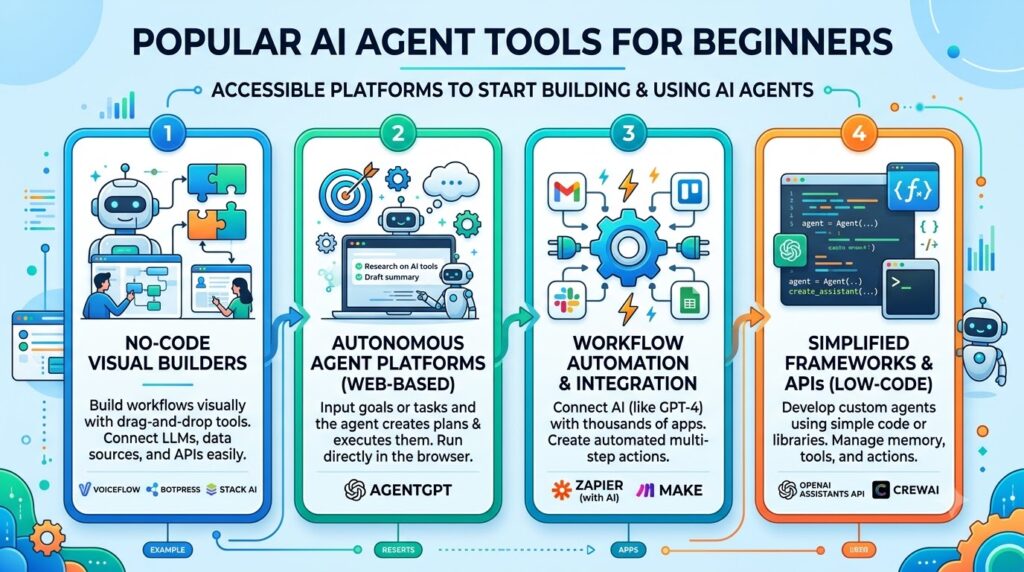
Popular AI Agent Tools for Beginners
| Tool | Main Use | Beginner Friendly |
| ChatGPT | Writing, research, task assistance | Yes |
| Google Gemini | Planning and summarizing | Yes |
| Microsoft Copilot | Office productivity | Yes |
| Zapier AI | Workflow automation | Yes |
| Notion AI | Notes and knowledge management | Yes |
These tools provide a practical introduction to AI-assisted workflows without requiring programming skills.
How to Start Using AI Agents
Step 1: Identify a Repetitive Task
Choose something you do frequently, such as:
- Writing appointment reminders
- Creating social media captions
- Organizing meeting notes
- Sending follow-up emails
Step 2: Use an AI Assistant
Start with ChatGPT or Gemini to help with that specific task.
Step 3: Add Automation
Connect the AI tool to your email, calendar, or task manager using an automation platform such as Zapier.
Step 4: Review the Results
Check whether the automation saves time and produces accurate outputs before expanding it to other processes.
Starting with one small workflow is usually much more effective than trying to automate an entire business immediately.
AI Agents in Everyday Life
You may already interact with AI agents without realizing it.
Examples
- Smart email assistants suggesting replies
- Calendar apps proposing meeting times
- Navigation apps choosing the fastest route
- Shopping apps recommending products
- Voice assistants setting reminders and controlling devices
The difference is that modern AI agents are becoming more autonomous and capable of coordinating multiple tasks together.
The Future of AI Agents
AI agents are evolving rapidly. Future systems are expected to:
- Work across multiple applications seamlessly
- Understand complex goals more accurately
- Collaborate with other AI agents
- Learn continuously from user behavior
- Provide proactive recommendations before users ask
For example, a future business AI agent might notice that customer inquiries have decreased, analyze recent sales trends, create a promotional campaign, schedule social media posts, and generate a performance report automatically.
This shift from reactive assistants to proactive digital workers is one of the most important trends in artificial intelligence.
Conclusion
Understanding what is an AI agent is becoming increasingly important because AI agents are rapidly moving from experimental technology into everyday business and personal productivity tools.
An AI agent is a software system that can understand a goal, gather information, make decisions, and take actions to achieve that goal. Unlike traditional chatbots that mainly provide answers, AI agents can handle multi-step workflows, interact with external applications, automate repetitive tasks, and adapt to changing situations.
For beginners, the easiest way to think about it is:
A chatbot can tell you what to do. An AI agent can often help do it for you.
Whether you are a student organizing study materials, a freelancer managing clients, a local business owner handling appointments, or a professional trying to reduce administrative work, AI agents can save time, improve organization, and increase productivity.
The best approach is to start small: automate one repetitive task, learn how the tool behaves, and gradually expand its role in your daily workflow. As AI technology continues to improve, AI agents are likely to become one of the most important digital productivity tools for both individuals and businesses.
Learning what is an AI agent today is not just about understanding a new technology term—it is about preparing for a future where humans and intelligent software increasingly work together to accomplish tasks faster, more accurately, and with far less manual effort.