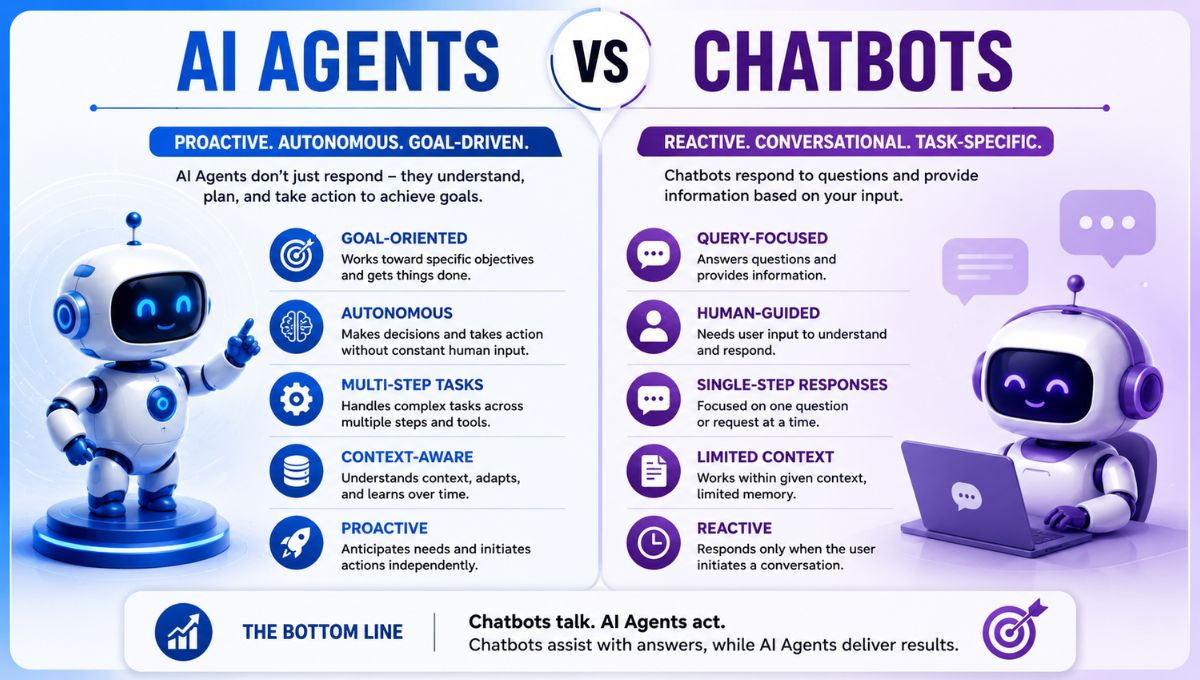
Artificial intelligence has become part of everyday business operations. Companies use AI to answer customer questions, create content, automate workflows, schedule meetings, and manage data. As AI adoption grows, two terms are often used interchangeably: AI agents and chatbots.
Many business owners assume they are the same thing. Both can communicate with users through text or voice, both use artificial intelligence, and both are designed to make interactions faster and easier. However, there is a significant difference between simply responding to a conversation and actually taking actions to complete a task.
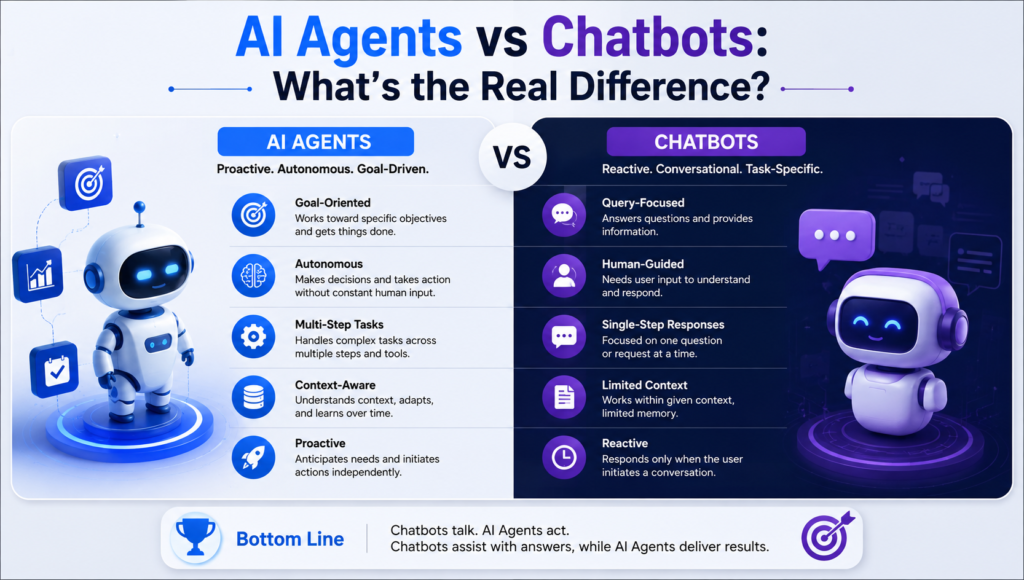
Understanding this difference is important for choosing the right technology for your business. A local restaurant that only needs automated responses for opening hours may not require an advanced AI agent. On the other hand, a service business that wants to manage appointments, send reminders, update customer records, and follow up automatically may benefit greatly from an AI agent.
This guide explains AI Agents vs Chatbots in simple language, covering how each works, their strengths and weaknesses, real-world examples, business use cases, and how to decide which solution is right for you.
What Is a Chatbot?
A chatbot is a software application designed primarily to simulate conversation with a user. Its main purpose is to answer questions, provide information, and guide users through predefined interactions.
Traditional chatbots often follow scripted rules. For example:
- If a user asks “What are your business hours?”, the chatbot sends the hours.
- If a user types “pricing”, it sends a pricing link.
- If a user selects “Track my order”, it asks for an order number.
Modern AI chatbots use Natural Language Processing (NLP), which allows them to understand a wider variety of user questions and respond in a more natural conversational style.
Common Chatbot Tasks
- Answering FAQs
- Providing business information
- Sharing links or documents
- Collecting basic customer details
- Guiding users through menus
- Offering simple troubleshooting steps
Example
A customer asks:
“Do you offer home delivery?”
The chatbot responds:
“Yes, we offer home delivery within 5 km of our store from 10 AM to 9 PM.”
The chatbot provides information, but it does not usually place the order, schedule delivery, and update inventory automatically.
What Is an AI Agent?
An AI agent is a more advanced system that can understand a goal, make decisions, and perform actions to achieve that goal.
Instead of only replying to messages, an AI agent can interact with other software systems such as:
- Calendars
- CRMs
- Email platforms
- Payment systems
- Inventory databases
- Project management tools
- Booking applications
Example
A customer says:
“Book a haircut appointment for tomorrow afternoon.”
An AI agent could potentially:
- Check available appointment slots
- Reserve a suitable time
- Add the booking to the calendar
- Send a confirmation message
- Schedule a reminder for the customer
- Notify the staff automatically
This is the key distinction: AI agents can take actions, not just hold conversations.
The Simplest Difference
Think of it this way:
| Technology | Primary Role |
|---|---|
| Chatbot | Talks with the user |
| AI Agent | Talks with the user and works on the user’s behalf |
A useful shortcut is:
Chatbot = Conversation
AI Agent = Conversation + Decision + Action
How Chatbots Work
Most chatbots follow one of two approaches.
Rule-Based Chatbots
These use predefined rules and decision trees.
Example:
- User selects 1 → Store Hours
- User selects 2 → Delivery Information
- User selects 3 → Contact Support
They are simple, predictable, and easy to control.
AI-Powered Chatbots
These use machine learning and NLP to understand user intent.
Example:
- “When are you open?”
- “What time does your shop close?”
- “Are you available tonight?”
The chatbot recognizes that all three questions are asking about business hours and provides the appropriate response.
Even advanced AI chatbots are often limited to responding within the conversation rather than performing complex external actions.
How AI Agents Work
AI agents usually follow a multi-step process:
| Step | What Happens |
| Receive Goal | The user provides an objective |
| Observe | The agent gathers relevant information |
| Analyze | It decides what needs to be done |
| Plan | It determines the sequence of actions |
| Act | It interacts with connected systems |
| Review | It checks the result and adjusts if needed |
This ability to plan and execute workflows is what makes AI agents significantly more powerful than standard chatbots.
Side-by-Side Comparison
| Feature | Chatbot | AI Agent |
| Answers questions | Yes | Yes |
| Understands natural language | Yes | Yes |
| Performs external actions | Limited | Yes |
| Handles multi-step workflows | Rarely | Yes |
| Makes decisions based on context | Minimal | Advanced |
| Integrates with multiple business systems | Sometimes | Usually |
| Learns and adapts over time | Limited | Often |
| Works toward a defined goal | Usually no | Yes |
Real-World Example: Restaurant Business
Chatbot Scenario
Customer:
“Can I reserve a table for four people tomorrow at 8 PM?”
Chatbot:
“Please call our restaurant at 98765-43210 to make a reservation.”
AI Agent Scenario
AI Agent:
- Checks table availability
- Reserves a table for four
- Sends a confirmation message
- Adds the reservation to the restaurant’s booking system
- Sends a reminder on the day of the booking
The chatbot redirects the customer. The AI agent completes the task.
Real-World Example: Local Salon
Chatbot
- Provides service prices
- Shares the salon address
- Lists available services
- Answers questions about opening hours
AI Agent
- Checks stylist availability
- Books appointments
- Sends confirmation messages
- Handles rescheduling requests
- Updates the salon calendar
- Sends automatic reminders
For businesses that depend heavily on appointments, the difference can directly affect customer convenience and staff workload.
Benefits of Chatbots
Chatbots remain extremely useful for many businesses.
Easy to Set Up
Most chatbot platforms provide templates that require little technical knowledge.
Lower Cost
Simple chatbots are generally cheaper to implement and maintain than full AI agent systems.
Consistent Responses
They provide standardized answers to common questions, reducing confusion for customers.
Good for High-Volume FAQs
Businesses that receive repetitive inquiries about:
- Hours
- Pricing
- Location
- Delivery areas
- Return policies
can often solve a large percentage of support requests with a chatbot alone.
Benefits of AI Agents
AI agents offer broader operational advantages.
Automate Entire Workflows
They can complete processes that normally require several manual steps.
Reduce Administrative Work
Tasks such as scheduling, follow-ups, data entry, and report generation can be handled automatically.
Improve Customer Experience
Customers can often complete actions immediately without being transferred to a human employee.
Scale More Efficiently
A small team can handle a larger volume of appointments, orders, or customer interactions with the help of AI agents.
When a Chatbot Is Enough
Choose a chatbot if your business mainly needs:
- FAQ automation
- Website visitor assistance
- Basic lead collection
- Order status information
- Simple customer support
- 24/7 informational responses
Good Examples
- Local grocery stores
- Small restaurants
- Retail shops
- Gyms
- Educational institutes
- Clinics with manual booking systems
When You Need an AI Agent
Choose an AI agent if you want to automate processes such as:
- Appointment scheduling
- Customer onboarding
- Lead qualification
- CRM updates
- Payment reminders
- Inventory checks
- Follow-up sequences
- Multi-step customer service workflows
Good Examples
- Salons and spas
- Repair services
- Real estate agencies
- Coaching centers
- Healthcare practices
- Home service businesses
- Consulting firms
Can a Chatbot Become an AI Agent?
Yes. Many modern AI platforms combine chatbot interfaces with agent capabilities.
For example, a conversational interface may:
- Understand the user’s request
- Trigger an automation workflow
- Access external systems
- Complete the requested task
- Report the result back to the user
In practice, the line between advanced chatbots and AI agents is becoming increasingly blurred. The important question is whether the system only responds or whether it can also take meaningful actions.
Common Misconceptions
“AI Agents Are Just Smarter Chatbots”
A smarter chatbot may generate better responses, but if it cannot perform tasks across other systems, it is still primarily a chatbot.
“Chatbots Are Obsolete”
Not at all. Chatbots are often the best choice for simple customer communication because they are easier and cheaper to deploy.
“AI Agents Work Without Human Oversight”
Current AI agents still require:
- Permission settings
- Workflow configuration
- Monitoring
- Error handling
- Human review for important decisions
A Practical Decision Framework
Ask these questions:
1. Do customers only need information?
- Yes → Chatbot
- No → Continue
2. Do customers need tasks completed automatically?
- Yes → AI Agent
3. Does the workflow involve multiple systems?
Examples:
- Calendar
- CRM
- Payments
- Inventory
- Yes → AI Agent
4. Is the process highly repetitive and rule-based?
- Yes → Chatbot may be sufficient
Example: Comparing the Same Request
User Request
“I need to change my appointment to Friday.”
Chatbot Response
“Please contact our support team to change your appointment.”
AI Agent Response
- Finds the existing appointment
- Checks Friday availability
- Reschedules the booking
- Updates the calendar
- Sends a new confirmation message
This single example captures the real difference between AI agents and chatbots better than any technical definition.
The Future: AI Agents + Conversational Interfaces
The future of business automation is likely to combine the strengths of both technologies.
Expected Trend
- Chatbot interface for natural conversation
- AI agent engine for planning and execution
- Automation platform for connecting business systems
Users will simply describe what they want, and the underlying AI agent will coordinate the necessary tools to complete the task.
For example:
“Send a thank-you message to customers who visited this week and offer them a 10% discount for their next visit.”
A future AI system could:
- Identify eligible customers
- Generate personalized messages
- Send them through email or WhatsApp
- Track responses
- Create follow-up tasks for interested customers
This is where conversational AI and intelligent automation are converging.
Long-Tail Keywords Naturally Covered
This article also addresses related search terms such as:
- AI agent vs chatbot difference
- chatbot vs AI agent for business
- what is the difference between AI agents and chatbots
- AI agents for small business automation
- chatbot or AI agent which is better
These related phrases improve topical relevance for search engines while keeping the content natural and useful for readers.
Internal Linking Opportunities
If this article is published on an AI tools blog, these would make strong internal links:
- What Is an AI Agent? A Beginner’s Guide
- AI Tools for Local Business Owners: 10 Free Picks
- Best AI Tools for Business Efficiency in 2026
These related topics help readers continue learning about practical AI automation and productivity tools.
Conclusion
The debate around AI Agents vs Chatbots is not about which technology is universally better. It is about understanding what problem you are trying to solve.
A chatbot is primarily designed for conversation and information delivery. It is excellent for answering common questions, guiding users through simple interactions, and providing 24/7 customer support at a relatively low cost.
An AI agent goes much further. It can understand goals, make decisions, interact with external systems, and complete multi-step tasks automatically. Instead of simply telling customers what to do, it can often do the work for them.
For many small and local businesses, the right approach is:
- Use a chatbot for FAQs and basic customer communication.
- Use an AI agent when you want to automate bookings, follow-ups, CRM updates, reminders, or other operational workflows.
As AI technology continues to evolve, we will increasingly see systems that combine both capabilities: chatbots for natural conversation and AI agents for intelligent task execution. Understanding this distinction today will help you choose the right automation strategy for your business, improve customer experience, reduce manual work, and prepare for the next generation of AI-powered operations.