
Artificial Intelligence (AI) is rapidly transforming the legal profession by helping lawyers work more efficiently, reduce repetitive tasks, and improve the quality of legal services. Traditionally, legal professionals spent countless hours researching case laws, reviewing contracts, drafting legal documents, organizing client records, and preparing court filings. Today, many of these time-consuming activities can be completed much faster with the help of AI-powered legal technology.
Modern AI Tools for Lawyers are designed to support—not replace—legal professionals. These intelligent platforms assist with legal research, contract analysis, document drafting, compliance monitoring, case management, client communication, and legal document review. By automating routine work, AI allows lawyers to focus more on legal strategy, client representation, negotiations, and courtroom preparation.
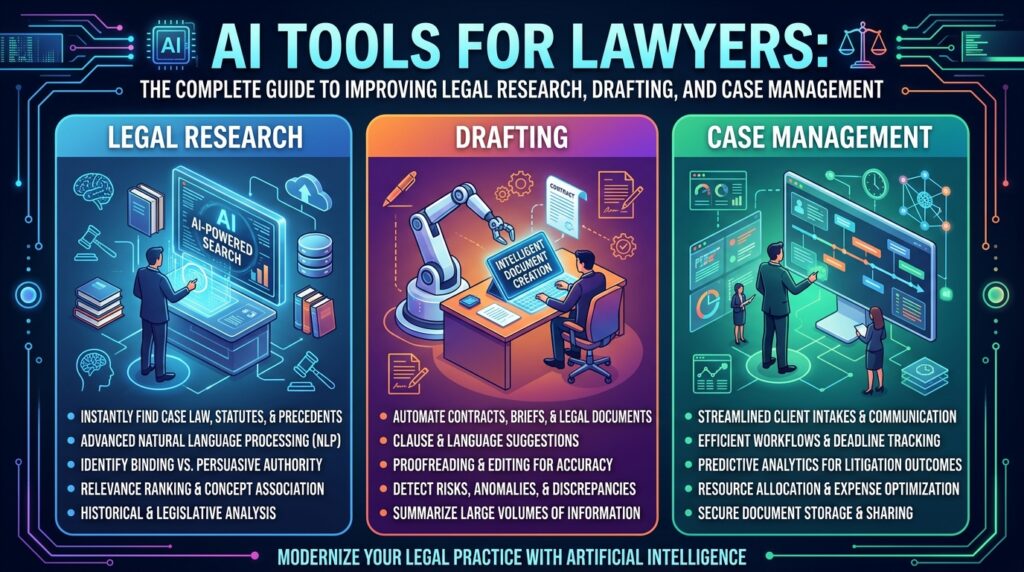
Law firms, corporate legal departments, government organizations, independent advocates, legal consultants, and legal startups are increasingly adopting AI solutions to improve productivity while maintaining accuracy and compliance. As legal technology continues to evolve, understanding how AI fits into modern legal practice has become essential for professionals who want to remain competitive.
What Are AI Tools for Lawyers?

AI Tools for Lawyers are software applications that use artificial intelligence, machine learning, and natural language processing (NLP) to perform legal tasks more efficiently. Unlike traditional legal software that mainly stores information, AI-powered tools analyze documents, understand legal language, summarize lengthy case files, identify important clauses, suggest edits, and assist with legal research.
These platforms can process thousands of legal documents within minutes, identify relevant legal precedents, compare contracts, highlight risks, and generate first drafts of agreements. Rather than replacing legal expertise, AI acts as an intelligent assistant that handles repetitive administrative work while leaving final legal decisions to qualified professionals.
AI legal tools are now widely used in litigation, corporate law, intellectual property, employment law, taxation, family law, criminal law, real estate, and compliance management.
Why AI Is Becoming Important in the Legal Industry

The legal profession deals with enormous amounts of information every day. Lawyers must review contracts, analyze regulations, interpret judgments, prepare documentation, communicate with clients, and meet strict deadlines. Completing these responsibilities manually often requires significant time and effort.
AI helps legal professionals by automating repetitive tasks while improving speed and consistency. Instead of manually searching hundreds of court judgments for relevant precedents, AI-powered research platforms can locate applicable cases within seconds. Document review, which previously took days, can now be completed much faster with intelligent document analysis.
This efficiency allows lawyers to spend more time advising clients, developing legal strategies, preparing arguments, and handling complex legal matters that require professional judgment.
How AI Is Transforming Modern Legal Practice
Artificial intelligence is changing nearly every stage of legal work. During legal research, AI identifies relevant statutes, judgments, regulations, and case precedents. During contract drafting, it suggests standard clauses, identifies missing provisions, and checks for inconsistencies.
When reviewing legal documents, AI highlights unusual language, conflicting clauses, potential risks, and compliance concerns. During litigation, AI assists with organizing evidence, summarizing depositions, and preparing legal arguments.
Many AI platforms also improve client communication by answering common questions, scheduling appointments, organizing case files, and generating progress reports.
These improvements allow law firms to manage larger workloads without compromising professional standards.
Major Categories of AI Tools for Lawyers
Different legal AI platforms are designed for specific purposes. Some focus on legal research, while others specialize in contract review, compliance, document automation, or case management.
| AI Tool Category | Primary Purpose |
|---|---|
| Legal Research | Search statutes, judgments, and case law |
| Contract Review | Analyze agreements and identify risks |
| Legal Drafting | Generate legal documents and templates |
| Document Review | Review and summarize legal files |
| Compliance Monitoring | Track regulatory requirements |
| Case Management | Organize clients, hearings, and files |
| E-Discovery | Analyze digital evidence |
| Legal Transcription | Convert audio into searchable text |
| Client Communication | Automate routine interactions |
| Billing & Time Tracking | Manage legal billing efficiently |
Using several AI tools together helps legal professionals streamline their daily workflow while maintaining high levels of accuracy.
AI-Powered Legal Research
Legal research is one of the most time-consuming responsibilities for lawyers. Finding relevant case law, statutes, regulations, and judicial decisions often requires reviewing hundreds of documents.
AI-powered legal research platforms simplify this process by understanding natural language queries instead of relying solely on exact keyword searches. Lawyers can ask questions in plain language, and AI identifies relevant judgments, legal provisions, and supporting authorities.
Many modern platforms also summarize lengthy judgments, making it easier for lawyers to quickly understand the key legal principles before reading the complete decision.
AI for Contract Drafting
Drafting contracts is a routine but essential legal task. AI assists by generating first drafts of agreements based on predefined templates and user instructions.
Lawyers can create employment contracts, service agreements, confidentiality agreements, partnership deeds, lease agreements, licensing contracts, and many other legal documents more efficiently. AI also suggests appropriate legal clauses based on the type of agreement being prepared.
Although every AI-generated draft should be reviewed carefully by a lawyer, automated drafting significantly reduces preparation time.
AI-Based Contract Review
Reviewing contracts manually often requires checking hundreds of clauses for inconsistencies, missing provisions, ambiguous language, and legal risks.
AI-powered contract review tools automatically identify unusual wording, conflicting obligations, missing clauses, renewal terms, indemnity provisions, payment conditions, confidentiality requirements, and potential compliance issues.
This enables lawyers to conduct faster and more consistent contract reviews while reducing the likelihood of overlooking critical details.
AI for Legal Document Summarization
Legal documents are often lengthy and highly detailed. AI can summarize court judgments, arbitration awards, contracts, witness statements, legal opinions, and case files into concise summaries that highlight the most important information.
These summaries help lawyers understand complex documents more quickly while deciding which sections require detailed review.
Summarization also improves collaboration among legal teams by making information easier to share and discuss.
AI in E-Discovery
E-discovery involves reviewing large volumes of digital evidence during litigation. Emails, text messages, contracts, financial records, photographs, videos, and electronic communications may all require examination.
AI speeds up this process by identifying relevant documents, removing duplicates, organizing evidence, and classifying information based on legal relevance.
This significantly reduces the time and cost associated with large-scale litigation.
AI for Compliance Management
Businesses operate under numerous legal and regulatory requirements. Compliance failures may lead to financial penalties, legal disputes, or reputational damage.
AI-powered compliance tools continuously monitor regulations, identify policy changes, compare organizational practices with legal requirements, and generate compliance reports.
Corporate legal departments use these tools to manage regulatory obligations more effectively.
AI in Case Management
Managing multiple legal cases requires careful organization. AI-powered case management systems help lawyers track court dates, filing deadlines, client communications, legal documents, invoices, and hearing schedules.
Many platforms also automate reminders for important deadlines, reducing the risk of missed court appearances or delayed filings.
Centralized case management improves collaboration among lawyers, paralegals, and administrative staff.
AI for Legal Billing and Time Tracking
Accurate billing is essential for law firms. AI helps record billable hours automatically by tracking work activities, meetings, document preparation, legal research, and client communication.
Automated billing reduces administrative work while improving transparency for both lawyers and clients.
Many systems also generate invoices and financial reports based on recorded activities.
AI for Client Communication
Law firms often receive repetitive client inquiries regarding appointments, case status, required documents, and consultation procedures.
AI-powered chatbots and virtual assistants can answer common questions, schedule consultations, collect initial information, and provide updates while maintaining professional communication standards.
This allows legal professionals to spend more time handling substantive legal work.
AI for Intellectual Property Lawyers
Intellectual property lawyers use AI to search trademarks, patents, copyrights, and published inventions. AI can compare similar trademarks, identify conflicts, and analyze patent databases much faster than manual research.
These capabilities improve efficiency during trademark registration, patent analysis, licensing negotiations, and IP litigation.
AI in Due Diligence
Corporate transactions often require reviewing thousands of legal documents during mergers, acquisitions, investments, and financing transactions.
AI accelerates due diligence by identifying important contractual terms, ownership information, financial obligations, litigation risks, and regulatory issues.
This reduces review time while improving consistency across large document collections.
Popular AI Tools Used by Lawyers
Several AI-powered platforms have become valuable resources for legal professionals worldwide. While different firms choose tools based on their practice areas and budgets, some of the most widely recognized solutions include:
| AI Platform | Primary Use |
|---|---|
| ChatGPT | Drafting, summarization, legal brainstorming |
| Harvey AI | Legal research and document analysis |
| Lexis+ AI | AI-assisted legal research |
| Westlaw Precision AI | Case law research and legal analysis |
| CoCounsel | Legal document review and research |
| Casetext | Case law search and litigation support |
| Spellbook | AI contract drafting |
| Ironclad AI | Contract lifecycle management |
| LawGeex | Automated contract review |
| Luminance | Due diligence and compliance |
Law firms typically evaluate these platforms based on security, accuracy, integration capabilities, pricing, and jurisdictional support.
Benefits of Using AI Tools for Lawyers
AI provides numerous practical benefits for legal professionals:
- Faster legal research
- Improved document accuracy
- Reduced repetitive administrative work
- Better contract review
- Quicker drafting of legal documents
- Enhanced compliance monitoring
- Efficient case management
- Faster due diligence
- Improved collaboration among legal teams
- Better client service
- Increased productivity
- Reduced operational costs
These advantages help lawyers deliver legal services more efficiently while maintaining professional quality.
Challenges and Limitations
Despite its benefits, AI has important limitations. AI-generated legal content may occasionally contain inaccuracies, outdated legal references, or incomplete analysis. Lawyers must always verify AI-generated information before relying on it for professional work.
Confidentiality, client privilege, cybersecurity, data privacy, and ethical obligations also require careful attention when using AI systems. Sensitive client information should only be handled through secure and approved legal technology platforms.
Most importantly, AI cannot replace legal reasoning, courtroom advocacy, negotiation skills, ethical judgment, or the professional responsibility of qualified lawyers.
Best Practices for Using AI in Legal Practice
Legal professionals can maximize AI’s benefits by following responsible practices:
- Always review AI-generated legal documents before use.
- Verify all legal citations and authorities independently.
- Protect confidential client information.
- Use secure AI platforms that comply with legal privacy standards.
- Treat AI as a research assistant rather than a legal decision-maker.
- Keep legal knowledge updated alongside technological skills.
- Maintain professional ethical standards at all times.
Following these practices ensures AI supports legal work while preserving professional integrity.
Future of AI in the Legal Profession
Artificial intelligence will continue to reshape legal practice in the coming years. Future AI systems are expected to provide more accurate legal research, multilingual legal analysis, predictive document review, advanced compliance monitoring, intelligent legal drafting, and deeper integration with court management systems.
As technology advances, lawyers who understand how to combine AI capabilities with legal expertise will be better positioned to serve clients efficiently while maintaining high standards of professional responsibility.
Conclusion
Artificial intelligence is becoming an essential part of modern legal practice. From legal research and contract drafting to compliance monitoring, document review, and case management, AI Tools for Lawyers are helping legal professionals improve productivity without replacing human expertise.
The increasing adoption of Legal AI Software demonstrates that AI is not a substitute for legal judgment but a powerful assistant that supports faster, more organized, and more efficient legal work. Lawyers who use AI responsibly can streamline their practice while continuing to provide accurate, ethical, and client-focused legal services.