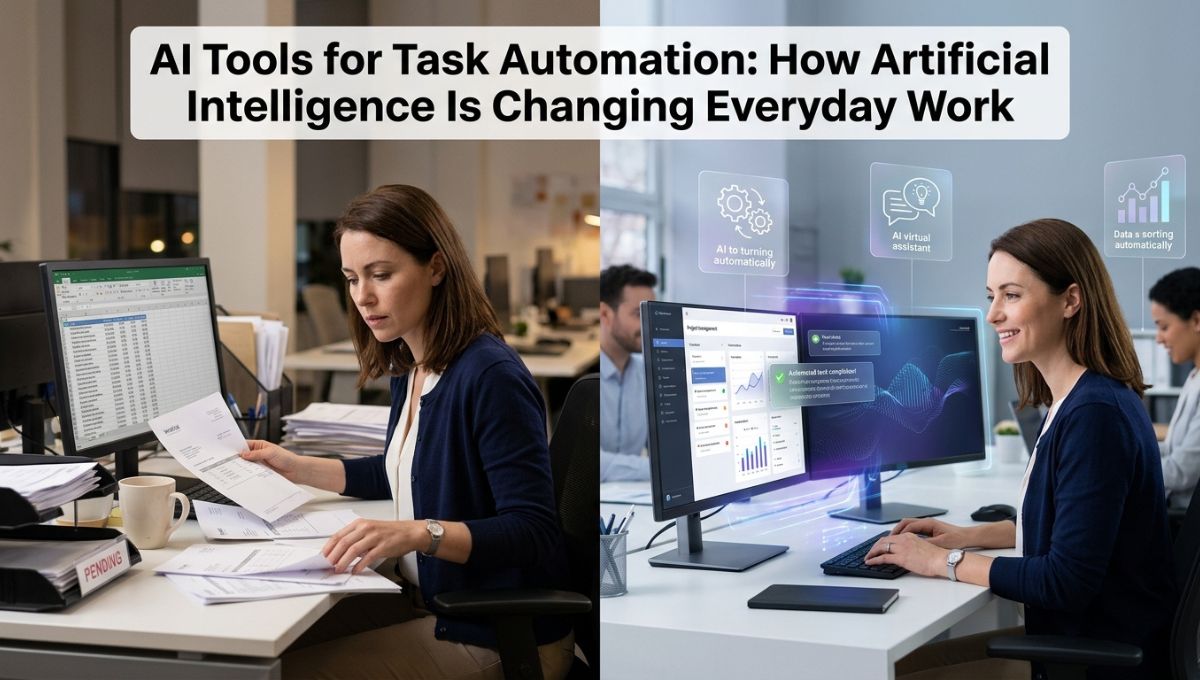
Artificial intelligence has become an important part of modern workplaces. From small businesses to large companies, organizations are using AI to reduce repetitive work, improve accuracy, and save valuable time. One of the biggest reasons behind the growing popularity of artificial intelligence is its ability to automate routine tasks that previously required manual effort. This allows employees to focus on creative thinking, decision-making, and customer service instead of spending hours on repetitive activities.

Today, AI Tools are being used across many industries, including education, healthcare, banking, retail, marketing, manufacturing, and customer support. Whether it is responding to emails, organizing documents, managing schedules, or analyzing business data, AI-powered automation is making work faster and more efficient. As technology continues to improve, task automation is becoming a key part of digital transformation for businesses of all sizes.
Understanding AI Tools for Task Automation
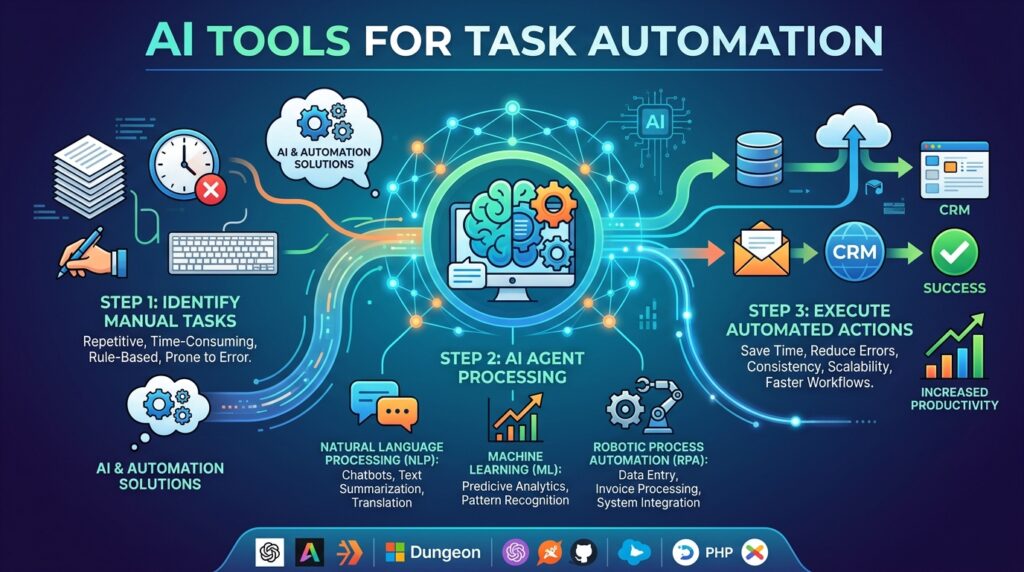
AI Tools for task automation are software applications that use artificial intelligence technologies such as machine learning, natural language processing, and predictive analytics to perform repetitive or time-consuming tasks with minimal human involvement. These tools can understand instructions, process information, recognize patterns, and complete various activities automatically.
Unlike traditional automation software that follows fixed rules, AI-powered tools can adapt to changing situations and improve their performance over time by learning from data. This makes them suitable for handling more complex tasks that involve decision-making and language understanding.
Task automation is not limited to one department. It supports finance teams, human resources, sales, customer service, marketing, operations, and administration. As businesses continue to generate more digital information, AI automation helps manage workloads efficiently while reducing errors.
Why Businesses Are Adopting Task Automation
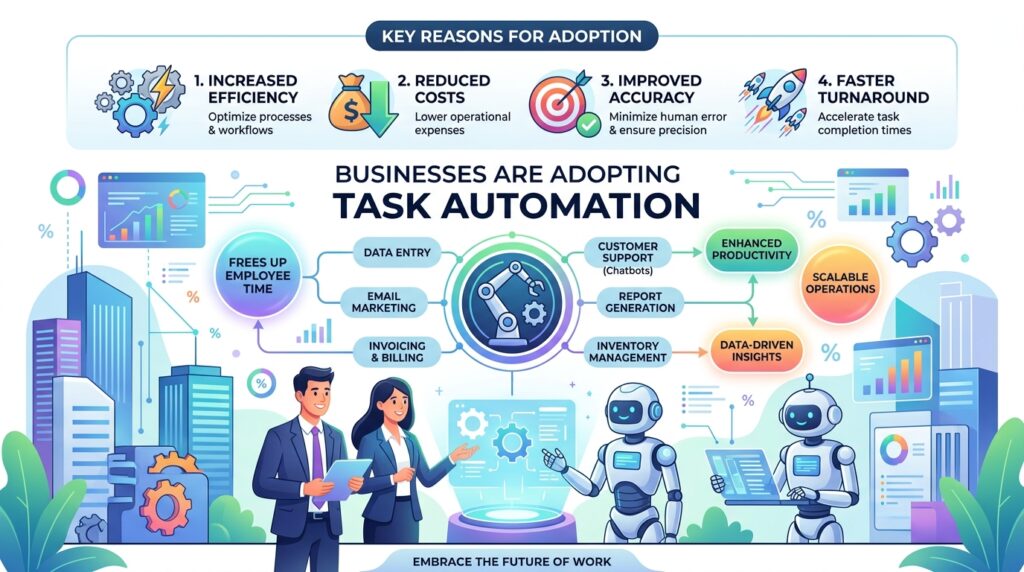
Companies are constantly looking for ways to improve productivity while reducing operational costs. Manual processes often consume significant time and increase the chances of mistakes. Task Automation powered by AI helps businesses streamline operations by handling repetitive activities consistently and accurately.
Automation also allows organizations to respond more quickly to customer requests, process information faster, and improve overall efficiency. Employees benefit because they spend less time on routine work and more time solving problems, collaborating with teams, and developing new ideas.
Small businesses, startups, and freelancers also benefit from AI automation because many modern tools are affordable, cloud-based, and easy to use without advanced technical knowledge.
Common Tasks That AI Can Automate
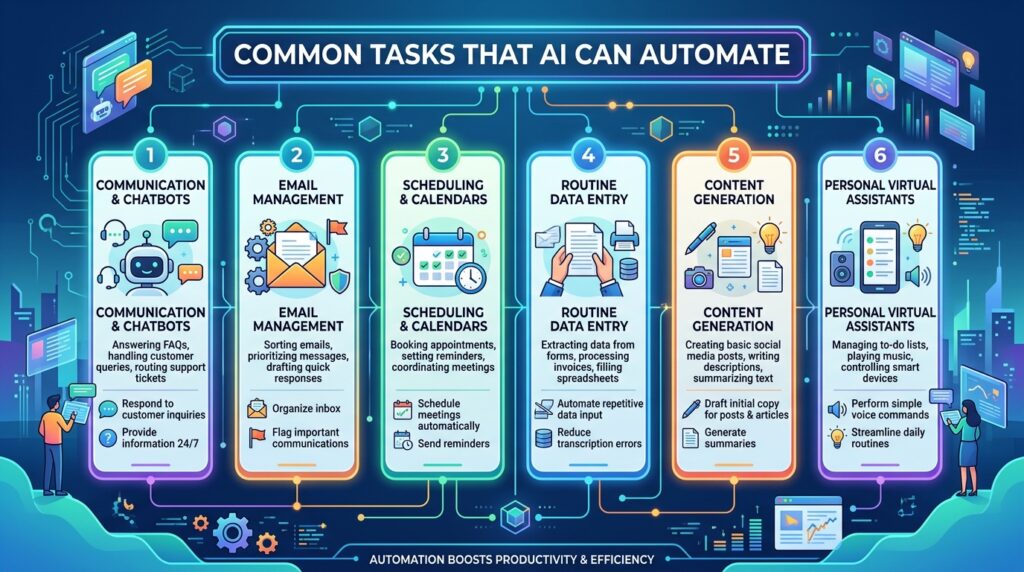
Artificial intelligence supports automation across a wide range of everyday business activities. Some of the most common tasks include:
- Managing emails and sorting messages
- Scheduling meetings and calendar management
- Data entry and database updates
- Document organization
- Invoice processing
- Customer support through chatbots
- Social media scheduling
- Content creation assistance
- Report generation
- Translation of documents
- Workflow approvals
- File management
- Meeting transcription
- Reminder notifications
- Basic accounting tasks
These automated processes reduce workload while improving consistency across business operations.
Major Benefits of Task Automation
Organizations adopt AI automation because it delivers measurable improvements in productivity and operational efficiency. The technology helps businesses complete tasks more quickly while maintaining high levels of accuracy.
Some of the key benefits include:
| Benefit | Description |
|---|---|
| Time Savings | Automates repetitive work and speeds up daily operations. |
| Higher Productivity | Employees focus on strategic and creative tasks. |
| Improved Accuracy | Reduces human errors in routine processes. |
| Cost Reduction | Lowers operational expenses by minimizing manual work. |
| Faster Decision-Making | Provides quick access to organized information and reports. |
| Better Customer Service | Enables faster responses through automated support systems. |
| Consistent Workflows | Ensures tasks follow standardized procedures every time. |
| Scalability | Handles increasing workloads without significantly increasing staff requirements. |
These advantages help businesses remain competitive while improving service quality and employee satisfaction.
Popular Uses of AI Automation Across Industries
Different industries use AI automation in unique ways depending on their operational needs. While the technology varies, the overall objective remains the same—improving efficiency and reducing repetitive manual work.
Healthcare organizations use AI to organize patient records, schedule appointments, and assist with medical documentation. Banks automate fraud detection, customer verification, and transaction monitoring. Educational institutions use AI to manage student records, grading support, and administrative communication.
Retail businesses automate inventory tracking, order management, customer recommendations, and online support. Marketing teams use AI to schedule campaigns, generate content ideas, analyze audience behavior, and prepare performance reports.
Manufacturing companies rely on AI for production monitoring, equipment maintenance scheduling, quality inspections, and supply chain optimization. Human resource departments automate resume screening, interview scheduling, employee onboarding, and attendance management.
AI in Office Productivity
Modern workplaces increasingly depend on digital collaboration, making office productivity one of the largest areas for AI adoption. Employees often spend considerable time handling emails, preparing reports, organizing documents, and attending meetings. AI simplifies these responsibilities through intelligent automation.
Many AI assistants can summarize meeting notes, convert speech into text, organize project files, generate presentations, and even draft business communications. These features reduce administrative workload while improving collaboration among team members.
Office automation also improves document search, file categorization, and workflow approvals, allowing employees to locate important information much faster than traditional manual systems.
Customer Support Through AI Automation
Customer service has experienced significant improvements with the introduction of AI-powered automation. Businesses now use virtual assistants and chatbots to answer common customer questions, provide order updates, guide users through services, and resolve basic issues around the clock.
Automated customer support systems can respond instantly, reducing waiting times and improving customer satisfaction. Human representatives can then focus on more complex cases that require personal attention.
This combination of automation and human expertise creates a more efficient support system while maintaining service quality.
AI Automation in Marketing
Marketing professionals use AI tools to simplify campaign management and content planning. Automation allows teams to schedule social media posts, analyze audience engagement, generate marketing reports, and organize customer information.
AI also helps businesses personalize communication by understanding customer preferences and delivering relevant recommendations. Email marketing campaigns, audience segmentation, and performance tracking become easier with automated systems.
These improvements help marketing teams make better use of their time while maintaining consistent communication with customers.
Challenges of AI-Based Automation
Although AI automation offers many benefits, organizations must also address several challenges during implementation. Businesses need reliable data, proper employee training, and strong cybersecurity measures to ensure successful adoption.
Some automated systems may require regular updates, monitoring, and human supervision to maintain accuracy. Organizations should also establish clear policies for data privacy and responsible AI usage.
Another important consideration is workforce adaptation. Employees may need training to work effectively alongside AI systems and understand how automation supports rather than replaces many job responsibilities.
Best Practices for Implementing Task Automation
Businesses planning to adopt AI automation should begin by identifying repetitive processes that consume significant employee time. Starting with smaller workflows allows organizations to evaluate results before expanding automation across departments.
Successful implementation often includes employee training, regular performance monitoring, secure data management, and continuous process improvement. Organizations should also choose AI solutions that integrate well with their existing software and business operations.
Regular evaluation helps businesses measure productivity gains, identify new automation opportunities, and ensure that AI continues delivering value over time.
The Future of AI Task Automation
The future of AI task automation is expected to bring even more advanced capabilities. AI systems are becoming better at understanding natural language, recognizing patterns, and assisting with increasingly complex workflows.
As technology continues to evolve, businesses may see greater collaboration between humans and intelligent software. Rather than replacing employees, AI is expected to become a supportive partner that handles routine work while allowing people to concentrate on innovation, creativity, and strategic planning.
Cloud computing, machine learning, and improved AI models are likely to make automation more accessible to businesses of every size, encouraging wider adoption across industries worldwide.
Conclusion
Artificial intelligence is changing the way organizations manage everyday work by making repetitive tasks faster, more accurate, and easier to complete. AI Tools are helping businesses automate activities such as document management, customer support, scheduling, reporting, and data processing, while Task Automation enables employees to focus on higher-value responsibilities.
As AI technology continues to develop, organizations are expected to integrate automation into more areas of their operations. Successful adoption depends on careful planning, employee training, responsible data management, and continuous monitoring. By combining human expertise with intelligent automation, businesses can improve efficiency, reduce operational workloads, and better prepare for the future of digital work.