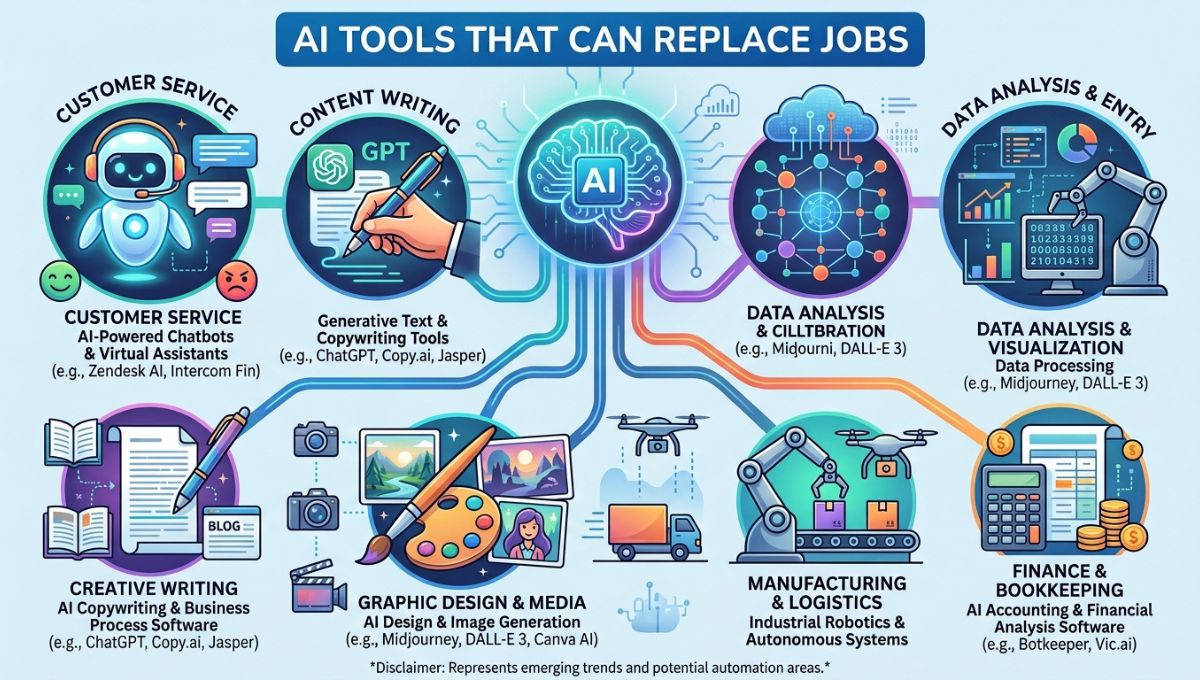
Artificial intelligence is transforming the workplace faster than ever before. Tasks that once required hours of manual effort can now be completed in minutes with the help of AI-powered tools. From writing articles and designing graphics to coding software and analyzing data, artificial intelligence has become an essential part of modern businesses. As AI technology continues to improve, many professionals are asking an important question: Can AI replace jobs?
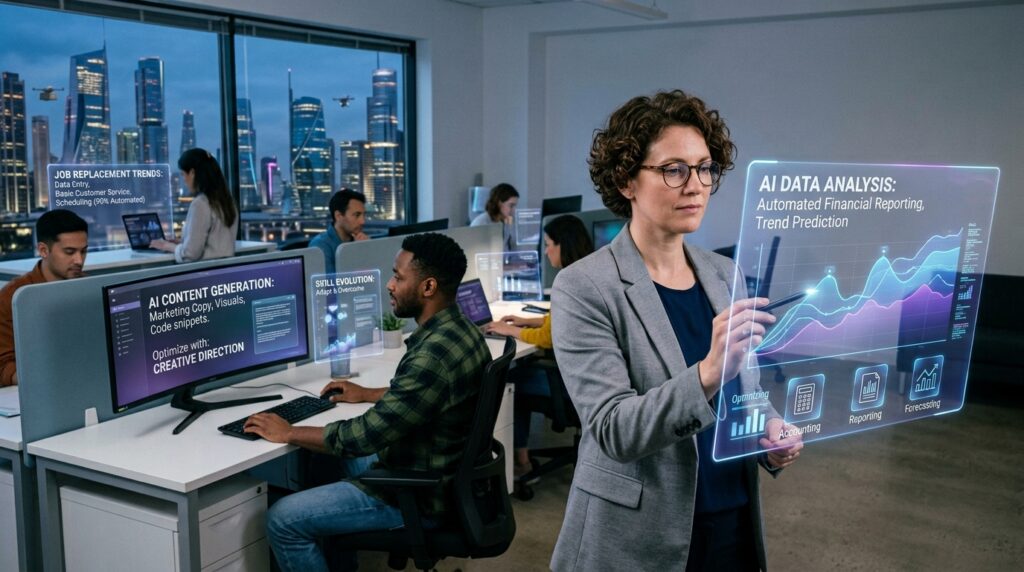
The answer is both yes and no. AI is capable of automating many repetitive, rule-based, and time-consuming tasks, which means certain job responsibilities are changing rapidly. However, instead of completely replacing human workers, AI is often reshaping roles by allowing people to focus on creativity, strategy, communication, and decision-making while machines handle routine work.
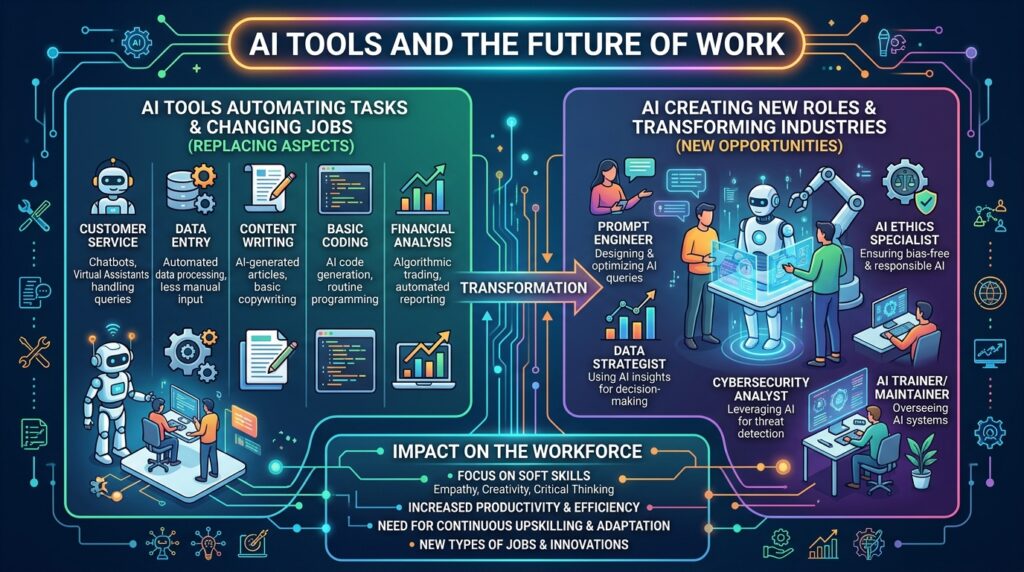
Today, businesses across industries are adopting AI tools to improve efficiency, reduce costs, and increase productivity. Companies that once required large teams for content writing, customer support, data entry, or graphic design can now complete many of these tasks using advanced AI platforms. While this shift creates concerns about job displacement, it also opens new career opportunities for professionals who learn to work alongside artificial intelligence.
If you’re wondering which AI tools are having the biggest impact on today’s workforce, this guide explores the most powerful AI platforms that are automating tasks traditionally performed by humans and changing the future of work.
ChatGPT
ChatGPT has become one of the most influential AI assistants in the world. It helps users generate articles, emails, reports, marketing copy, business proposals, product descriptions, and social media content within seconds.
Content writers, customer support representatives, virtual assistants, researchers, educators, and marketers increasingly use ChatGPT to complete tasks that previously required hours of manual work. Businesses also integrate ChatGPT into customer service systems to answer frequently asked questions and provide instant support around the clock.
Rather than replacing every writer or support agent, ChatGPT automates repetitive writing tasks, allowing professionals to focus on strategy, creativity, and complex communication.
GitHub Copilot
Software development has experienced significant transformation with the introduction of GitHub Copilot. This AI coding assistant generates code, explains programming concepts, identifies bugs, suggests improvements, and automates repetitive development tasks.
Developers use GitHub Copilot to increase productivity while reducing the time spent writing standard code structures. Junior programmers also benefit from real-time coding assistance and learning opportunities.
Although AI can generate functional code, experienced software engineers remain essential for system architecture, security, testing, debugging, and solving complex technical challenges.
Cursor AI
Cursor AI is another advanced coding assistant that understands entire software projects rather than individual code snippets. Developers can ask questions, request new features, refactor applications, and debug programs directly within the editor.
This significantly reduces development time for routine programming tasks and allows software teams to deliver projects faster. Companies adopting AI-powered development tools often improve productivity without increasing team size.
However, human expertise remains critical for understanding business requirements, software design, and long-term maintenance.
Midjourney
Graphic design has changed dramatically with AI image generation platforms such as Midjourney. Designers can create professional illustrations, advertising graphics, concept art, social media visuals, product mockups, and branding materials using simple text prompts.
Marketing agencies and businesses use Midjourney to generate creative concepts quickly, reducing the time spent on early-stage design work.
While AI accelerates image creation, experienced designers continue to provide artistic direction, branding strategy, user experience knowledge, and creative storytelling that AI cannot fully replicate.
Canva AI
Canva AI simplifies graphic design by automatically generating presentations, advertisements, posters, resumes, brochures, and social media graphics.
Small businesses, entrepreneurs, educators, and marketers use Canva AI to create professional-quality visuals without advanced design skills. Features such as Magic Design, AI writing assistance, background removal, and automatic layout generation reduce the need for manual editing.
This automation affects routine design work while allowing professional designers to concentrate on advanced branding, creative campaigns, and custom visual experiences.
Runway
Video production has become significantly more accessible through Runway’s AI-powered editing tools. Users can generate videos from text prompts, remove objects, replace backgrounds, create subtitles, and enhance footage automatically.
Marketing teams, YouTubers, educators, and social media creators use Runway to produce engaging content much faster than traditional editing methods.
Although AI handles repetitive editing tasks, filmmakers, directors, and creative professionals remain essential for storytelling, cinematography, and artistic vision.
ElevenLabs
ElevenLabs has transformed voice production through highly realistic AI-generated speech. Businesses use it to create podcasts, audiobooks, online courses, customer support systems, YouTube narration, and multilingual communication.
The platform reduces production costs by eliminating the need for repeated voice recording sessions for routine projects.
Professional voice actors continue to play an important role in entertainment, emotional storytelling, advertising, and high-end media production where unique human expression remains valuable.
Perplexity AI
Research and information gathering have become more efficient with Perplexity AI. Instead of manually searching dozens of websites, users receive summarized answers supported by reliable sources.
Researchers, consultants, journalists, students, and analysts use Perplexity AI to conduct market research, verify facts, compare products, and explore complex topics.
While AI speeds up research, human professionals remain responsible for evaluating information quality, making judgments, and applying critical thinking.
NotebookLM
NotebookLM helps users organize, analyze, and understand large collections of documents. Businesses use it to summarize reports, extract insights, review policies, and answer questions based on uploaded materials.
Students, educators, consultants, and legal professionals benefit from faster document analysis and improved knowledge management.
Instead of replacing researchers, NotebookLM serves as an intelligent assistant that reduces time spent searching through lengthy documents.
Synthesia
Synthesia enables organizations to produce professional AI presenter videos without cameras or recording studios. Training videos, onboarding materials, educational content, and multilingual business presentations can be created using AI avatars.
Corporate training departments, educational institutions, and marketing teams save significant production costs while maintaining consistent communication.
Creative directors and video producers still contribute strategic planning, storytelling, branding, and audience engagement that AI-generated videos alone cannot fully achieve.
Fireflies AI
Administrative work has become easier with Fireflies AI, an intelligent meeting assistant that records conversations, generates transcripts, identifies action items, and summarizes discussions automatically.
Businesses use Fireflies AI to improve collaboration, reduce manual note-taking, and ensure important decisions are documented accurately.
Administrative professionals benefit from automation while focusing on scheduling, coordination, communication, and organizational planning.
Which Jobs Are Most Affected by AI?
Artificial intelligence is having the greatest impact on jobs involving repetitive, predictable, and data-driven tasks. Some roles experiencing significant automation include:
- Data entry specialists
- Customer support agents handling routine inquiries
- Basic content writers
- Transcription professionals
- Graphic designers performing repetitive tasks
- Video editors handling standard editing
- Administrative assistants managing documentation
- Market researchers collecting basic information
- Social media content creators producing routine posts
- Junior programmers writing repetitive code
These positions are evolving as AI assumes routine responsibilities, allowing professionals to concentrate on higher-value work.
Jobs That AI Cannot Fully Replace
Despite rapid advancements, artificial intelligence still struggles with tasks requiring emotional intelligence, ethical judgment, creativity, leadership, and complex interpersonal communication.
Professions that continue relying heavily on human expertise include:
- Doctors and surgeons
- Psychologists and therapists
- Teachers and educators
- Business leaders
- Lawyers
- Scientists
- Architects
- Creative directors
- Skilled trades
- Entrepreneurs
These careers require empathy, innovation, strategic thinking, and real-world experience that AI cannot fully replicate.
How Professionals Can Stay Relevant
The future of work belongs to individuals who learn how to collaborate with artificial intelligence rather than compete against it. Professionals should focus on developing skills that complement AI instead of relying solely on routine tasks.
Learning prompt engineering, AI-assisted productivity, critical thinking, communication, leadership, creativity, project management, and industry-specific expertise will become increasingly valuable.
Businesses are not simply hiring people who know how to use AI—they are hiring professionals who know how to combine AI with human judgment to deliver better outcomes.
Continuous learning, adaptability, and digital literacy will become essential career advantages in an AI-driven economy.
Conclusion
Artificial intelligence is reshaping the global workforce by automating repetitive tasks, increasing productivity, and transforming how businesses operate. Tools such as ChatGPT, GitHub Copilot, Cursor AI, Midjourney, Canva AI, Runway, ElevenLabs, Perplexity AI, NotebookLM, Synthesia, and Fireflies AI demonstrate how rapidly technology is changing traditional job responsibilities.
While these AI tools can automate many routine activities, they are generally replacing tasks rather than entire professions. Human creativity, emotional intelligence, leadership, ethical decision-making, and strategic thinking remain essential across nearly every industry.
Instead of viewing AI as a threat, professionals should see it as a powerful partner that can eliminate repetitive work and create opportunities for higher-value contributions. Those who embrace artificial intelligence, continuously upgrade their skills, and learn to work alongside AI will be best positioned to succeed in the future workplace as technology continues evolving throughout 2026 and beyond.