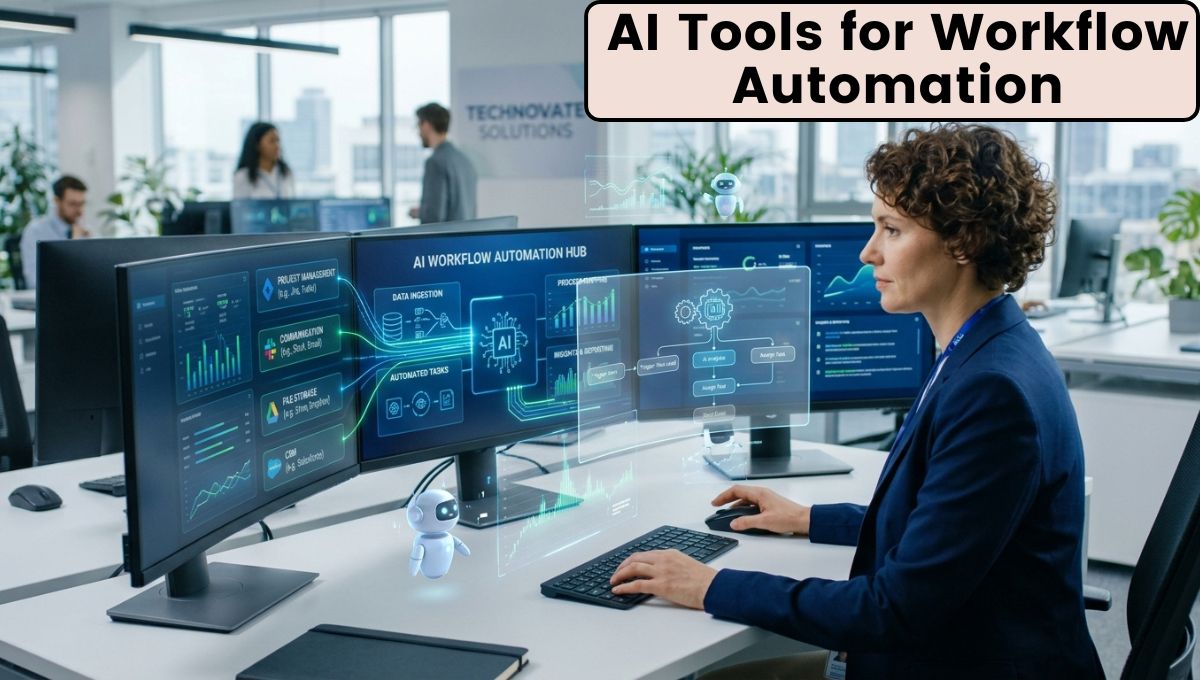
Artificial Intelligence (AI) is changing how businesses operate by making everyday workflows faster, smarter, and more efficient. Organizations no longer need employees to spend hours performing repetitive tasks such as entering data, sending emails, creating reports, processing invoices, scheduling meetings, updating customer records, or managing approvals. Instead, AI-powered workflow automation tools can complete these activities automatically, allowing employees to focus on strategic work that adds greater value to the business.
Today, AI Tools for Workflow Automation are used by startups, small businesses, large enterprises, government organizations, educational institutions, healthcare providers, financial companies, marketing agencies, and freelancers. These intelligent platforms help automate workflows across sales, customer support, finance, human resources, marketing, operations, project management, software development, and many other business functions.
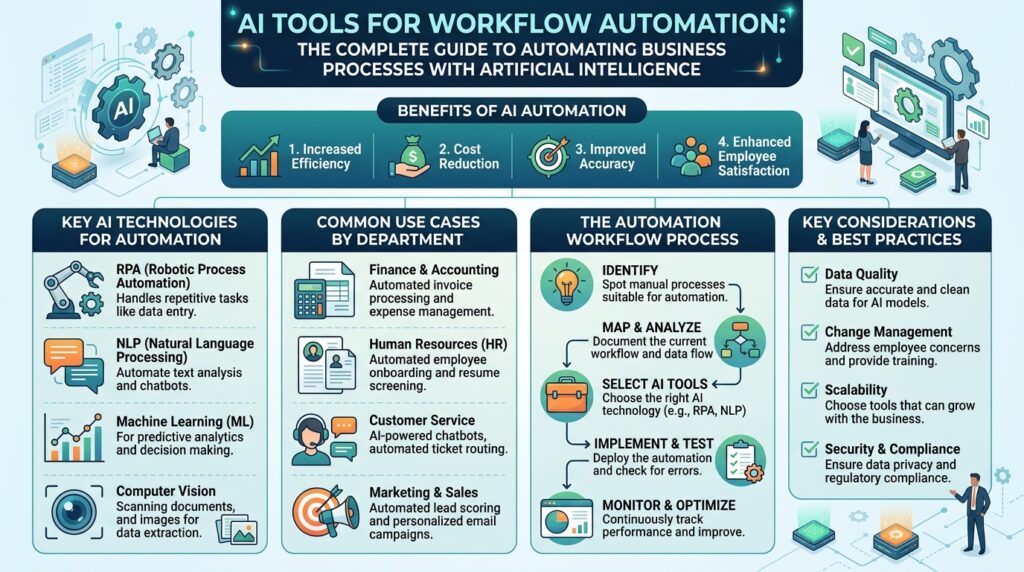
Unlike traditional automation software that simply follows predefined rules, AI-powered workflow automation tools can understand natural language, analyze data, recognize patterns, classify documents, make intelligent recommendations, and continuously improve through machine learning. These advanced capabilities enable businesses to automate more complex processes while improving productivity, reducing operational costs, and delivering better customer experiences.
This comprehensive guide explains what AI workflow automation tools are, how they work, their key features, the best tools available, practical business use cases, implementation strategies, benefits, challenges, and future trends.
What Are AI Tools for Workflow Automation?
AI Tools for Workflow Automation are software platforms that combine artificial intelligence with workflow automation technologies to automate business processes from beginning to end. These platforms use machine learning, natural language processing (NLP), robotic process automation (RPA), optical character recognition (OCR), predictive analytics, and intelligent decision-making to streamline operations.
Traditional workflow automation relies on fixed rules and predefined conditions. AI-powered workflow automation goes beyond simple rule-based systems by understanding context, interpreting unstructured information, learning from historical data, and making recommendations during workflow execution.
For example, when a customer submits a support request, an AI workflow can automatically analyze the message, determine its urgency, identify the appropriate department, create a support ticket, send an acknowledgment email, update the CRM system, and notify the assigned support representative—all without requiring manual intervention.
These intelligent workflows improve speed, consistency, and operational efficiency across organizations of every size.
Why Businesses Are Adopting AI Workflow Automation

Businesses face increasing pressure to deliver faster services while controlling operational costs. Employees often spend a significant portion of their workday completing repetitive administrative tasks instead of focusing on innovation, customer relationships, and business growth.
AI workflow automation addresses this challenge by reducing manual effort and improving process efficiency. Organizations can automate repetitive activities such as data entry, invoice approvals, document processing, employee onboarding, marketing campaigns, lead management, customer support, financial reporting, and compliance monitoring.
As businesses grow, automation also improves scalability by enabling organizations to manage increasing workloads without proportionally increasing staffing requirements.
The combination of AI and workflow automation enables companies to respond faster to customers, reduce human errors, improve compliance, and increase overall productivity.
How AI Workflow Automation Works

AI workflow automation follows a structured process that combines intelligent analysis with automated actions.
A workflow begins when a trigger occurs, such as receiving an email, submitting an online form, uploading a document, completing a purchase, or updating customer information. AI analyzes the incoming data using natural language processing, machine learning, or computer vision depending on the type of information received.
Based on its analysis, AI determines the appropriate action. It may classify the request, extract important information, update databases, notify employees, generate documents, schedule meetings, or initiate additional workflows automatically.
Unlike traditional automation, AI systems continue learning from previous interactions, improving accuracy and decision-making over time.
Core Technologies Behind AI Workflow Automation
Several technologies work together to create intelligent workflow automation systems.
| Technology | Purpose |
|---|---|
| Artificial Intelligence | Intelligent decision-making |
| Machine Learning | Learns from historical data |
| Natural Language Processing (NLP) | Understands written and spoken language |
| Robotic Process Automation (RPA) | Automates repetitive software tasks |
| Optical Character Recognition (OCR) | Reads printed and scanned documents |
| Computer Vision | Recognizes images and visual information |
| Predictive Analytics | Forecasts future outcomes |
| Workflow Engines | Coordinate business processes |
Each technology contributes to automating different stages of complex business operations.
Essential Features of AI Workflow Automation Tools
Modern AI workflow automation platforms include numerous features that simplify business operations.
| Feature | Business Benefit |
|---|---|
| Drag-and-Drop Workflow Builder | Simplifies automation design |
| AI Decision Making | Intelligent workflow routing |
| Document Processing | Automated data extraction |
| Email Automation | Faster communication |
| CRM Integration | Centralized customer management |
| Approval Automation | Faster business decisions |
| Reporting Dashboards | Real-time performance monitoring |
| API Integrations | Connect multiple software systems |
| Security Controls | Protect sensitive business data |
| Collaboration Features | Improve team coordination |
These features help organizations automate routine operations while maintaining flexibility and control.
Best AI Tools for Workflow Automation
Numerous AI platforms provide workflow automation capabilities for businesses of different sizes.
| AI Tool | Best For | Key Features |
|---|---|---|
| Zapier AI | Small businesses | Workflow automation, AI actions, app integrations |
| Make | Advanced automation | Visual workflow builder, integrations |
| Microsoft Power Automate | Enterprise automation | Microsoft ecosystem integration |
| UiPath | Robotic Process Automation | Enterprise workflow automation |
| Automation Anywhere | Large organizations | Intelligent automation platform |
| Workato | Business integration | Enterprise workflow orchestration |
| ClickUp AI | Project management | Task automation and documentation |
| Notion AI | Knowledge management | AI writing and workflow organization |
| Monday AI | Team collaboration | Automated project workflows |
| Airtable AI | Database workflows | AI-enhanced data management |
| HubSpot AI | Sales and marketing | CRM automation |
| Salesforce Einstein | Customer relationship management | AI-powered CRM workflows |
| Fireflies.ai | Meeting automation | Recording, transcription, summaries |
| Otter.ai | Meeting intelligence | Automated meeting notes |
| ChatGPT | Content generation | Writing and AI assistance |
| Claude | Long-form document analysis | Summaries and drafting |
| Google Gemini | Productivity | AI research and document support |
Choosing the right platform depends on workflow complexity, integration requirements, business size, security needs, and budget.
AI Workflow Automation for Customer Support
Customer support teams use AI workflow automation to provide faster and more consistent service.
When a customer submits a support request, AI automatically analyzes the inquiry, determines its category, assigns priority, creates a ticket, updates the CRM system, sends confirmation emails, and routes the request to the appropriate support representative.
Simple inquiries can be resolved by AI chatbots, while more complex cases are escalated to human agents with complete conversation history already attached.
This workflow reduces response times while improving customer satisfaction.
AI Workflow Automation for Sales
Sales teams automate lead capture, customer follow-ups, CRM updates, appointment scheduling, proposal generation, and sales reporting.
For example, when a visitor downloads a product brochure, AI automatically creates a CRM record, scores the lead, schedules follow-up emails, assigns the lead to a sales representative, and tracks future customer engagement.
Automation ensures every potential customer receives timely attention.
AI Workflow Automation for Marketing
Marketing teams use AI to automate email campaigns, audience segmentation, social media scheduling, lead nurturing, advertising optimization, and campaign reporting.
AI also analyzes customer behavior to personalize marketing content and recommend the most effective communication strategies.
These workflows improve marketing performance while reducing manual campaign management.
AI Workflow Automation for Human Resources
Human resource departments automate resume screening, interview scheduling, onboarding, payroll processing, attendance management, employee surveys, and performance reviews.
AI significantly reduces administrative workloads while improving employee experiences throughout the hiring and employment lifecycle.
AI Workflow Automation for Finance
Finance teams automate invoice processing, expense approvals, payment reminders, budgeting, financial reporting, reconciliation, and fraud detection.
Document automation combined with OCR enables AI to extract information from invoices, validate purchase orders, identify discrepancies, and initiate approval workflows automatically.
This improves financial accuracy while accelerating business operations.
AI Workflow Automation for Healthcare
Healthcare organizations automate patient appointments, medical records, insurance verification, billing, prescription management, and appointment reminders.
Medical staff spend less time on administrative tasks and more time providing patient care.
AI Workflow Automation for Education
Educational institutions automate student admissions, attendance tracking, assignment reminders, course recommendations, fee management, and student communication.
AI also helps personalize learning experiences while simplifying administrative operations.
AI Workflow Automation for Manufacturing
Manufacturing companies automate inventory management, production scheduling, predictive maintenance, quality inspections, equipment monitoring, and supply chain coordination.
AI analyzes operational data to identify potential issues before they cause production delays.
Benefits of AI Workflow Automation Tools
Organizations implementing AI workflow automation experience numerous advantages.
- Faster business operations
- Increased employee productivity
- Reduced manual work
- Lower operational costs
- Improved workflow consistency
- Better customer experiences
- Fewer human errors
- Faster decision-making
- Enhanced compliance
- Better collaboration
- Improved scalability
- Real-time business insights
These benefits help organizations improve operational efficiency while supporting long-term business growth.
Challenges and Limitations
Despite its advantages, AI workflow automation requires careful planning.
Organizations should consider implementation costs, employee training, software integration, cybersecurity, data privacy, regulatory compliance, and workflow optimization before deploying automation solutions.
Human oversight remains essential for critical business decisions that require ethical judgment, strategic thinking, or specialized expertise.
Best Practices for Implementing AI Workflow Automation
Businesses can maximize automation success by following these best practices.
- Identify repetitive processes suitable for automation.
- Map existing workflows before automating them.
- Choose platforms that integrate with current software.
- Start with small pilot projects.
- Train employees on AI-assisted workflows.
- Monitor automation performance regularly.
- Protect confidential business information.
- Continuously improve workflows based on analytics.
Following these practices helps organizations achieve successful long-term automation.
Future of AI Workflow Automation
AI workflow automation will continue evolving through autonomous AI agents, multimodal AI systems, predictive business intelligence, conversational workflow management, and deeper integration across enterprise software ecosystems.
Future AI platforms will require less manual configuration while becoming increasingly capable of managing complex business operations independently.
Organizations investing in AI workflow automation today will be better prepared for future digital transformation and sustained competitive advantage.
Conclusion
Artificial intelligence is transforming how organizations manage daily operations by automating repetitive tasks, improving efficiency, and enabling smarter decision-making. AI Tools for Workflow Automation help businesses streamline customer support, sales, finance, human resources, marketing, project management, and many other operational processes while reducing costs and improving productivity.
The increasing adoption of Workflow Automation Software demonstrates that intelligent automation is becoming a core component of modern business operations. By selecting the right AI tools, implementing automation strategically, and maintaining appropriate human oversight, organizations can build faster, more efficient, and future-ready workflows that support sustainable growth.