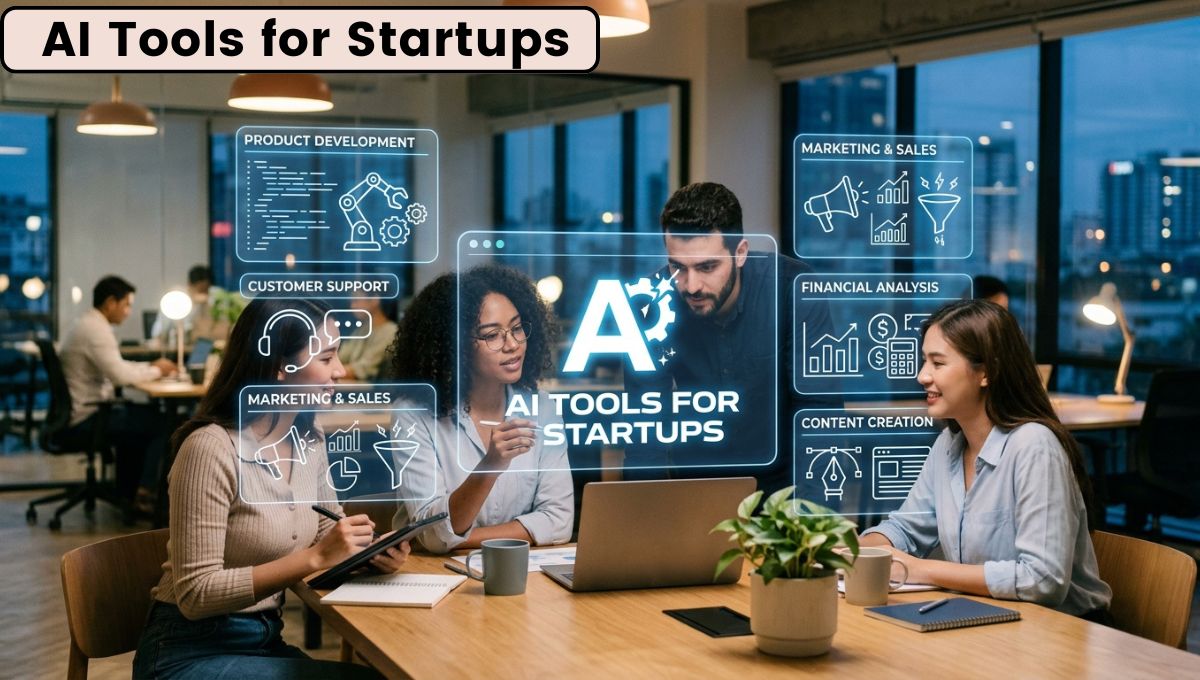
Startups operate in fast-moving and highly competitive environments where efficiency, innovation, and smart decision-making are essential for success. Unlike established companies, startups often work with limited budgets, small teams, and tight timelines. To overcome these challenges, many entrepreneurs are turning to AI Tools for Startups to automate tasks, improve productivity, reduce costs, and accelerate growth.
Artificial intelligence is no longer reserved for large corporations with extensive resources. Today, startups across industries such as technology, e-commerce, marketing, education, healthcare, finance, and software development are using AI-powered platforms to streamline operations and gain a competitive advantage. From content creation and customer support to market research and product development, AI is helping startups achieve more with fewer resources.

The rapid advancement of AI technology has made powerful tools accessible to businesses of all sizes. As a result, startups can now leverage automation and data-driven insights to make smarter decisions, improve customer experiences, and scale their operations more efficiently.
Why AI Is Important for Startups
Building a startup involves managing multiple responsibilities simultaneously. Founders and small teams often handle marketing, customer support, product development, sales, administration, and business planning at the same time.
Artificial intelligence helps reduce this workload by automating repetitive tasks and providing actionable insights. Instead of spending hours on manual processes, startup teams can focus on innovation, growth, and customer relationships.
Common startup activities supported by AI include:
- Content creation
- Customer service
- Market research
- Sales outreach
- Data analysis
- Product development
- Social media management
- Business planning
- Marketing automation
These capabilities help startups maximize efficiency while operating with limited resources.
Benefits of Using AI Tools for Startups
The growing popularity of AI among startups is driven by several practical advantages.
Some major benefits include:
| Benefit | Description |
|---|---|
| Cost Reduction | Minimizes the need for additional staffing |
| Increased Productivity | Automates repetitive business tasks |
| Faster Decision-Making | Provides insights based on data analysis |
| Improved Customer Support | Delivers faster responses to customers |
| Enhanced Marketing | Supports content creation and campaign management |
| Better Scalability | Helps businesses grow efficiently |
These advantages allow startups to compete more effectively while maintaining operational flexibility.
ChatGPT
ChatGPT is one of the most versatile AI tools available for startups. It can assist with content creation, customer communication, brainstorming, research, business planning, and marketing activities.
Startup teams commonly use ChatGPT for:
- Writing blog articles
- Creating social media content
- Drafting emails
- Generating marketing copy
- Conducting market research
- Building business plans
- Preparing investor presentations
- Creating customer support responses
Its flexibility makes it valuable across nearly every stage of startup growth.
Notion AI
Notion AI enhances productivity and knowledge management by integrating artificial intelligence into the popular workspace platform.
Startups use Notion AI to:
- Summarize meeting notes
- Organize documentation
- Generate content drafts
- Create project plans
- Manage team collaboration
By centralizing information and automating documentation tasks, Notion AI helps teams remain organized and efficient.
Jasper
Jasper AI is a content creation platform designed to support marketing teams and businesses. Startups frequently use Jasper to generate website copy, blog content, social media posts, advertisements, and email campaigns.
The platform helps reduce content production time while maintaining consistency in messaging. For startups focused on building brand awareness, Jasper can be a valuable marketing resource.
Its templates and automation features support a wide range of content needs.
Canva Magic Studio
Canva offers AI-powered design capabilities that make professional visual content accessible to startups without dedicated design teams.
Users can create:
- Social media graphics
- Marketing materials
- Business presentations
- Product visuals
- Brand assets
Features such as AI image generation, background removal, and automated design suggestions help startups create high-quality visuals quickly.
HubSpot AI
HubSpot combines customer relationship management with AI-powered marketing, sales, and customer support features.
Startups use HubSpot to:
- Manage leads
- Automate email campaigns
- Track customer interactions
- Analyze sales performance
- Generate content
Its integrated approach allows businesses to manage customer relationships and marketing activities from a single platform.
Grammarly
Grammarly helps startups improve communication quality by providing AI-powered writing assistance.
The platform supports:
- Grammar correction
- Tone analysis
- Clarity improvements
- Content editing
- Professional communication
Startups use Grammarly to enhance emails, proposals, presentations, website content, and marketing materials.
Zapier AI
Zapier enables businesses to automate workflows by connecting different applications and services.
AI-powered automation can help startups:
- Transfer data between platforms
- Automate lead management
- Schedule tasks
- Manage notifications
- Streamline administrative processes
This reduces manual work and allows teams to focus on strategic activities.
Copy.ai
Copy.ai assists startups with marketing and sales content generation. The platform helps create blog articles, advertisements, product descriptions, email campaigns, and social media posts.
Its AI-powered templates support rapid content production, making it particularly useful for startups with limited marketing resources.
The platform helps maintain consistent messaging across various communication channels.
Tidio
Tidio provides AI-powered customer support solutions through chatbots and live chat functionality.
Startups use Tidio to:
- Answer customer inquiries
- Automate support responses
- Assist website visitors
- Improve customer experiences
- Reduce support workloads
Its automation capabilities allow businesses to provide assistance even when support teams are unavailable.
Surfer SEO
Surfer SEO helps startups improve their search engine visibility through AI-assisted content optimization.
The platform provides:
- Keyword recommendations
- Content analysis
- SEO audits
- Competitor research
- Content scoring
These features help startups attract organic traffic and strengthen their online presence.
Important Features to Look for in AI Startup Tools
Selecting the right AI platform depends on a startup’s goals, industry, and growth stage.
Some important features include:
| Feature | Why It Matters |
|---|---|
| Automation Capabilities | Reduces manual workloads |
| Content Generation | Supports marketing and communication |
| Collaboration Tools | Improves team productivity |
| Analytics and Insights | Helps guide business decisions |
| Customer Support Features | Enhances customer experiences |
| Integration Options | Connects with existing software |
| Scalability | Supports future business growth |
Evaluating these features can help startups choose tools that align with their objectives.
Best Practices for Using AI in Startups
While AI can significantly improve efficiency, startups should combine automation with human expertise and oversight.
Recommended practices include:
- Review AI-generated content before publication.
- Verify important information and data.
- Maintain brand voice consistency.
- Monitor customer feedback regularly.
- Use AI insights to support decision-making.
- Continuously evaluate tool performance.
These practices help businesses maximize the benefits of AI while maintaining quality and authenticity.
Challenges of AI Adoption for Startups
Despite its advantages, AI implementation may present certain challenges for growing businesses.
Common concerns include:
- Budget limitations.
- Data privacy and security.
- Integration complexity.
- Employee training requirements.
- Dependence on technology.
- Quality control of AI-generated outputs.
Addressing these issues through careful planning can improve the effectiveness of AI adoption.
AI Tools and Their Primary Startup Applications
| AI Tool | Primary Use |
|---|---|
| ChatGPT | Content creation and business support |
| Notion AI | Productivity and knowledge management |
| Jasper | Marketing content generation |
| Canva | Graphic design and branding |
| HubSpot | CRM and marketing automation |
| Grammarly | Writing assistance and editing |
| Zapier | Workflow automation |
| Copy.ai | Marketing and sales content |
| Tidio | Customer support automation |
| Surfer SEO | Search engine optimization |
This overview demonstrates how different AI tools address specific startup needs.
How AI Helps Startups Scale Faster
One of the biggest challenges startups face is scaling operations without significantly increasing costs. AI helps solve this problem by automating tasks that would otherwise require additional employees.
Examples include:
- Automated customer support through chatbots.
- AI-generated marketing content.
- Automated lead management.
- Workflow automation between software tools.
- Data analysis and reporting.
By reducing manual workloads, startups can focus resources on innovation, product development, and customer acquisition.
The Future of AI for Startups
Artificial intelligence is expected to become even more important for startup growth in the coming years. Future developments may include advanced business planning tools, predictive analytics, automated market research, and more sophisticated customer engagement systems.
AI platforms are also likely to become more affordable and accessible, allowing startups to adopt advanced technologies earlier in their growth journeys. As competition increases across industries, businesses that effectively leverage AI may gain significant advantages in efficiency, innovation, and scalability.
The growing integration of AI into everyday business operations suggests that it will remain a key driver of startup success for years to come.
Conclusion
The adoption of AI Tools for Startups is helping entrepreneurs and growing businesses operate more efficiently, reduce costs, and scale faster. From content creation and workflow automation to customer support and marketing optimization, artificial intelligence provides practical solutions for many of the challenges startups face.
Tools such as ChatGPT, Notion AI, Jasper, Canva, HubSpot, Grammarly, Zapier, Copy.ai, Tidio, and Surfer SEO demonstrate how AI can support various aspects of startup operations. These platforms enable businesses to maximize productivity while focusing on innovation and growth.
As artificial intelligence continues to evolve, startups that integrate AI into their workflows may gain a stronger competitive position in the marketplace. By combining technology with human creativity and strategic thinking, businesses can unlock new opportunities and accelerate their path to success.