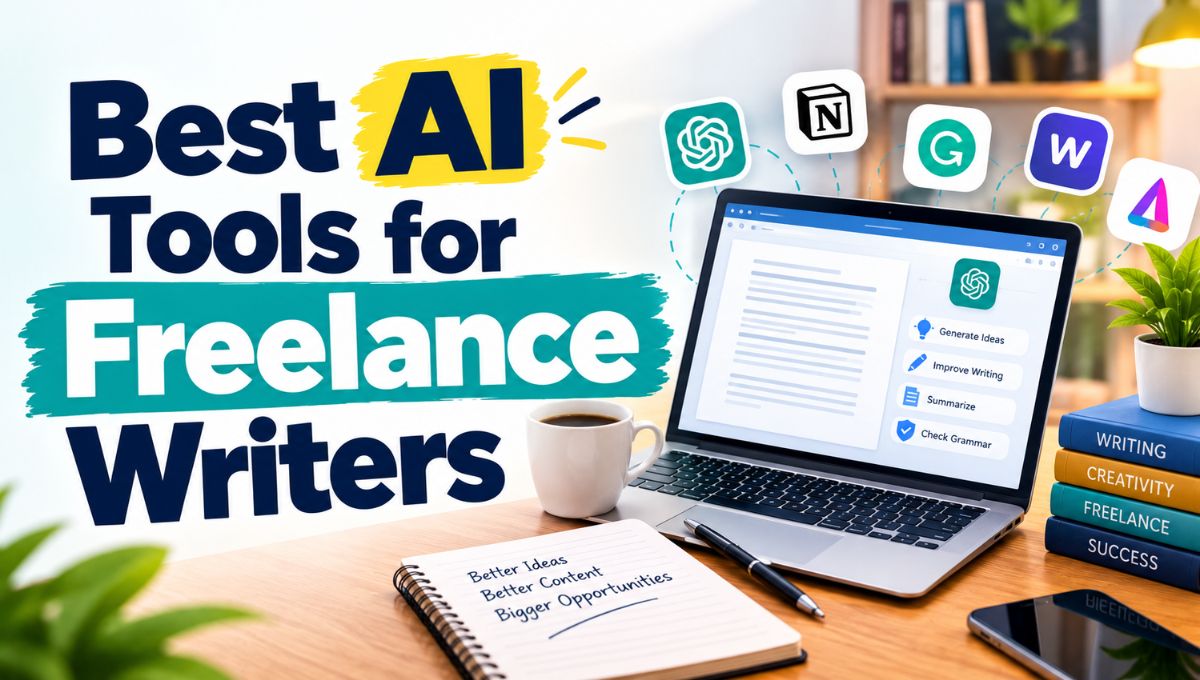
Freelance writing in 2026 is no longer just about putting words on a page. Writers are expected to research faster, understand SEO, produce different content formats, meet tight deadlines, maintain client-specific brand voices, fact-check information, and often manage their own marketing and client communication.
That is where AI tools can make a major difference. The best AI tools for freelance writers in 2026 can help with everything from brainstorming and research to drafting, editing, SEO optimization, content repurposing, proofreading, and client communication. However, the most effective freelance writers are not using AI simply to generate finished articles. They are using it as a research assistant, writing partner, editor, idea generator, and productivity tool while keeping human judgment at the center.
Tools such as ChatGPT, Claude, Grammarly, Jasper, Perplexity, QuillBot, Surfer, Writesonic, Hemingway Editor, and Canva each solve different parts of the freelance writing workflow.
For example, OpenAI’s current writing guidance recommends a workflow of Plan → Draft → Revise → Package, while emphasizing that writers should review AI output rather than treating it as a final authority.
This guide covers the best AI tools for freelance writers in 2026, what each tool does best, who should use it, and how to build an efficient AI-powered writing workflow without sacrificing originality or quality.
Best AI Tools for Freelance Writers
| AI Tool | Best For | Research | Writing | Editing | SEO | Repurposing |
|---|---|---|---|---|---|---|
| ChatGPT | All-purpose writing assistant | ✅ | ✅ | ✅ | ✅ | ✅ |
| Claude | Long-form writing and editing | ✅ | ✅ | ✅ | ⚪ | ✅ |
| Grammarly | Editing and proofreading | ⚪ | ✅ | ⭐ | ⚪ | ✅ |
| Jasper | Marketing and client content | ✅ | ⭐ | ✅ | ✅ | ⭐ |
| Perplexity | Research and source discovery | ⭐ | ⚪ | ⚪ | ⚪ | ⚪ |
| QuillBot | Paraphrasing and rewriting | ⚪ | ✅ | ⭐ | ⚪ | ✅ |
| Surfer | SEO content optimization | ⚪ | ✅ | ⭐ | ⭐ | ⚪ |
| Writesonic | SEO and marketing content | ✅ | ⭐ | ✅ | ⭐ | ✅ |
| Hemingway Editor | Readability and clarity | ⚪ | ⚪ | ⭐ | ⚪ | ⚪ |
| Canva | Visual content and presentations | ⚪ | ⚪ | ⚪ | ⚪ | ⭐ |
| Notion AI | Notes and content organization | ✅ | ✅ | ✅ | ⚪ | ✅ |
| Copy.ai | Marketing copy and workflows | ⚪ | ⭐ | ✅ | ✅ | ⭐ |
| Sudowrite | Creative writing | ⚪ | ⭐ | ⭐ | ⚪ | ⚪ |
| Otter.ai | Interviews and transcription | ⭐ | ⚪ | ⚪ | ⚪ | ⚪ |
| Google Gemini | Research and Google Workspace | ✅ | ✅ | ✅ | ⚪ | ✅ |
1. ChatGPT — Best Overall AI Tool for Freelance Writers
If a freelance writer wants one flexible AI tool that can assist with multiple parts of the writing business, ChatGPT is one of the strongest choices.
It can help with:
- Brainstorming
- Research planning
- Outlines
- Article drafts
- Rewriting
- Editing
- Headlines
- Social media content
- Email writing
- Client proposals
- Content briefs
- SEO ideas
- Interview questions
- Content repurposing
- Creative writing
- Research assistance
OpenAI’s current writing guidance specifically highlights drafting, rewriting, tightening, adapting tone, organizing ideas, and turning rough notes into polished communication.
The biggest advantage for freelancers is flexibility.
You don’t have to use ChatGPT as an “article generator.” You can use it at different stages of the writing process.
A better freelance writing workflow with ChatGPT
Instead of saying:
“Write a 2,000-word article about digital marketing.”
Give it a structured task:
Research → outline → key questions → draft → fact-check → edit → optimize → repurpose
This produces a much more controlled workflow.
Where ChatGPT is especially useful
A freelance writer can give ChatGPT rough interview notes and ask it to organize them into themes.
You can also paste an existing article and ask for:
- Weak arguments
- Repetition
- Missing context
- Awkward transitions
- Unclear sentences
- Unsupported claims
- Better headings
OpenAI also describes writers using ChatGPT as a sounding board, research assistant, editor and tool for finding better wording rather than simply handing over the entire writing process.
Best for
Freelancers who want one versatile AI assistant for their entire writing workflow.
2. Claude — Best for Long-Form Writing and Editing
Claude is another powerful option for freelance writers, particularly those who work with long documents, detailed instructions, editing and nuanced writing.
It can be useful for:
- Long-form articles
- Reports
- Essays
- White papers
- Book projects
- Content briefs
- Editing
- Summarization
- Rewriting
- Style analysis
- Research synthesis
One of its biggest advantages is working with large amounts of context.
A freelance writer can provide:
- Client guidelines
- Previous articles
- Brand documentation
- Interview transcripts
- Research notes
- Content requirements
and ask Claude to work within those constraints.
Best use case
Imagine a client gives you a 20-page brand document.
Instead of reading it only once and relying on memory, you can use AI to extract:
- Brand voice
- Target audience
- Preferred terminology
- Words to avoid
- Content objectives
- Formatting requirements
Then use those findings as a writing framework.
Best for
Long-form writers, editors, ghostwriters and freelancers handling complex client instructions.
3. Grammarly — Best AI Editor for Freelance Writers
Grammarly has evolved far beyond basic spell-checking. Its current AI features support drafting, rewriting, brainstorming, proofreading, paraphrasing, tone adjustment and other writing tasks. Grammarly also offers AI agents such as Proofreader, Paraphraser, Reader Reactions, Citation Finder and Humanizer.
For freelance writers, this makes Grammarly particularly useful after the first draft.
What Grammarly can help with
- Grammar
- Spelling
- Punctuation
- Clarity
- Conciseness
- Tone
- Sentence structure
- Repetition
- Paragraph rewrites
- Paraphrasing
Its paragraph-level rewrite feature can improve, rephrase, shorten, translate or adjust selected text.
Why freelancers should use it
Clients rarely pay only for words.
They pay for writing that is:
- Clear
- Professional
- Easy to read
- Appropriate for the audience
- Consistent
- Error-free
Grammarly can provide another editorial layer before you deliver the work.
Best for
Proofreading, polishing and improving client-ready writing.
4. Jasper — Best for Freelance Marketing Writers
Jasper is particularly useful for freelance writers who specialize in marketing content.
It is built around marketing workflows rather than functioning only as a general chatbot.
Jasper currently offers marketing-focused tools for:
- Blog content
- Website copy
- Ads
- Social media
- Product descriptions
- Campaign content
- SEO/GEO content
- Content repurposing
Jasper says its copywriting workflow includes a document editor, marketing templates, rewriting tools, collaboration and brand voice features.
Jasper Brand Voice
One of Jasper’s strongest features for freelancers is its focus on consistent brand voice.
Jasper can analyze examples of existing writing and create a Brand Voice based on characteristics such as tone and style.
This is useful when you have multiple clients.
For example:
Client A: Professional and technical
Client B: Friendly and conversational
Client C: Premium and sophisticated
Client D: Casual and humorous
Instead of manually remembering every client’s preferences, you can build structured writing contexts.
Jasper’s newer IQ system can incorporate brand voice, audiences, knowledge, style guides and product information into content generation.
Best for
Freelance copywriters, content marketers and writers managing multiple brand voices.
5. Perplexity — Best AI Research Tool for Freelance Writers
Research is one of the most time-consuming parts of freelance writing.
Perplexity is particularly useful when you need to quickly investigate a topic and identify sources.
Its Research mode can conduct multiple searches, read numerous sources and synthesize the findings into a report. Perplexity says its Research mode performs dozens of searches and can read hundreds of sources as it works through a complex research task.
Freelance writing use cases
Use Perplexity for:
- Background research
- Industry research
- Competitor research
- Statistics discovery
- Current events
- Product research
- Expert information
- Source discovery
- Research questions
Important rule
Never assume an AI research answer is automatically correct.
Open the underlying sources.
Check:
- Publication date
- Original source
- Author
- Data methodology
- Context
- Whether the claim actually appears in the cited source
Perplexity itself has recently highlighted the importance of checking claims, dates and citations when dealing with AI-generated research.
Best for
Research-heavy freelance writing and source discovery.
6. QuillBot — Best for Paraphrasing and Rewriting
QuillBot is useful when a writer needs to rewrite existing material while preserving the underlying meaning.
It can help with:
- Paraphrasing
- Sentence restructuring
- Summarization
- Grammar
- Word choice
- Tone adjustments
For freelance writers, it can be particularly helpful during editing.
For example, suppose a paragraph is technically correct but repetitive.
Instead of rewriting every sentence manually, you can use a paraphrasing tool to generate alternatives and then select the version that best fits your own voice.
Important caution
Paraphrasing is not the same as creating original reporting or original thinking.
Never use an AI paraphraser as a way to disguise copied material.
Use it to improve your own writing or transform material you have the right to use.
Best for
Rewriting, sentence variation and editing.
7. Surfer — Best for SEO-Focused Freelance Writers
If SEO articles make up a large part of your freelance writing income, an SEO-focused platform can be useful alongside your general AI writing assistant.
Surfer is designed around content optimization rather than simply generating paragraphs.
It can help writers evaluate:
- Keywords
- Search intent
- Content structure
- Topic coverage
- Competitor content
- On-page optimization
- Content opportunities
Why SEO writers need this
Writing a technically excellent article does not automatically make it competitive in search.
An SEO writer needs to understand what the searcher wants and whether the content covers the topic sufficiently.
A good workflow is:
Keyword research → search intent → outline → draft → SEO optimization → human editing
AI should support the process rather than replace SEO judgment.
Best for
Freelancers specializing in SEO blogs and organic search content.
8. Writesonic — Best for AI SEO Content
Writesonic is another option for freelance writers who produce SEO and marketing content.
It is designed around AI-assisted content creation and marketing workflows.
Potential use cases include:
- Blog articles
- Landing pages
- Product descriptions
- SEO content
- Marketing copy
- Content optimization
- Article rewriting
For freelancers managing large content workloads, a platform that combines generation and optimization can reduce the need to move constantly between separate applications.
Best for
SEO freelancers and content marketers producing content at scale.
9. Hemingway Editor — Best for Readability
Not every useful AI writing tool needs to generate text.
Hemingway Editor is valuable because it focuses on readability and clarity.
A freelance writer can use it to identify:
- Long sentences
- Difficult sentences
- Passive constructions
- Excessive adverbs
- Complicated wording
- Dense paragraphs
This is particularly useful for:
- Blog posts
- Web copy
- Newsletters
- Landing pages
- Business articles
Why readability matters
Online readers scan.
They rarely read every sentence carefully.
A strong freelance writer therefore needs to know when a sentence is technically correct but unnecessarily difficult.
AI can help produce a draft, but readability tools can help you see where the draft needs simplification.
Best for
Writers who want cleaner, simpler and more readable copy.
10. Canva — Best for Writers Who Create Visual Content
Many freelance writers now offer more than written articles.
Clients increasingly ask writers to create:
- LinkedIn posts
- Instagram carousels
- Pinterest graphics
- Newsletter graphics
- Blog images
- Presentations
- Lead magnets
- PDF guides
Canva is useful for turning written ideas into visual assets.
Example
A freelance writer creates a 2,000-word article.
That article can become:
- 1 LinkedIn post
- 5 social posts
- 1 Instagram carousel
- 10 quote graphics
- 1 newsletter
- 1 downloadable checklist
Canva can then turn some of those assets into polished visual content.
Best for
Freelance writers offering content marketing packages instead of writing-only services.
11. Notion AI — Best for Organizing Freelance Writing Projects
Freelance writing involves more than writing.
You also need to manage:
- Ideas
- Deadlines
- Clients
- Briefs
- Research
- Content calendars
- Assignments
- Revisions
- Invoices
- Editorial notes
Notion AI can help writers organize and work with this information inside a broader workspace.
Example freelance content system
Create a database with:
| Client | Article | Status | Deadline | Keyword |
| Client A | AI Marketing Guide | Drafting | Sept. 10 | AI marketing |
| Client B | SEO Trends | Research | Sept. 12 | SEO trends |
| Client C | SaaS Guide | Editing | Sept. 14 | SaaS tools |
AI can then help summarize notes, generate outlines, extract action items and transform rough information into organized content.
Best for
Freelancers managing multiple clients and assignments.
12. Copy.ai — Best for Marketing Copy and Repurposing
Copy.ai is particularly relevant to freelancers working in marketing copy.
It can help with:
- Website copy
- Sales copy
- Email campaigns
- Social posts
- Product descriptions
- Lead-generation content
- Content repurposing
This makes it useful for writers who have moved beyond traditional blog writing into broader content marketing.
Best for
Copywriters and freelance marketers.
13. Sudowrite — Best for Creative Writers
Freelancers who write fiction, stories, scripts or other creative material have different requirements from SEO writers.
Sudowrite is designed specifically around creative writing workflows.
It can help with:
- Story ideas
- Character development
- Descriptions
- Brainstorming
- Scene development
- Plot exploration
- Rewriting
The important distinction is that creative writers generally need AI to help them explore possibilities rather than produce generic finished prose.
Best for
Novelists, screenwriters and creative freelancers.
14. Otter.ai — Best for Interview-Based Writing
Interview-based writing can be extremely time-consuming.
A 60-minute interview can produce a large transcript that then needs to be reviewed, organized and turned into an article.
Transcription tools can reduce that workload.
A freelance writer can use an AI transcription workflow to:
- Record an interview.
- Generate a transcript.
- Identify important statements.
- Organize themes.
- Extract potential quotes.
- Create an article outline.
- Write the article.
- Verify quotes against the original recording.
Best for
Journalists, interview writers, ghostwriters and content writers conducting expert interviews.
15. Google Gemini — Best for Google Workspace Users
Freelancers who already use Google Workspace may find Gemini particularly useful for working alongside their existing productivity environment.
Potential uses include:
- Brainstorming
- Drafting
- Summarization
- Research
- Document work
- Email assistance
- Content planning
- Data organization
The biggest advantage is not necessarily that Gemini can “write better” than every other AI.
It is that freelancers already working heavily with Google tools can benefit from keeping more of their workflow inside the same ecosystem.
Best for
Freelancers deeply invested in Google Workspace.
Which AI Tool Is Best for Freelance Writers?
There is no universal winner.
Different freelance writing specialties benefit from different tools.
Best overall: ChatGPT
Choose ChatGPT if you want a flexible tool that can assist with research planning, brainstorming, writing, editing and content repurposing.
Best for editing: Grammarly
Choose Grammarly when your biggest need is improving clarity, grammar, tone and readability.
Best for research: Perplexity
Choose Perplexity when you regularly need to investigate current topics and locate sources quickly.
Best for marketing writers: Jasper
Choose Jasper if you produce marketing content for multiple brands and need consistent voice and style.
Best for SEO writers: Surfer
Choose Surfer when search optimization is a major part of your freelance service.
Best for creative writers: Sudowrite
Choose Sudowrite if you write fiction, scripts or other creative work.
Best for paraphrasing: QuillBot
Choose QuillBot when rewriting and sentence-level transformation are frequent parts of your workflow.
Best for readability: Hemingway Editor
Choose Hemingway when you want to make your writing more concise and accessible.
What Should Freelance Writers Actually Use AI For?
The biggest mistake is thinking that AI’s primary purpose is to write complete articles.
For professional freelancers, AI can be more valuable in the stages surrounding writing.
1. Brainstorming
You can ask AI to generate:
- Article angles
- Questions readers may have
- Counterarguments
- Examples
- Headlines
- Subtopics
- Interview questions
But don’t automatically accept the first ideas.
Use AI to expand your thinking.
2. Research Planning
Instead of asking:
“Research this topic.”
Ask:
“What should I investigate before writing about this subject?”
This can reveal:
- Missing questions
- Important terminology
- Potential sources
- Industry debates
- Data requirements
- Expert perspectives
3. Outlining
AI is excellent at turning a broad topic into a logical structure.
For example:
Topic: Best CRM software for small businesses
Possible structure:
- Introduction
- What small businesses need from CRM software
- Best CRM platforms
- Comparison table
- Individual reviews
- Pricing considerations
- Free vs paid
- How to choose
- Conclusion
You can then modify the outline based on your own research.
4. First Drafting
AI can help overcome the blank-page problem.
Instead of starting from zero, create a rough draft and then improve it.
The goal should be:
AI draft → human rewrite → fact-check → editorial polish
not:
AI draft → publish
5. Editing
This is arguably one of the best uses of AI.
Ask an AI editor:
- Where am I repetitive?
- Which claims need evidence?
- Which sections are weak?
- Where is the argument unclear?
- Which paragraphs are too long?
- Does the introduction answer the reader’s question?
- Does the conclusion add anything useful?
This turns AI into an editorial assistant.
AI Writing Workflow for Freelancers
A practical freelance workflow can look like this:
Step 1: Understand the brief
Extract:
- Client
- Audience
- Topic
- Purpose
- Word count
- Tone
- Deadline
- Keywords
- CTA
- Sources required
Step 2: Research
Use Perplexity or another research tool to identify:
- Primary sources
- Industry reports
- Official documentation
- Recent statistics
- Expert commentary
Always open and verify important sources.
Step 3: Build the outline
Use ChatGPT or Claude to organize the research into a logical structure.
Step 4: Write the first draft
Write yourself or use AI to accelerate selected sections.
For high-value work, keep your own expertise and point of view at the center.
Step 5: Fact-check
Verify:
- Numbers
- Dates
- Product features
- Prices
- Statistics
- Quotes
- Company claims
- Research findings
This is especially important for AI-generated content.
Step 6: Edit
Use Grammarly, Claude, ChatGPT or your own editorial process.
Look for:
- Repetition
- Generic language
- Weak transitions
- Overused phrases
- Unsupported claims
- Unnecessary adjectives
- Incorrect terminology
Step 7: Optimize for search
For SEO projects, review:
- Search intent
- Primary keyword
- Related terms
- Heading structure
- Internal links
- External sources
- Title
- Meta description
- Readability
Step 8: Humanize
This does not mean trying to “beat an AI detector.”
It means making the content genuinely yours.
Add:
- Experience
- Examples
- Opinions
- Original analysis
- Specific details
- Real-world context
- Useful comparisons
Step 9: Deliver
Package the work professionally.
Depending on the client, this could include:
- Google Doc
- Word document
- SEO metadata
- Source list
- Social snippets
- Suggested images
- Content summary
AI Tools for Different Types of Freelance Writers
SEO freelance writers
Recommended stack:
ChatGPT + Perplexity + Surfer + Grammarly
Use:
- ChatGPT for outlining and drafting
- Perplexity for research
- Surfer for optimization
- Grammarly for final editing
Copywriters
Recommended stack:
ChatGPT + Jasper + Grammarly + Canva
This combination covers:
- Copywriting
- Brand voice
- Editing
- Visual content
Ghostwriters
Recommended stack:
Claude + ChatGPT + Grammarly
The focus should be on:
- Voice analysis
- Long-form context
- Interview notes
- Editing
- Consistency
Journalists and research writers
Recommended stack:
Perplexity + ChatGPT + Otter.ai + Grammarly
Use:
- Otter for interviews
- Perplexity for source discovery
- ChatGPT for organization
- Grammarly for editing
Creative writers
Recommended stack:
Claude + ChatGPT + Sudowrite
Use AI for:
- Brainstorming
- Character development
- Plot exploration
- Structural feedback
- Revision
How AI Can Help Freelancers Earn More
AI does not automatically increase freelance income.
But it can allow writers to provide more value per client.
Suppose a freelancer previously delivered only:
One 2,000-word article
A more advanced service could include:
- 2,000-word SEO article
- Meta title
- Meta description
- LinkedIn post
- Newsletter version
- Five social media posts
- Content upgrade
- Image brief
AI can help with the repetitive transformation work.
This means the freelancer can sell content packages instead of individual articles.
That is often a better business model.
Example Content Repurposing Workflow
Start with:
1 long-form article
Turn it into:
1 newsletter
3 LinkedIn posts
5 short social posts
1 carousel
10 headline variations
1 video script
The writer remains responsible for quality and strategy, while AI reduces the repetitive formatting and adaptation work.
Should Freelance Writers Use Free or Paid AI Tools?
It depends on workload.
Occasional writer
Start with free versions of:
- ChatGPT
- Grammarly
- Canva
- Perplexity
You may not need a large subscription stack.
Full-time freelance writer
Paid tools become more useful when you regularly need:
- Large context windows
- Higher usage limits
- Advanced research
- SEO optimization
- Brand voice
- Automation
- Collaboration
High-volume content freelancer
A specialized stack can make sense.
For example:
ChatGPT + Perplexity + Surfer + Grammarly
or:
Jasper + Grammarly + Perplexity
The important thing is not to subscribe to every AI platform.
Choose tools based on actual workflow problems.
Recent analysis of AI tools for small businesses similarly emphasizes choosing a few tools that solve specific problems instead of accumulating overlapping subscriptions.
Common AI Mistakes Freelance Writers Should Avoid
1. Publishing raw AI output
AI-generated content can sound polished while still being inaccurate, generic or repetitive.
Always edit.
2. Trusting AI facts blindly
AI can produce incorrect:
- Statistics
- Dates
- Quotes
- Names
- Citations
- Product details
Verify important claims using reliable sources.
3. Losing your personal voice
If every article sounds like AI, clients may have difficulty distinguishing your work from thousands of generic AI-generated articles.
Your value is your:
experience + judgment + voice + research + perspective
4. Using AI to replace expertise
A writer should know enough about the topic to recognize when an AI-generated statement is suspicious.
5. Ignoring client policies
Some clients allow AI-assisted editing but prohibit AI-generated drafts.
Others have specific disclosure requirements.
Always follow the client’s agreement.
6. Trying to “humanize” everything just to fool detectors
AI detectors are not a reliable definition of writing quality.
The better goal is to create genuinely useful, original writing with human judgment and editing.
Recent research also distinguishes between fully AI-generated writing and AI-assisted editing, finding that they can leave different stylistic patterns.
Will AI Replace Freelance Writers?
AI will almost certainly change freelance writing, but “replace all writers” is too simplistic.
The bigger shift is that clients increasingly have access to cheap text generation.
That means generic writing is becoming less valuable.
Freelancers can respond by moving toward higher-value work.
Instead of selling:
“I write 1,500-word articles.”
Offer:
“I research, write, optimize and repurpose expert content for B2B SaaS companies.”
Instead of:
“I write blog posts.”
Offer:
“I turn founder interviews into authoritative thought-leadership articles and LinkedIn content.”
Instead of:
“I write social posts.”
Offer:
“I create a complete monthly content system from one long-form article.”
AI makes basic production cheaper.
That makes expertise, strategy and differentiation more important.
A recent 2026 research paper examining AI and freelance work argues that freelancers may face particular pressure as AI changes how knowledge work is produced and evaluated, making skill development and adaptation increasingly important.
The Best AI Stack for a Freelance Writer in 2026
If you don’t want to pay for ten different tools, start with a small stack.
Best beginner stack
ChatGPT + Grammarly + Canva
Good for general writing, editing and content creation.
Best SEO writing stack
ChatGPT + Perplexity + Surfer + Grammarly
Good for research-heavy SEO content.
Best marketing writing stack
Jasper + ChatGPT + Grammarly + Canva
Good for brand content and multi-channel marketing.
Best research-heavy stack
Perplexity + ChatGPT + Grammarly
Good for journalists, B2B writers and research-based content.
Best creative writing stack
Claude + ChatGPT + Sudowrite
Good for fiction, scripts and creative projects.
Best AI Tools for Freelance Writers in 2026
The best AI tools for freelance writers are not necessarily the ones that can generate the longest article in the shortest time.
The best tools are the ones that help writers think better, research faster, edit more effectively and deliver more value to clients.
ChatGPT is the best overall option for most freelancers because it can support brainstorming, outlining, drafting, editing and repurposing.
Claude is excellent for long-form work and complex editing.
Grammarly is one of the strongest choices for proofreading, rewriting, clarity and tone.
Jasper is particularly useful for freelance marketing writers who need brand consistency.
Perplexity is a powerful research companion for finding and synthesizing current information.
QuillBot is useful for paraphrasing and sentence-level rewriting.
Surfer is valuable for SEO-focused freelancers.
Writesonic is another strong option for SEO and marketing content workflows.
Hemingway Editor helps make writing clearer and easier to read.
Canva is useful when writers also create visual content.
Notion AI helps freelancers organize projects and content systems.
Sudowrite is better suited to creative writers.
The most effective approach is to build a workflow rather than rely on a single tool:
Research → Plan → Draft → Fact-check → Edit → Optimize → Repurpose → Deliver
AI can accelerate almost every step, but the freelancer should remain responsible for accuracy, originality, judgment and the final result.
In 2026, the strongest freelance writers will not necessarily be those who use the most AI.
They will be the writers who know where AI helps, where human expertise matters, and how to combine both without sacrificing quality.