The best AI tools for marketers in 2026 include ChatGPT for campaign strategy and content, Canva for visual marketing, HubSpot for CRM and marketing automation, Semrush for SEO research, Jasper for brand-focused content, Perplexity for research, Grammarly for editing, and Zapier for workflow automation. The right combination depends on whether you need help with content creation, SEO, social media, advertising, customer research, analytics, or automation.
There is no single AI marketing tool that is best at everything. A practical marketing stack usually combines a general-purpose AI assistant with specialized tools for SEO, design, customer data, automation, and campaign management.
AI has moved beyond simple text generation. Marketers can now use AI to research audiences, develop campaign concepts, generate content variations, analyze marketing data, create visuals, summarize customer feedback, and automate repetitive workflows. OpenAI’s current marketing guidance, for example, describes ChatGPT use cases across campaign planning, content creation, research, data analysis and image generation.
This guide covers the best AI tools for marketers in 2026, what each tool does best, who should use it, its strengths and limitations, and how to choose the right tools without building an unnecessarily complicated marketing stack.
What Are AI Marketing Tools?
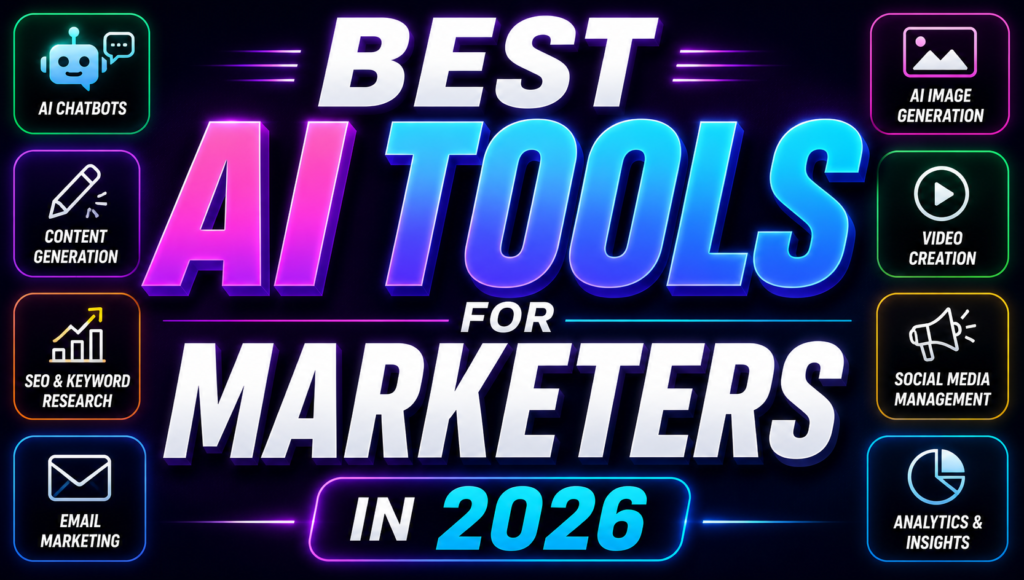
AI marketing tools are software applications that use artificial intelligence to assist with marketing activities.
Depending on the platform, AI can help marketers with:
- Content writing
- SEO research
- Keyword research
- Social media content
- Email marketing
- Advertising
- Customer segmentation
- Market research
- Competitor research
- Image generation
- Video creation
- Marketing analytics
- Workflow automation
- Personalization
- Campaign planning
The important difference between modern AI marketing tools and older automation software is that AI can work with natural-language instructions and unstructured information.
For example, a marketer can provide customer research and ask an AI system to identify recurring pain points, audience segments and potential messaging angles.
ChatGPT’s current marketing resources specifically describe workflows for campaign briefs, audience insights, campaign concepts, competitive positioning and performance analysis.
Best AI Tools for Marketers in 2026
The following tools cover different parts of a modern marketing workflow.
| AI Tool | Best For | Main Marketing Use |
|---|---|---|
| ChatGPT | General marketing work | Strategy, copy, research, analysis |
| Canva | Visual marketing | Social graphics, presentations, creative assets |
| HubSpot | Marketing automation | CRM, campaigns, customer workflows |
| Semrush | SEO marketing | Keywords, competitors, content research |
| Jasper | Brand content | Marketing copy and brand consistency |
| Perplexity | Research | Market and competitor research |
| Grammarly | Editing | Copy editing, tone and clarity |
| Google Gemini | Google ecosystem | Research, content and Workspace tasks |
| Adobe Firefly | Creative production | Generative images and design assets |
| Zapier | Automation | Connecting marketing apps and workflows |
Capabilities, plans and limits can change, so marketers should verify current product information before making purchasing decisions.
1. ChatGPT — Best Overall AI Tool for Marketers
ChatGPT is one of the most versatile AI tools available to marketers in 2026.
It can support campaign planning, content creation, audience research, data analysis, brainstorming, messaging development and creative production. OpenAI’s current marketing resources specifically recommend ChatGPT for campaign concepts, landing pages, email campaigns, product messaging, competitor analysis, audience insights and marketing-performance analysis.
What Marketers Can Use ChatGPT For
You can use ChatGPT to create:
- Blog outlines
- Email campaigns
- Social media captions
- Ad copy variations
- Product descriptions
- Campaign briefs
- Customer personas
- Marketing calendars
- Video scripts
- Landing-page copy
- Content repurposing plans
It can also analyze spreadsheets and other marketing data when the relevant tools and file capabilities are available.
OpenAI’s marketing guidance specifically describes using ChatGPT to analyze campaign-performance data, identify high-performing channels and interpret A/B test results.
Best For
Best for: Freelance marketers, content marketers, social media managers, agencies and marketing teams that need one flexible AI assistant.
Limitation
ChatGPT should not automatically be treated as a source of verified market statistics or keyword-search data. Important facts, performance claims and business information should be checked against reliable sources.
2. Canva — Best AI Tool for Visual Marketing
Canva is particularly useful for marketers who need to produce visual content quickly.
Marketing teams can use it for:
- Social media graphics
- Advertisements
- Presentations
- Posters
- Infographics
- Blog graphics
- Promotional designs
- Video content
Canva’s AI-powered features can help marketers move from a written concept to visual assets without requiring advanced graphic-design skills.
This makes Canva particularly useful for small marketing teams where one person may handle content, social media and design.
Best For
Best for: Social media marketers, small businesses, content creators and teams producing frequent visual content.
Why It Matters
A marketing campaign rarely consists of text alone.
One campaign may require:
- Instagram graphics
- LinkedIn posts
- Email banners
- Blog images
- Presentation slides
- Advertising creatives
A visual design platform can therefore complement a general-purpose AI assistant.
3. HubSpot — Best for AI Marketing Automation
HubSpot is useful for businesses that want AI connected to customer relationship management and marketing workflows.
Its AI capabilities can be used alongside broader HubSpot marketing and CRM functions.
Marketing teams can use this type of platform for:
- Customer data
- Lead management
- Email marketing
- Campaign management
- Sales and marketing coordination
- Customer segmentation
- Workflow automation
- Reporting
OpenAI’s current business marketing information also lists HubSpot among the systems that can be connected to ChatGPT Work for marketing workflows.
Best For
Best for: Businesses and marketing teams already using a CRM and looking to connect AI with customer and campaign workflows.
Limitation
A CRM-centered AI platform can be more than a solo blogger or freelancer needs.
4. Semrush — Best AI SEO Tool for Marketers
Semrush is particularly useful for marketers whose strategy depends heavily on organic search.
SEO teams can use it for:
- Keyword research
- Competitor analysis
- SERP research
- Site audits
- Backlink analysis
- Content research
- Search visibility
- SEO reporting
AI can help marketers brainstorm content, but dedicated SEO platforms remain useful when marketers need structured keyword and competitive data.
For example, an AI assistant might suggest:
“AI tools for small businesses.”
An SEO platform can then help investigate whether the topic has meaningful search demand and what competing pages currently appear in search results.
Best For
Best for: SEO specialists, content marketers, affiliate marketers and businesses that rely on organic traffic.
5. Jasper — Best for Brand-Focused Marketing Content
Jasper focuses heavily on marketing content and brand-oriented workflows.
It can be useful for teams producing large volumes of:
- Advertising copy
- Blog content
- Social media copy
- Email content
- Product messaging
- Campaign assets
One advantage of a dedicated marketing-writing platform is that teams can build repeatable processes around brand messaging instead of treating every writing task as a completely new prompt.
Recent 2026 comparisons continue to position Jasper as a specialist option for marketing teams that need brand consistency and content production at scale.
Best For
Best for: Marketing departments, agencies and content teams that need consistent brand messaging across multiple channels.
6. Perplexity — Best AI Tool for Marketing Research
Marketing decisions depend heavily on research.
Perplexity is useful when marketers need to investigate topics, competitors, markets and sources through an AI-powered research interface.
Potential use cases include:
- Competitor research
- Market research
- Topic research
- Industry research
- Customer questions
- Content research
- Source discovery
The major advantage of research-focused AI is that it can help marketers move from a question to a structured research summary more quickly.
However, marketers should still open important sources and verify critical claims before using them in published campaigns.
Best For
Best for: Content strategists, SEO professionals, market researchers and marketers who regularly perform online research.
7. Grammarly — Best AI Tool for Editing Marketing Copy
Grammarly is useful after the first draft has already been created.
Marketing teams can use AI-assisted editing to improve:
- Grammar
- Clarity
- Tone
- Conciseness
- Professional writing
- Brand communication
This is especially useful when multiple people create marketing content.
A brand may want its email copy, website text and social posts to sound consistent even when they are written by different team members.
Best For
Best for: Marketing teams, agencies, email marketers and businesses producing large amounts of written communication.
8. Google Gemini — Best for Google-Centered Marketing Workflows
Google Gemini can be useful for marketers who already rely heavily on Google’s ecosystem.
Potential marketing applications include:
- Brainstorming
- Research
- Content creation
- Document work
- Spreadsheet-related tasks
- Workspace productivity
For teams that spend much of their working day inside Google products, integration with the broader Google ecosystem can be an important consideration.
Best For
Best for: Marketers who rely heavily on Google Workspace and Google’s broader productivity ecosystem.
9. Adobe Firefly — Best for AI Creative Assets
Adobe Firefly is designed for generative creative work.
Marketers can use generative AI for tasks such as:
- Concept development
- Image creation
- Creative variations
- Marketing visuals
- Background changes
- Promotional graphics
This is particularly useful when marketers need to explore several creative directions before a campaign is finalized.
Best For
Best for: Designers, creative marketers, advertising teams and businesses already using Adobe’s creative ecosystem.
10. Zapier — Best for AI Marketing Automation
Zapier is useful when the problem is not creating content but connecting different marketing applications.
For example, a marketing workflow might involve:
Lead form → CRM → Email → Spreadsheet → Notification → Reporting
Automation can reduce repetitive manual work between these systems.
AI can make these workflows more flexible by helping classify information, summarize incoming data or trigger different actions based on content.
Best For
Best for: Marketing operations teams, agencies and businesses with repetitive cross-platform workflows.
Which AI Tool Is Best for Different Marketing Tasks?
Instead of asking which AI tool is universally best, match the tool to the job.
Best AI Tool for Content Marketing
ChatGPT is a strong general-purpose option for content planning, drafting, rewriting and content repurposing.
Jasper is worth considering when brand-focused content production and repeatable marketing workflows are priorities.
Best AI Tool for SEO
Semrush is a strong choice for marketers who need dedicated SEO research, keyword analysis and competitor intelligence.
A general AI assistant can complement Semrush by helping transform SEO research into content briefs and editorial plans.
Best AI Tool for Social Media
Canva is useful for producing visual social content, while ChatGPT can help with captions, hooks, content calendars and variations.
Using both can create a simple social-media workflow:
Idea → Caption → Visual → Review → Publish
Best AI Tool for Marketing Research
Perplexity and ChatGPT can both support research, although marketers should verify important information against primary or authoritative sources.
Best AI Tool for Email Marketing
AI assistants can help generate subject-line variations, email drafts, personalization ideas and campaign concepts.
CRM and marketing-automation platforms become more useful when those messages need to be connected to customer segments and automated workflows.
Best AI Tool for Marketing Design
Canva is a practical option for marketers who need fast social graphics, presentations and promotional materials.
Adobe Firefly is more relevant when generative creative production is a major part of the workflow.
How Marketers Should Actually Use AI in 2026
The biggest mistake is treating AI as a replacement for marketing strategy.
AI works best when the marketer provides:
- Audience information
- Brand guidelines
- Product information
- Campaign objectives
- Customer research
- Channel requirements
- Existing performance data
For example, instead of asking:
“Write an ad for my product.”
Give the AI:
“Create five Facebook ad concepts for a productivity app aimed at freelance designers aged 25–40. The main problem is managing multiple client deadlines. Use a professional but conversational tone and focus on the benefit of reducing missed deadlines.”
The second prompt provides context.
Better context generally produces more useful marketing output.
OpenAI’s current marketing guidance similarly recommends giving AI relevant context and using it across the progression from campaign ideas and briefs to assets and performance analysis.
AI Marketing Tools Should Not Replace Human Strategy
AI can generate content quickly, but speed alone does not create a successful marketing campaign.
A marketer still needs to decide:
- Who is the audience?
- What problem are you solving?
- Why should customers care?
- What differentiates the product?
- What proof supports the claim?
- Which channel is appropriate?
- What action should the customer take?
AI can help explore these questions, but human judgment remains important.
This is especially important for advertising claims, financial information, healthcare content, legal claims and other areas where inaccurate information can create serious problems.
How to Choose the Best AI Marketing Tool
Before subscribing to another AI platform, ask five questions.
1. What problem does it solve?
Do not buy an AI tool simply because it has an impressive feature list.
Identify the repetitive task that is actually slowing your team down.
2. Does it fit your existing workflow?
A tool that requires marketers to copy information between five different applications may create more work than it removes.
3. Does it provide something your current tools cannot?
If your existing AI assistant already handles your writing needs, another writing-only tool may provide limited additional value.
4. Can your team use it consistently?
A powerful tool that nobody uses is less valuable than a simpler tool integrated into daily work.
5. Can you measure its impact?
Track practical outcomes such as:
- Time saved
- Campaign production speed
- Number of content assets produced
- Editing time
- Lead response time
- Conversion rate
- Cost per acquisition
- Organic traffic
- Revenue influenced by campaigns
OpenAI’s marketing guidance recommends measuring AI by outcomes rather than simply counting logins or prompts.
Simple AI Marketing Stack for Small Teams
A small marketing team does not need 20 AI subscriptions.
A practical stack could contain:
ChatGPT for strategy, research, writing and analysis.
Canva for visual content.
Semrush for SEO and keyword research.
HubSpot or another CRM for customer and marketing workflows.
Zapier for connecting repetitive processes.
This five-tool structure covers a large portion of common marketing work without requiring a separate application for every task.
The exact stack should depend on your existing software, team size, marketing channels and budget.
How AI Is Changing Marketing in 2026
The biggest change is not simply that AI can write faster.
AI is increasingly becoming part of the complete marketing workflow.
A campaign can move through:
Research → Strategy → Content → Design → Distribution → Analysis → Optimization
AI can assist at multiple points in this cycle.
OpenAI describes marketing workflows that move from idea and brief to assets and launch, then back into performance review and optimization.
This means marketers can spend less time performing repetitive production tasks and more time deciding what should actually be produced.
Another important development is the growing connection between AI and advertising platforms.
OpenAI’s current advertising documentation describes conversational intent as an additional relevance signal for ChatGPT advertising and recommends clear, specific and benefit-focused ad copy.
OpenAI has also expanded its ChatGPT advertising pilot during 2026, including new ways for advertisers to buy and measure campaigns.
This is an emerging area, so marketers should monitor official platform documentation rather than relying on older articles about AI advertising.
Conclusion
The best AI tools for marketers in 2026 are not necessarily the tools with the most features. The best tools are the ones that solve specific marketing problems and fit naturally into an existing workflow.
ChatGPT is a strong general-purpose option for campaign planning, content creation, research and data analysis.
Canva is useful for visual marketing and social-media creative production.
Semrush is valuable for SEO research and search-focused marketing.
Jasper can help marketing teams manage brand-focused content production.
Perplexity can support research and information discovery.
HubSpot is useful when AI needs to work alongside CRM and marketing automation.
Grammarly can improve written communication and consistency.
Adobe Firefly can support generative creative production.
Zapier can connect marketing applications and automate repetitive workflows.
The right choice depends on your marketing goals.
A blogger may need only ChatGPT and an SEO platform. A social-media manager may benefit more from ChatGPT and Canva. An enterprise marketing team may need a broader combination of CRM, automation, analytics, creative and content tools.
The most effective AI marketing strategy is therefore not to collect as many AI tools as possible.
It is to build a small, reliable stack where each tool has a clear job.
Use AI for research, ideation, production and analysis—but keep human oversight for strategy, brand decisions, fact-checking, customer understanding and final approval.
That combination allows marketers to gain the speed of AI without sacrificing the judgment and creativity that make marketing effective.
What are the best AI tools for marketers in 2026?
The best AI tools depend on the marketing task. ChatGPT is a strong general-purpose option, Canva is useful for visual marketing, Semrush is suited to SEO, HubSpot supports CRM and automation, and specialized tools such as Jasper, Perplexity, Grammarly and Adobe Firefly cover additional marketing workflows.
How can marketers use AI to improve their marketing?
Marketers can use AI for campaign planning, audience research, content creation, SEO research, social media, advertising copy, visual production, customer-data analysis and workflow automation. AI works best when marketers provide clear business goals, audience information, brand guidelines and reliable source material.
Are AI marketing tools worth using for small businesses?
AI marketing tools can be useful for small businesses because they can reduce repetitive work and help a small team produce content, analyze information and create marketing assets more efficiently. The best approach is to start with one or two tools that solve an actual business problem rather than paying for many overlapping AI subscriptions.