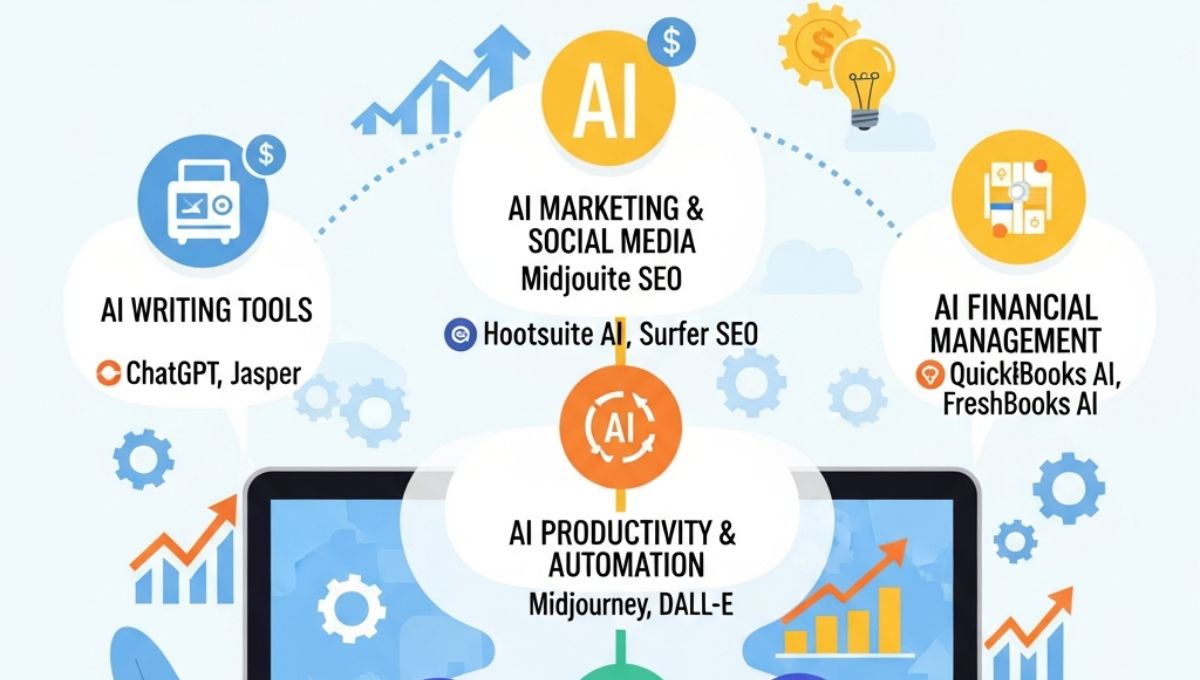
Freelancers using AI earn up to 22% more than those who don’t. They deliver faster, take on more clients, and charge higher rates not because they work harder, but because they work smarter.
If you’re still doing everything manually, you’re leaving real money on the table every single week. This guide shows you exactly which AI tools to use, how to price your new capabilities, and how to turn AI into a consistent income boost starting with just one tool and $20/month.
AI Won’t Replace You But It Will Replace Freelancers Who Ignore It
You’re losing money right now. Not because you lack skills because the freelancer pitching against you uses AI and delivers twice the work in half the time.
That gap is real and growing fast. Upwork’s 2025 In-Demand Skills Report confirms freelancers with AI skills earn up to 22% more than those without. A separate analysis shows AI-augmented freelancers earn 25% more year-over-year compared to peers doing traditional work alone.
The good news? You don’t need a technical degree. You don’t need to write code. You need to know which AI tools to use, how to price what you deliver, and how to stop charging for time when AI means time is no longer your constraint.
Here are 9 ways to use AI tools to increase your freelance income starting this week.
1. Automate Repetitive Work and Take On More Clients
Every freelance workflow bleeds time somewhere. Writers lose it to research. Developers lose it to boilerplate code. Marketers lose it to formatting reports.
AI tools close those leaks permanently. ChatGPT cuts research and first-draft time by 60–80%. GitHub Copilot handles code completion so developers focus on architecture instead of syntax. Otter.ai transcribes every client call automatically no manual notes, no missed details.
The income math is direct. Save three hours per project. Take on one more project per week. At $100/hour, that’s $300 extra every week, or $15,600 per year from a single tool.
Action step: Track exactly where your time goes this week. Identify the single biggest time drain. Find the AI tool that eliminates it. Use it daily for two weeks until it is instinctive. Then raise your capacity and pitch one more client.
2. Add AI-Enhanced Add-Ons to Existing Packages
You don’t need to rebuild your services. You need to add one upgrade option on top of what you already sell.
Freelancers do this by offering AI-powered extras alongside standard deliverables. A copywriter adds “tone-optimised revision via AI delivered 24 hours faster.” A graphic designer adds “3 AI-generated concept variants before final design.” A virtual assistant adds “automated weekly dashboard summaries” to reporting packages.
Clients pay for outcomes and speed not for which tool produced them. Price the add-on at 20–30% above your base rate and frame it around client benefit: faster turnaround, higher polish, more options.
This method requires zero repositioning. It generates immediate extra revenue from clients who already trust you and are already paying you.
3. Offer Prompt Engineering as a Premium Service
Prompt engineering is not a buzzword. It is a billable skill with documented rate benchmarks and growing demand.
Businesses need AI tools to do specific, reliable things — generate brand-accurate copy, handle customer enquiries consistently, qualify leads automatically. Most businesses cannot get consistent results from AI without expert guidance. You can charge to solve that problem.
| Experience Level | Hourly Rate | Monthly Potential |
|---|---|---|
| Entry-level (general prompts) | $50–$80/hr | $3,000–$5,000 |
| Mid-level (niche-specific) | $100–$150/hr | $5,000–$12,000 |
| Senior (agent and workflow design) | $200–$400/hr | $15,000–$30,000+ |
The difference between entry-level and senior rates is specialisation, not experience years. A prompt engineer who focuses exclusively on customer service automation for e-commerce brands commands higher rates than one who offers general prompt services. Niche down first, then expand.
Build a portfolio of before-and-after examples showing what your prompts produce versus generic AI output. Package your work into monthly optimisation retainers — that converts one-time project income into recurring revenue.
4. Build and Sell No-Code AI Chatbots on Retainer
This income stream appears in almost no freelancing article, yet it produces some of the most consistent recurring income available right now.
Small businesses want chatbots that handle appointment bookings, answer customer questions, and qualify incoming leads. They don’t want to build them. They want someone to build and maintain them monthly.
No-code platforms — Tidio, Botpress, ManyChat — let you build fully functional AI chatbots in hours, with zero coding. One freelancer targeting dental and medical practices charges $800 per setup and $200/month per client for ongoing maintenance. With 15 clients, that produces $3,000/month in recurring income from roughly 15 hours of weekly work.
The model works because of the retainer structure. A single chatbot setup sale converts into $2,400/year per client. A setup fee of $800 covers your time. The monthly retainer locks in predictable income that compounds as your client list grows.
Target businesses that run heavily on enquiries: dental clinics, law firms, real estate agents, gyms, beauty salons, tutoring centres. Every one of them has a phone that rings with questions their staff answers manually every day. You automate that problem. They pay you every month to keep it running.
5. Create Passive Income With AI Digital Products
AI makes product creation fast enough that passive income is no longer theoretical for freelancers.
Prompt packs sell consistently on Gumroad, PromptBase, and Etsy. A curated library of 500 marketing prompts sells for $47–$97 per purchase. Notion templates built with AI assistance, niche ebooks drafted with ChatGPT and refined by hand, and printable planners created via Canva AI all generate recurring downloads without active client work.
Some creators earn over $5,000/month from prompt libraries alone. The business model is simple: create once, sell indefinitely. Amazon KDP and Etsy handle payment and delivery automatically, leaving you responsible only for traffic.
Pick one narrow niche. Prompts for real estate agents. Notion templates for freelance designers. A social media caption kit for fitness coaches. Create a lean, focused product. List it on two platforms. Measure what sells and build more of it.
Your first product will not earn $5,000/month. It will teach you what the market actually wants. That knowledge is worth more than the initial revenue.
6. Position Yourself as an AI Consultant, Not Just a Freelancer
The highest-earning freelancers right now are not selling tasks. They are selling transformation.
AI consulting rates reflect this completely. Independent AI consultants charge $150–$300/hour. Retainer engagements for ongoing advisory and implementation support run $2,000–$10,000/month. One operations manager turned AI consultant charges $5,000 for an initial AI workflow assessment, then $3,500/month per retainer client. With seven clients, she earns over $34,000/month working 30–35 hours per week.
You do not need a technical background to start. Domain expertise in marketing, finance, operations, or law — combined with solid working knowledge of AI tools — is enough to deliver real value to businesses trying to figure out how AI fits into their workflows.
The reposition is one sentence. Stop saying “I’m a copywriter who uses AI.” Start saying “I’m an AI Content Strategist who helps SaaS companies cut content production costs by 60%.” Same tools. Same skills. Completely different rate ceiling.
The companies with the biggest budgets are not looking for someone who knows ChatGPT. They are looking for someone who can take their specific problem and make AI solve it reliably. That is a consulting problem, not a freelancing problem. Price it accordingly.
7. Use AI to Enter Higher-Paying Niches Fast
AI compresses niche entry time from months to weeks.
A freelance writer with no financial background uses Perplexity AI to research terminology, Claude to verify accuracy, and ChatGPT to structure drafts — then applies human judgement and editing on top. Clients in legal, medical, and financial niches pay two to three times standard content rates because they need accuracy and subject-matter depth. AI gives you the foundation. Your editing and critical thinking provide the depth.
The same applies in every discipline. A developer uses AI research tools to enter AI integration projects without years of prior experience. A marketer uses no-code AI platforms to offer predictive analytics services to e-commerce brands.
Pick one adjacent niche that pays more than your current work. Spend two weeks using AI tools to learn its language, key pain points, and common deliverables. Build one portfolio piece demonstrating your capability in that niche. Pitch it at a higher rate than your current clients pay.
Speed of niche expansion is now a competitive advantage. AI is the accelerant.
8. Switch to Value-Based Pricing
This is the most important shift in this entire article — and the one most freelancers resist longest.
When AI cuts your task time in half, an hourly rate punishes your own efficiency. A 10-hour project that now takes five hours earns you 50% less. That is the direct opposite of what technology adoption should do for your income.
Value-based pricing fixes this. You price based on the outcome you deliver, not the time you spend delivering it. A chatbot that saves a dental practice $3,000/month in staff time is worth $800 in setup and $200/month in maintenance — regardless of whether it took you two hours or twenty to build.
The framework is straightforward. Identify the cost of the client’s problem. Price your solution at 10–20% of that cost. A marketing automation setup that generates $10,000/month in new leads is worth $1,000–$2,000 as a project fee.
AI tools give freelancers enormous leverage because they reduce input while maintaining or improving output quality. Hourly pricing erases that leverage. Value-based pricing captures every unit of it.
One additional reframe: your AI tool subscriptions are not expenses. A $500/month AI toolkit that generates $5,000 in extra monthly income produces a 1,000% return on investment. Track it that way, report it that way, and pitch it that way to clients who ask why they should pay your higher rate.
9. Keep More of What You Earn
Platform fees are the silent income killer that almost no AI freelancing article addresses.
On a $1,000 project, major platforms take $100–$200 in commission before you receive a cent. As AI makes you more productive, this fee structure becomes increasingly punishing — your time per dollar earned decreases, but the platform’s cut stays fixed or grows.
Commission-free platforms change this equation. Platforms that charge flat subscriptions instead of project percentages let you keep the full financial gain from every productivity improvement AI delivers. For a freelancer earning $60,000/year, eliminating a 20% platform fee returns $12,000/year directly to your income — without winning a single new client.
The practical approach: use major platforms for initial client acquisition and portfolio visibility. Once a client relationship is established and trust is built, migrate long-term clients to direct arrangements or lower-fee platforms. Keep your AI efficiency gains instead of splitting them with a platform that played no role in delivering the work.
Best AI Tools for Freelancers by Category
| Tool | Category | Starting Cost | Best For |
|---|---|---|---|
| ChatGPT Plus | Writing / Research | $20/month | Content, proposals, ideation |
| Claude | Writing / Analysis | Free / $20/month | Long documents, strategy |
| GitHub Copilot | Development | $10/month | Code completion, debugging |
| Canva AI | Design | Free / $15/month | Social media, presentations |
| Grammarly | Editing | Free / $12/month | Proposals, client emails |
| Otter.ai | Transcription | Free / $8.33/month | Meeting notes, interviews |
| Jasper | Marketing Copy | $39/month | Ad copy, email sequences |
| Midjourney | Image Generation | $10/month | Visual content, product shots |
| Descript | Video / Audio | Free / $12/month | Video editing, transcription |
| Perplexity AI | Research | Free / $20/month | Fast niche research |
| Tidio / Botpress | Chatbot Building | Free / $19/month | Client chatbot services |
How Much Can AI-Skilled Freelancers Actually Earn?
| AI Service Type | Monthly Income Range | Hours/Week |
|---|---|---|
| AI-augmented content writing | $3,000–$8,000 | 25–35 hrs |
| Prompt engineering (mid-level) | $5,000–$12,000 | 20–30 hrs |
| No-code chatbot retainer | $3,000–$8,000 | 10–20 hrs |
| AI consulting / workflow advisory | $10,000–$35,000 | 30–40 hrs |
| Digital products (passive) | $500–$5,000+ | 2–5 hrs |
| AI-augmented design / development | $5,000–$15,000 | 25–35 hrs |
Months one to three run lower while you build skills, case studies, and portfolio evidence. Consistent effort across any one of these paths produces measurable income growth by month four.
Conclusion: The Gap Between AI Freelancers and Everyone Else Keeps Growing
The freelancers earning $10,000–$35,000/month from AI-adjacent work did not start there.
They started by picking one tool. Learning it in two weeks. Measuring the time it saved. Charging for the outcome it helped them deliver faster. Then they added one more income stream — a retainer client, a digital product, a consulting package — and repeated the process.
The income gap between AI-skilled and non-AI freelancers widens every quarter. Upwork data, PeoplePerHour platform results, and independent rate benchmarks all point the same direction: AI-augmented freelancers win more contracts, charge higher rates, and keep more clients long-term.
You do not need every tool on this list. You need one tool that fixes your biggest bottleneck, one pricing shift that reflects the value you now deliver, and one new income stream that runs while you sleep.
Start with a $32/month investment — ChatGPT Plus and Grammarly. Build one client case study that shows faster delivery or better output. Raise one rate. The compounding effect takes over from there.
The window is open. The freelancers who move first capture the premium rates while demand still outstrips supply. That window does not stay open forever.