
Businesses lose hours every day on repetitive tasks. Leads wait for replies, customers do not get quick answers, and teams spend time on work that does not grow revenue. Many people try AI tools, but most fail to get real results.
The problem is not AI itself. The problem is how people use it inside their workflows. An AI automation business solves this by building systems that handle tasks automatically, improve speed, and create consistent results without increasing workload or hiring more people.
Why AI Automation Businesses Are Growing Fast
AI has moved from experimentation to daily use. Businesses now depend on it for operations like customer support, lead generation, marketing follow-ups, and internal processes.
Companies want faster execution and lower costs. Automation helps them achieve both. A small team can now handle work that once required multiple employees.
This shift creates demand for people who understand how to connect processes and build working systems. Businesses no longer want isolated tools. They want complete solutions that improve how their operations run.
Small and medium businesses feel this need the most. They often lack large teams, so automation becomes a direct advantage. If you can help them save time or increase revenue, they are willing to pay.
The growth in AI adoption also reduces technical barriers. Many tools now allow you to build automation without coding. This makes it easier to start and deliver results quickly.
What an AI Automation Business Actually Does
An AI automation business focuses on workflows. It studies how a task happens and then builds a system that completes it automatically.
The goal is not to install software. The goal is to improve outcomes.
For example, consider a business that receives leads through a website. Without automation, someone checks the form, sends a reply, asks questions, and schedules a call. This process takes time and often leads to delays.
With automation, the system captures the lead, sends an instant response, asks qualifying questions, and books an appointment. The entire process runs without manual effort.
Another example involves customer support. Many businesses receive the same questions repeatedly. Instead of answering each query manually, an AI system can respond instantly, guide the customer, and escalate only complex issues.
These systems increase efficiency, reduce errors, and maintain consistency. The key idea is simple. You do not sell tools. You build systems that solve specific problems.
Step-by-Step: How to Start an AI Automation Business

Step 1 – Pick a Niche
Choosing a niche improves focus and clarity. It allows you to understand one industry deeply instead of trying to serve everyone.
Select industries where communication and repetitive tasks play a major role. Real estate, healthcare clinics, coaching businesses, and e-commerce stores are strong starting points.
When you focus on one niche, you start noticing patterns. Many businesses face similar problems. This allows you to create repeatable solutions instead of starting from scratch each time.
A niche also improves your marketing. Instead of saying you help businesses, you can say you help real estate agents respond to leads faster or help clinics manage patient calls. This clarity makes it easier for clients to understand your value.
Step 2 – Identify a Painful Workflow
Every business has tasks that slow them down. Your job is to find one task that creates the most friction.
Look for activities that happen daily and require time. These tasks often involve communication, data handling, or repetitive decision-making.
Common examples include manual follow-ups, missed calls, delayed responses, repetitive customer queries, and manual data entry.
Talk to business owners and ask direct questions. Ask where they lose time or where they miss opportunities. Observe their current process and note inefficiencies.
A strong problem usually connects to revenue or customer experience. If solving the problem saves money or increases income, the business will see clear value in your solution.
Step 3 – Design the Automation System
After identifying the problem, design a simple system. Break the workflow into steps.
Start with the input. This is the trigger that starts the process. It could be a form submission, a message, or a call.
Next, define the processing stage. This is where AI analyzes the input, applies logic, and decides the next action.
Finally, define the output. This is the action taken, such as sending a message, updating a record, or booking an appointment.
Keep the system clear and focused. Avoid adding unnecessary features. A simple system that works reliably is more valuable than a complex system that fails.
Write down the workflow before building it. This helps you understand the process and avoid confusion during development.
Step 4 – Choose the Right Tools
Tools help you build and connect automation systems. However, they are only a part of the process.
Use tools for creating AI agents, managing workflows, and storing data. Many no-code platforms allow you to design systems visually, which reduces development time.
Choose tools that integrate well with each other. Integration allows data to move smoothly between systems, which improves performance.
Avoid using too many tools. A simple setup is easier to manage and maintain.
Focus on reliability. If your system fails, it affects the client’s business directly.
Step 5 – Get Your First Clients
Start with accessible clients. Local businesses, small companies, and personal contacts are good starting points.
When reaching out, focus on the problem you solve. Do not talk about features or tools. Talk about results.
For example, instead of saying you build automation systems, say you can help them respond to leads instantly and increase bookings.
Offer a simple solution. You can start with a small project or a trial system. This reduces risk for the client and allows you to demonstrate value.
Once you deliver results, clients are more likely to continue working with you and recommend your services to others.
Consistency in outreach is important. You may not get immediate results, but regular effort leads to opportunities.
Best AI Automation Business Ideas

Real estate businesses often struggle with slow lead response. An AI chatbot combined with an automated booking system can solve this problem. Pricing for such solutions can range from moderate to high depending on complexity.
Healthcare clinics frequently miss calls due to limited staff. An AI voice receptionist can handle calls, provide information, and schedule appointments.
E-commerce businesses face customer support overload. An AI support system can answer common queries, track orders, and handle returns efficiently.
Coaching businesses need better lead qualification. An automated funnel can capture leads, ask questions, and filter serious prospects.
Agencies often spend time on onboarding clients. An automated onboarding system can collect information, assign tasks, and streamline the process.
These ideas focus on solving real problems. Each solution improves efficiency and creates measurable value.
Tools You Need
An AI automation business does not require a large set of tools. A few well-chosen tools can handle most tasks.
You need a system for building AI agents, a platform for connecting workflows, and a database or CRM for managing data.
These tools allow you to capture information, process it, and take action automatically.
Ease of use matters. Tools that support visual workflows make it easier to design and modify systems.
Scalability also matters. As your business grows, your tools should handle increased usage without issues.
Pricing Models That Work in 2026
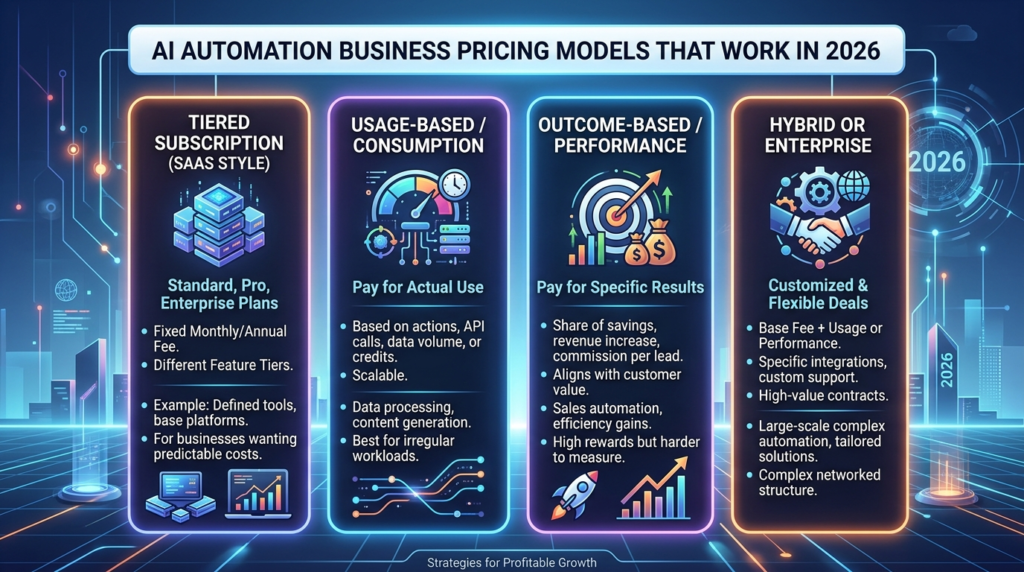
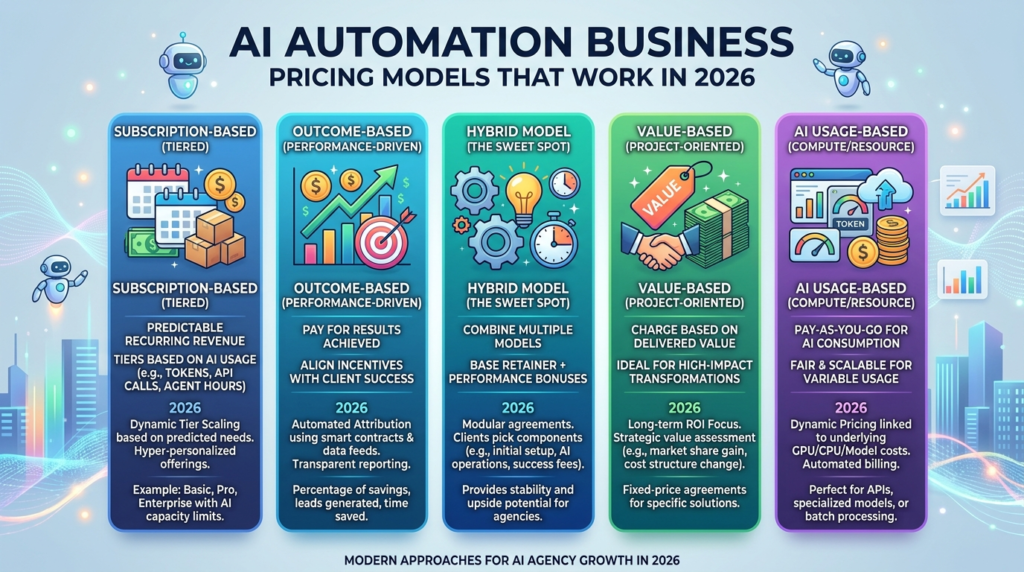
Pricing determines how your business grows. A strong pricing model supports both you and your clients.
A setup fee combined with a monthly retainer is common. The setup fee covers building the system, and the retainer covers maintenance and updates.
Performance-based pricing aligns your earnings with results. You can charge based on leads generated, appointments booked, or revenue impact.
Productized packages simplify your offerings. Instead of custom pricing for every client, you offer fixed solutions with clear pricing.
Recurring revenue is important. It creates stability and allows you to plan growth.
Avoid one-time payments only. They limit your long-term potential.
Mistakes to Avoid
Many beginners focus too much on tools and ignore outcomes. Clients care about results, not the technology used.
Choosing no niche leads to weak positioning. A broad approach makes it difficult to stand out.
Overbuilding systems creates complexity. Complex systems are harder to maintain and more likely to fail.
Ignoring workflows leads to poor results. If the process is unclear, automation will not work effectively.
Skipping validation wastes time. Always test your idea before building a full system.
Avoid these mistakes by focusing on clarity, simplicity, and execution.
Scaling Beyond Freelancing
An AI automation business often begins as a service. Growth requires moving beyond individual projects.
Productizing your service allows you to create repeatable solutions. This reduces effort and increases efficiency.
Standard systems help you serve more clients without increasing workload.
Focusing on high-value clients improves revenue stability. A few strong clients can generate consistent income.
Recurring services such as maintenance, updates, and optimization create ongoing revenue.
Building a team becomes possible once you establish clear systems. Each team member can handle specific parts of the process.
Scaling depends on structure. The more organized your business, the easier it becomes to grow.
Unique Strategy: Focus on Workflow Ownership
Many people focus on tools, but tools change over time. Workflows remain valuable.
When you control a workflow, you influence how a business operates in that area. This creates long-term value.
For example, a lead generation system or a customer support system becomes a core part of the client’s operations.
Clients depend on these systems daily. This dependence increases retention and strengthens your position.
Workflow ownership also allows you to improve and expand your solutions over time.
Instead of selling a one-time service, you become a part of the client’s business process.
Advanced Insight: Vertical AI Advantage
General solutions face strong competition. Specialized solutions create better opportunities.
Vertical AI focuses on one industry and solves its specific problems. This approach improves accuracy and performance.
For example, automation for real estate differs from automation for healthcare. Each industry has unique workflows and requirements.
Specialization improves trust. Clients prefer providers who understand their industry.
It also reduces competition because fewer people focus deeply on one niche.
This approach allows you to create stronger solutions and charge higher prices.
Conclusion
Starting an AI automation business in 2026 depends on solving real problems through structured workflows. Tools support the process, but they do not create value on their own.
Focus on one niche, identify a clear problem, and build a simple system that delivers results. Keep your approach practical and outcome-driven.
Growth comes from repeatable systems, strong positioning, and consistent execution. When you build solutions that businesses rely on every day, you create a stable and scalable business.