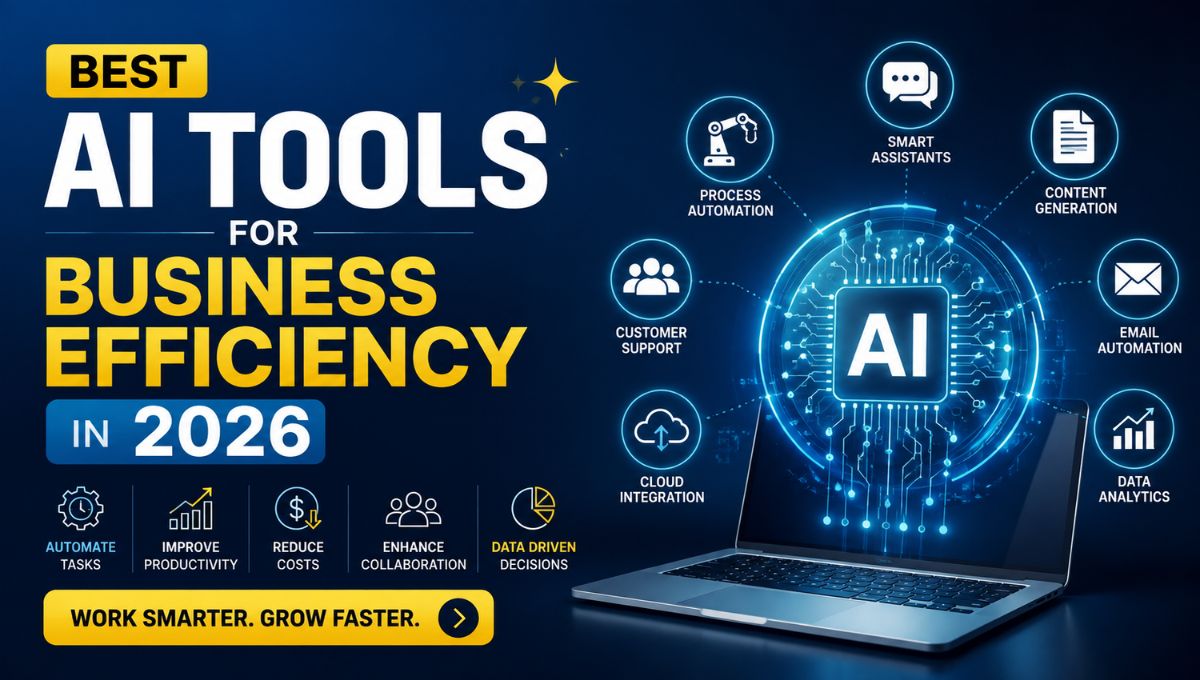
Business efficiency has become one of the most important factors for growth in 2026. Companies are under constant pressure to reduce costs, improve productivity, respond faster to customers, and make better decisions using data. Artificial intelligence is no longer a futuristic concept used only by large technology companies. It has become a practical business tool that helps organizations automate repetitive tasks, improve communication, analyze information quickly, and streamline operations across departments.
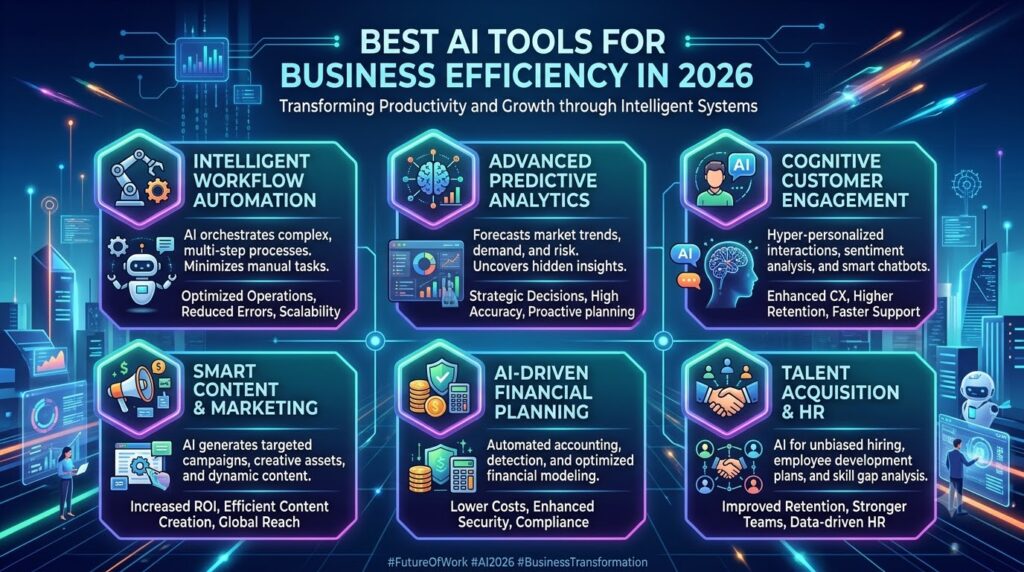
From startups and small businesses to global enterprises, companies are adopting AI tools to save time, reduce manual work, and increase output without significantly increasing staff or operational expenses. AI is being used for customer support, marketing, sales, accounting, project management, document processing, data analysis, and internal collaboration. The biggest advantage is that many modern AI tools are cloud-based, easy to use, and require little or no coding knowledge.
Choosing the right AI tools can have a significant impact on overall business performance. The best solutions are those that integrate smoothly into existing workflows, improve employee productivity, and deliver measurable efficiency gains. This guide explores the Best AI Tools for Business Efficiency in 2026, explaining their features, benefits, and ideal use cases for different types of businesses.
Why AI Is Essential for Business Efficiency in 2026
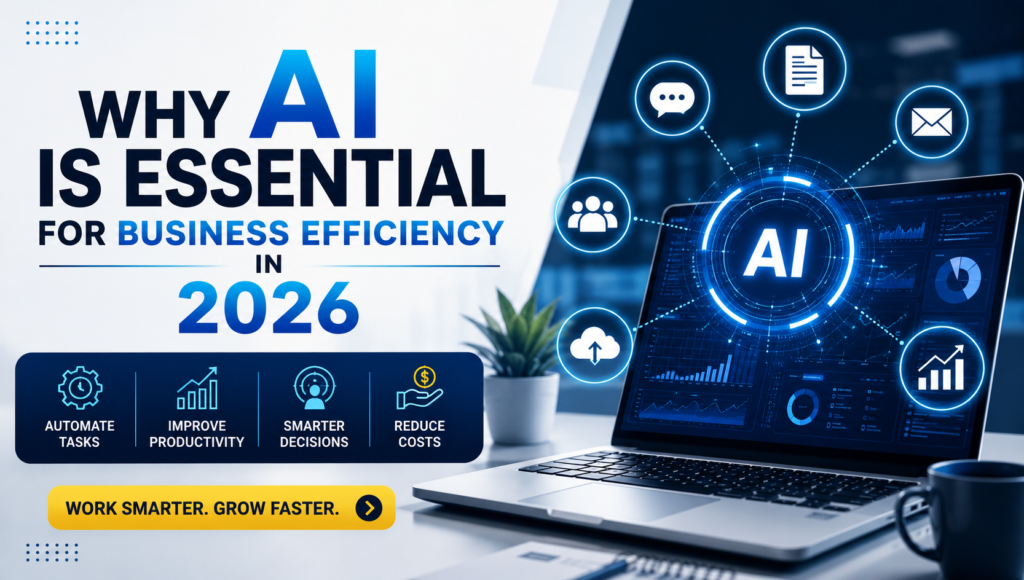
Traditional business processes often involve repetitive manual work such as writing emails, preparing reports, updating spreadsheets, responding to customer inquiries, organizing documents, and scheduling meetings. These tasks consume valuable employee time that could be spent on strategic planning, innovation, customer relationships, and revenue-generating activities.
AI tools help businesses by:
- Automating repetitive tasks
- Improving response times
- Reducing human errors
- Organizing information efficiently
- Generating insights from data
- Supporting faster decision-making
- Enhancing collaboration between teams
- Scaling operations without proportional increases in staffing
As competition becomes more intense in 2026, companies that effectively use AI are gaining advantages in productivity, customer service, and operational speed.
ChatGPT
Best for: Content creation, communication, brainstorming, customer support assistance, and workflow automation.
ChatGPT remains one of the most versatile AI tools available in 2026. Businesses use it to draft emails, create marketing content, summarize meetings, generate reports, write product descriptions, and assist customer support teams with response templates.
Key Features
- Natural language understanding
- Content generation for blogs, social media, and marketing
- Email drafting and editing
- Meeting summaries
- Research assistance
- Idea generation and brainstorming
- Integration with various business workflows
Efficiency Benefits
Teams can reduce the time spent writing routine documents, preparing communication materials, and organizing information. This is particularly valuable for small businesses that do not have dedicated content or administrative departments.
Best For
- Small businesses
- Marketing teams
- Consultants
- Freelancers
- Customer support departments
Microsoft Copilot
Best for: Businesses already using Microsoft 365.
Microsoft Copilot integrates directly with Word, Excel, PowerPoint, Outlook, and Teams, making it one of the strongest productivity-focused AI solutions for business environments.
Key Features
- AI-assisted document writing
- Spreadsheet analysis and formula generation
- Automatic presentation creation
- Email summarization in Outlook
- Meeting recap generation in Teams
- Data insights from Excel workbooks
Efficiency Benefits
Employees can create reports, presentations, and analyses much faster without switching between multiple applications. Copilot is especially powerful for organizations heavily invested in the Microsoft ecosystem.
Best For
- Corporate offices
- Financial teams
- Administrative departments
- Enterprise productivity environments
Google Gemini for Workspace
Best for: Teams using Gmail, Google Docs, Sheets, Slides, and Meet.
Gemini brings AI assistance directly into Google Workspace, helping teams work more efficiently within familiar Google applications.
Key Features
- Email drafting and summarization
- Document writing assistance
- Spreadsheet formula suggestions
- Presentation content generation
- Meeting note summaries
- Collaborative AI assistance
Efficiency Benefits
Gemini reduces the time spent on routine communication, document preparation, and collaborative editing. Its cloud-based nature makes it particularly useful for remote and distributed teams.
Best For
- Startups
- Remote teams
- Educational organizations
- Small and medium-sized businesses
Notion AI
Best for: Knowledge management, project organization, and team documentation.
Notion AI combines note-taking, databases, project management, and AI-powered writing assistance in a single platform.
Key Features
- AI-generated summaries
- Task and project organization
- Meeting note automation
- Document drafting
- Knowledge base management
- Team collaboration tools
Efficiency Benefits
Businesses can centralize information, reduce duplicate documentation, and make internal knowledge easier to access. This improves onboarding, project coordination, and cross-team communication.
Best For
- Startups
- Product teams
- Agencies
- Operations and project management teams
Zapier AI
Best for: Automating workflows between different business applications.
Zapier has expanded its AI capabilities to make automation easier for non-technical users.
Key Features
- Connects thousands of business apps
- AI-assisted workflow creation
- Automated data transfer
- Trigger-based task execution
- Cross-platform process automation
Efficiency Benefits
Zapier eliminates repetitive manual actions such as copying data between systems, sending notifications, updating CRM records, and generating follow-up tasks automatically.
Best For
- Businesses using multiple software tools
- Sales operations
- Marketing automation
- Administrative workflow automation
HubSpot AI
Best for: Sales, marketing, and customer relationship management.
HubSpot has integrated AI across its CRM, marketing, and customer service platforms.
Key Features
- AI email generation
- Marketing campaign assistance
- Lead scoring and insights
- Customer support automation
- Content optimization suggestions
- Sales forecasting support
Efficiency Benefits
Sales and marketing teams can automate outreach, personalize customer communication, and manage leads more effectively, resulting in faster sales cycles and improved customer engagement.
Best For
- Sales teams
- Marketing agencies
- SaaS companies
- Customer relationship management
Canva Magic Studio
Best for: Quick business graphics, presentations, and marketing materials.
Canva’s AI-powered Magic Studio helps businesses create professional visuals without hiring a dedicated designer.
Key Features
- AI presentation generation
- Social media design assistance
- Background removal
- Text-to-image generation
- Brand kit management
- Video and animation templates
Efficiency Benefits
Businesses can produce marketing materials, proposals, presentations, and social media content much faster while maintaining consistent branding.
Best For
- Small businesses
- Marketing teams
- Entrepreneurs
- Content creators
ClickUp AI
Best for: Task management and operational productivity.
ClickUp combines project management with AI-powered productivity features.
Key Features
- AI task summaries
- Automatic project updates
- Writing assistance for documentation
- Meeting note generation
- Workflow tracking
- Team productivity dashboards
Efficiency Benefits
Managers spend less time preparing status updates and coordinating tasks, while teams gain clearer visibility into project progress and priorities.
Best For
- Operations teams
- Software development teams
- Agencies
- Cross-functional business teams
Fireflies.ai
Best for: Meeting transcription and follow-up automation.
Meetings often generate important decisions that are easily forgotten. Fireflies.ai automatically records, transcribes, and summarizes conversations.
Key Features
- Automatic meeting transcription
- AI-generated summaries
- Action item extraction
- Searchable meeting archives
- Integration with Zoom, Teams, and Google Meet
Efficiency Benefits
Teams no longer need to take detailed manual notes during meetings, and follow-up actions can be tracked more consistently.
Best For
- Sales calls
- Client meetings
- Remote teams
- Management discussions
QuickBooks with AI Features
Best for: Accounting and financial operations.
QuickBooks has added AI-powered features that help automate bookkeeping and financial management tasks.
Key Features
- Automated expense categorization
- Invoice reminders
- Cash flow insights
- Financial report generation
- Transaction matching assistance
Efficiency Benefits
Small businesses can reduce the time spent on bookkeeping while improving the accuracy of financial records and cash flow monitoring.
Best For
- Small businesses
- Freelancers
- Retail businesses
- Service-based companies
Comparison Table of the Best AI Tools
| Tool | Primary Use | Best Business Size |
|---|---|---|
| ChatGPT | Content & communication | Small to large |
| Microsoft Copilot | Office productivity | Medium to large |
| Google Gemini | Collaboration & documents | Small to medium |
| Notion AI | Knowledge management | Small to medium |
| Zapier AI | Workflow automation | All sizes |
| HubSpot AI | Sales & marketing | Medium to large |
| Canva Magic Studio | Design & presentations | Small to medium |
| ClickUp AI | Project management | Medium to large |
| Fireflies.ai | Meeting productivity | All sizes |
| QuickBooks AI | Accounting & finance | Small businesses |
Best AI Stack for a Small Business in 2026
A practical and cost-effective AI setup for a small business could look like this:
| Business Function | Recommended AI Tool |
| Content & communication | ChatGPT |
| Documents & collaboration | Google Gemini |
| Design & presentations | Canva Magic Studio |
| Workflow automation | Zapier AI |
| Accounting | QuickBooks AI |
This combination covers the most common operational needs without requiring expensive enterprise software.
How to Choose the Right AI Tool
When selecting AI tools for business efficiency, consider the following factors:
Existing Software
Choose tools that integrate with the applications your team already uses, such as Microsoft 365, Google Workspace, Slack, or your CRM system.
Team Skill Level
Some tools are designed for non-technical users, while others may require more advanced setup and configuration.
Primary Bottleneck
Identify where your business loses the most time:
- Email management
- Reporting
- Customer support
- Marketing content
- Data entry
- Meeting coordination
- Project tracking
Scalability
Select tools that can grow with your business and support additional users and workflows as operations expand.
Common Mistakes to Avoid
Automating Everything at Once
Start with one or two high-impact processes before expanding AI adoption across the organization.
Ignoring Employee Training
Even user-friendly AI tools require basic training to ensure employees use them effectively and responsibly.
Relying Entirely on AI Output
AI-generated content, reports, and recommendations should still be reviewed by humans for accuracy, compliance, and business context.
Overlooking Data Security
Ensure that any AI tool used by the business follows appropriate security and privacy standards, especially when handling customer or financial data.
The Future of Business AI in 2026 and Beyond
AI tools are evolving rapidly from simple assistants into AI agents capable of performing multi-step tasks independently. Future business AI systems are expected to:
- Coordinate workflows across multiple applications
- Make proactive recommendations
- Detect operational inefficiencies automatically
- Predict customer needs more accurately
- Generate real-time business insights from connected data sources
Businesses that begin adopting AI strategically in 2026 will be better positioned to benefit from these future advancements.
Conclusion
Artificial intelligence has become one of the most effective ways to improve Business Efficiency in 2026. The best AI tools are not necessarily the most complex ones; they are the tools that save employees time, reduce repetitive work, improve communication, and help organizations make faster and better decisions.
For most businesses, ChatGPT offers the greatest flexibility for content and communication tasks, Microsoft Copilot excels in office productivity, Google Gemini is ideal for collaborative cloud-based work, Zapier AI provides powerful workflow automation, and Canva Magic Studio makes professional design accessible to non-designers.
The most successful approach is to combine several complementary AI tools rather than relying on a single platform for everything. By starting with clear business goals, focusing on high-impact workflows, and integrating AI gradually into daily operations, companies can achieve significant improvements in productivity, cost efficiency, and overall operational performance.
As AI technology continues to advance, businesses that embrace these tools thoughtfully and strategically will gain a strong competitive advantage in an increasingly digital and fast-moving business environment.