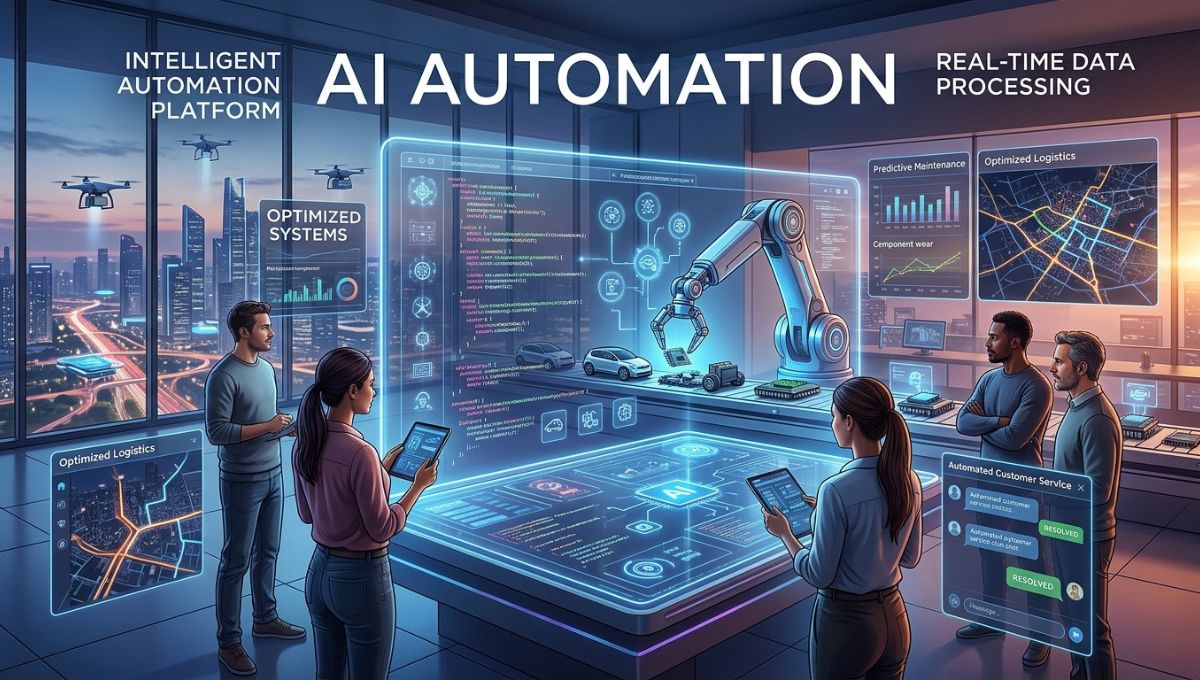
Artificial Intelligence (AI) is changing the way people and businesses work. From answering customer questions and generating content to analyzing data and managing business processes, AI has become an important part of modern technology. One of its most valuable applications is AI Automation, which combines artificial intelligence with automation to perform tasks with little or no human intervention.
Businesses of all sizes are using AI Automation to save time, reduce costs, improve productivity, and eliminate repetitive work. Whether it is sending automated emails, processing invoices, scheduling meetings, managing customer support, or analyzing large amounts of data, AI automation helps organizations complete tasks faster and more accurately.
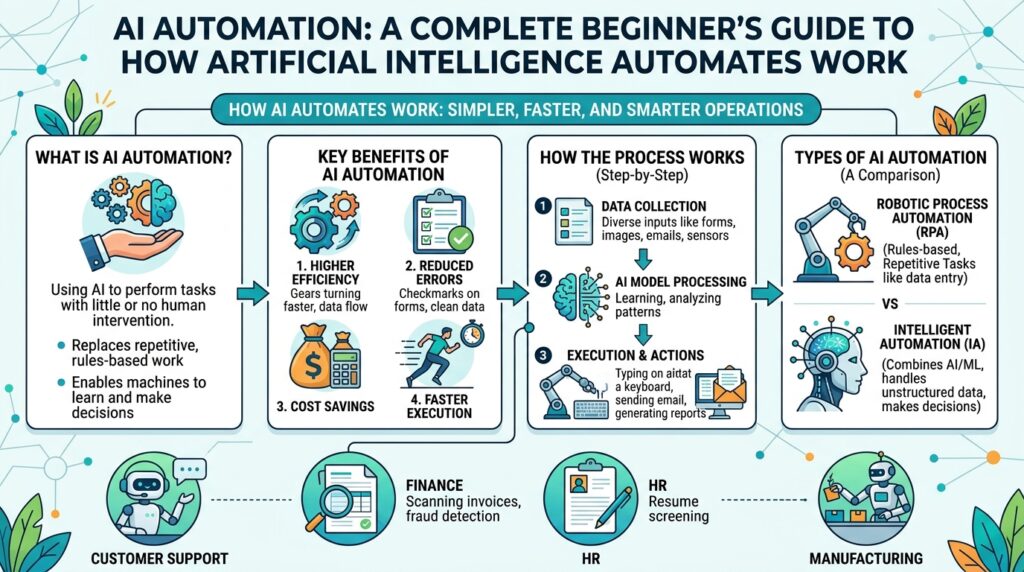
Unlike traditional automation, which follows fixed rules and instructions, AI automation can learn from data, recognize patterns, understand language, and make intelligent decisions. This makes it suitable for handling more complex business processes that previously required human involvement.
As digital transformation continues across industries, AI automation is becoming an essential technology for improving efficiency, supporting innovation, and delivering better customer experiences.
Understanding AI Automation
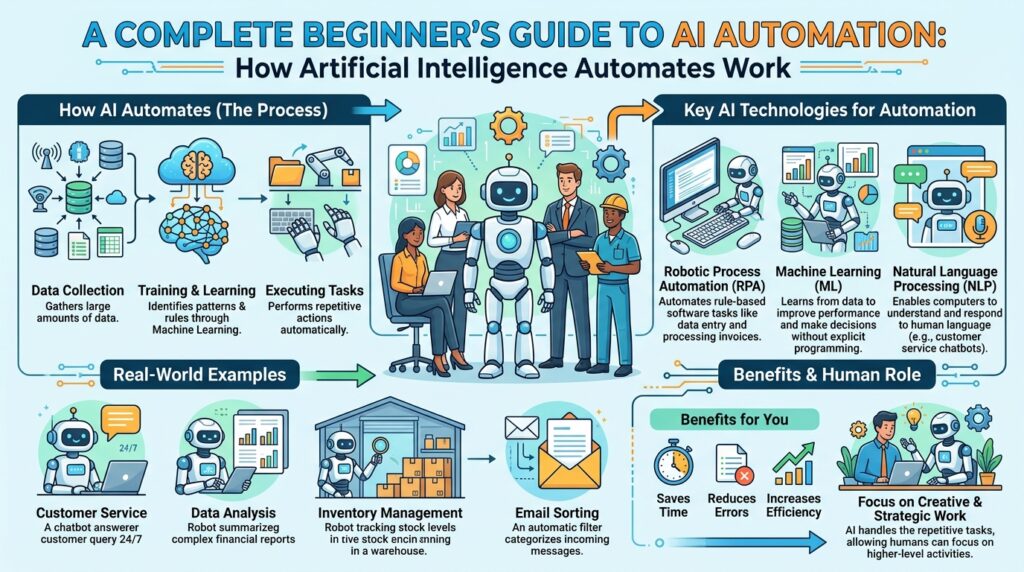
AI Automation refers to the use of artificial intelligence technologies to automate tasks, workflows, and business processes. It combines machine learning, natural language processing (NLP), computer vision, predictive analytics, and robotic process automation (RPA) to create systems that can perform tasks intelligently.
Traditional automation works only when every rule is predefined. For example, if a company wants software to send an email whenever a customer places an order, traditional automation can perform this task because the instructions are fixed.
AI automation goes much further. Instead of simply following rules, it can analyze customer behavior, identify unusual patterns, recommend actions, classify documents, understand written language, summarize reports, answer questions, and continuously improve its performance based on new data.
This ability to learn and adapt makes AI automation far more flexible than conventional automation systems.
How AI Automation Works
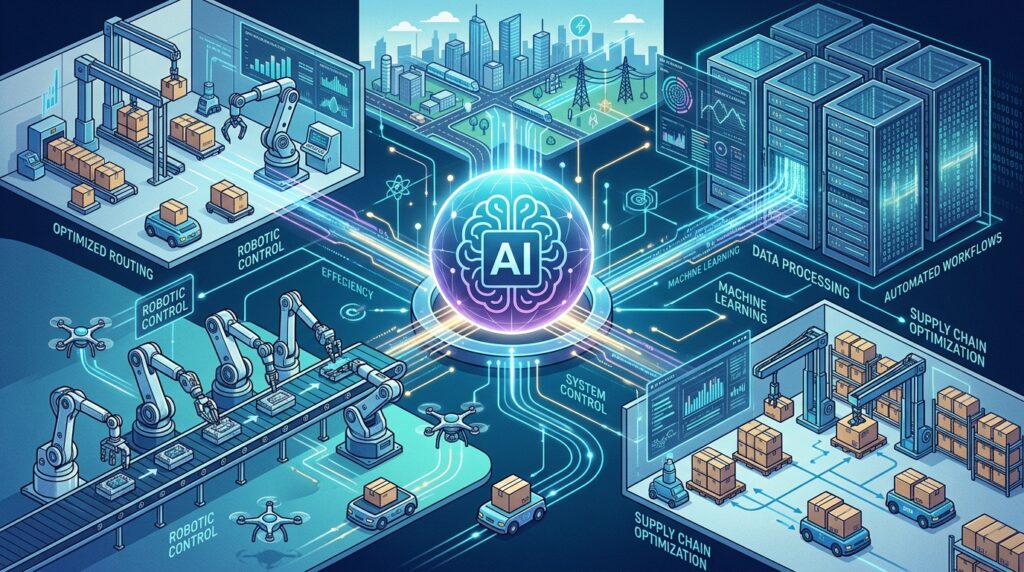
AI automation combines several advanced technologies that work together to perform intelligent tasks.
Machine learning enables systems to identify patterns and improve accuracy over time. Natural language processing allows AI to understand written and spoken language. Computer vision helps AI recognize images, documents, videos, and objects. Robotic Process Automation (RPA) performs repetitive digital tasks by interacting with software applications in the same way a human would.
These technologies are integrated into workflows so that AI can automatically collect information, analyze data, make recommendations, complete tasks, and trigger additional actions without requiring constant human supervision.
For example, an AI automation system can receive a customer email, understand its content, categorize the request, create a support ticket, send an acknowledgment email, and notify the appropriate team—all within seconds.
Key Technologies Behind AI Automation
Several technologies work together to make AI automation possible.
| Technology | Purpose |
|---|---|
| Artificial Intelligence | Enables intelligent decision-making |
| Machine Learning | Learns from data and improves accuracy |
| Natural Language Processing (NLP) | Understands human language |
| Computer Vision | Analyzes images, documents, and videos |
| Robotic Process Automation (RPA) | Automates repetitive digital tasks |
| Predictive Analytics | Forecasts future outcomes |
| Optical Character Recognition (OCR) | Extracts text from scanned documents |
| Workflow Automation | Connects business processes automatically |
Each technology plays a unique role in helping organizations automate operations more effectively.
Difference Between AI Automation and Traditional Automation
Many people assume AI automation and traditional automation are the same, but they work differently.
| Traditional Automation | AI Automation |
|---|---|
| Follows predefined rules | Learns from data and adapts |
| Cannot make decisions | Makes intelligent recommendations |
| Handles repetitive tasks | Handles repetitive and complex tasks |
| Requires manual programming | Continuously improves with learning |
| Limited flexibility | Highly adaptable |
| Best for structured workflows | Works with structured and unstructured data |
Traditional automation remains useful for simple repetitive tasks, while AI automation is better suited for dynamic business environments where decisions and analysis are required.
Common Applications of AI Automation
AI automation is used across almost every industry and business function.
Customer service teams use AI chatbots to answer questions, resolve common issues, and provide support around the clock. Marketing teams automate email campaigns, social media scheduling, and customer segmentation. Finance departments automate invoice processing, expense tracking, and financial reporting.
Healthcare organizations automate appointment scheduling, medical documentation, and patient record management. Human resource departments use AI for resume screening, interview scheduling, employee onboarding, and workforce analytics.
Manufacturing companies automate quality inspections, predictive maintenance, inventory management, and production planning. Software development teams automate testing, deployment, documentation, and code reviews.
These applications demonstrate how AI automation improves productivity across diverse industries.
Types of AI Automation
AI automation can be applied in many different ways depending on business requirements.
Business Process Automation
Business process automation focuses on automating complete workflows such as purchase approvals, customer onboarding, document management, and internal approvals.
Customer Service Automation
AI-powered chatbots and virtual assistants provide instant responses to customer inquiries while reducing the workload for human support teams.
Marketing Automation
Marketing automation platforms personalize campaigns, manage email marketing, schedule social media posts, analyze customer behavior, and improve lead generation.
Finance Automation
AI automates accounting, invoicing, payment processing, fraud detection, budgeting, and financial forecasting.
HR Automation
Human resources departments automate recruitment, payroll, attendance tracking, employee engagement, and performance management.
IT Automation
IT teams automate infrastructure monitoring, software deployment, cybersecurity alerts, system maintenance, and technical support.
Each type of automation addresses different operational needs while improving efficiency.
Benefits of AI Automation
Organizations implementing AI automation experience numerous advantages.
- Faster task completion
- Reduced manual work
- Improved productivity
- Better accuracy
- Lower operational costs
- Fewer human errors
- Improved customer satisfaction
- Better resource utilization
- Faster decision-making
- Increased scalability
- Better workflow consistency
- More time for strategic work
These benefits enable businesses to improve performance while allowing employees to focus on higher-value activities.
Challenges of AI Automation
Although AI automation offers significant benefits, organizations should also understand its limitations.
Implementing AI automation often requires investment in software, employee training, and workflow redesign. AI systems also depend on high-quality data, and inaccurate information can reduce performance.
Privacy, cybersecurity, ethical AI usage, and regulatory compliance are additional considerations that businesses must address when deploying AI-powered systems.
Human oversight remains essential for reviewing important decisions and managing exceptional situations that require professional judgment.
Industries Using AI Automation
AI automation has become an essential technology across numerous industries.
| Industry | AI Automation Applications |
|---|---|
| Healthcare | Patient records, appointments, billing |
| Banking | Fraud detection, loan processing |
| Retail | Inventory management, recommendations |
| Manufacturing | Predictive maintenance, quality inspection |
| Education | Student support, grading assistance |
| Human Resources | Recruitment, onboarding |
| Marketing | Campaign automation, analytics |
| Finance | Accounting, reporting |
| Legal | Document review, contract analysis |
| Customer Support | Chatbots and virtual assistants |
The widespread adoption of AI automation demonstrates its versatility across different sectors.
Popular AI Automation Tools
Many software platforms help businesses automate workflows using artificial intelligence.
| AI Tool | Primary Purpose |
|---|---|
| Zapier AI | Workflow automation |
| Make | Business process automation |
| Microsoft Power Automate | Enterprise automation |
| UiPath | Robotic Process Automation |
| Automation Anywhere | Enterprise workflow automation |
| Workato | Business integration |
| Notion AI | Documentation automation |
| ClickUp AI | Project management |
| HubSpot AI | Marketing and CRM automation |
| Salesforce Einstein | Sales and customer intelligence |
| ChatGPT | Content generation and business assistance |
| Claude | Document summarization |
| Fireflies.ai | Meeting automation |
Choosing the right platform depends on business size, workflow complexity, integration requirements, and budget.
Best Practices for Implementing AI Automation
Organizations can improve implementation success by following several best practices.
- Start by identifying repetitive tasks suitable for automation.
- Choose AI tools that integrate with existing software.
- Train employees to use AI effectively.
- Monitor automation performance regularly.
- Protect sensitive business data.
- Review AI-generated results before making important decisions.
- Continuously optimize workflows as business needs evolve.
These practices help organizations maximize the benefits of AI automation while minimizing operational risks.
The Future of AI Automation
AI automation is expected to become increasingly intelligent over the coming years. Future systems will likely provide better predictive analytics, autonomous workflows, multilingual communication, advanced document understanding, and deeper integration across business applications.
Organizations that adopt AI automation responsibly will be better prepared to improve efficiency, reduce costs, increase innovation, and remain competitive in an increasingly digital business environment.
Conclusion
AI Automation combines artificial intelligence with workflow automation to perform tasks more intelligently than traditional automation systems. Instead of simply following fixed rules, AI automation can learn from data, understand language, analyze information, and make informed recommendations.
As businesses continue embracing digital transformation, Intelligent Automation is becoming a key driver of productivity, operational efficiency, and customer satisfaction. Organizations that implement AI automation thoughtfully can streamline repetitive work, improve decision-making, and create more agile, efficient, and scalable operations while allowing employees to focus on creativity, strategy, and innovation.