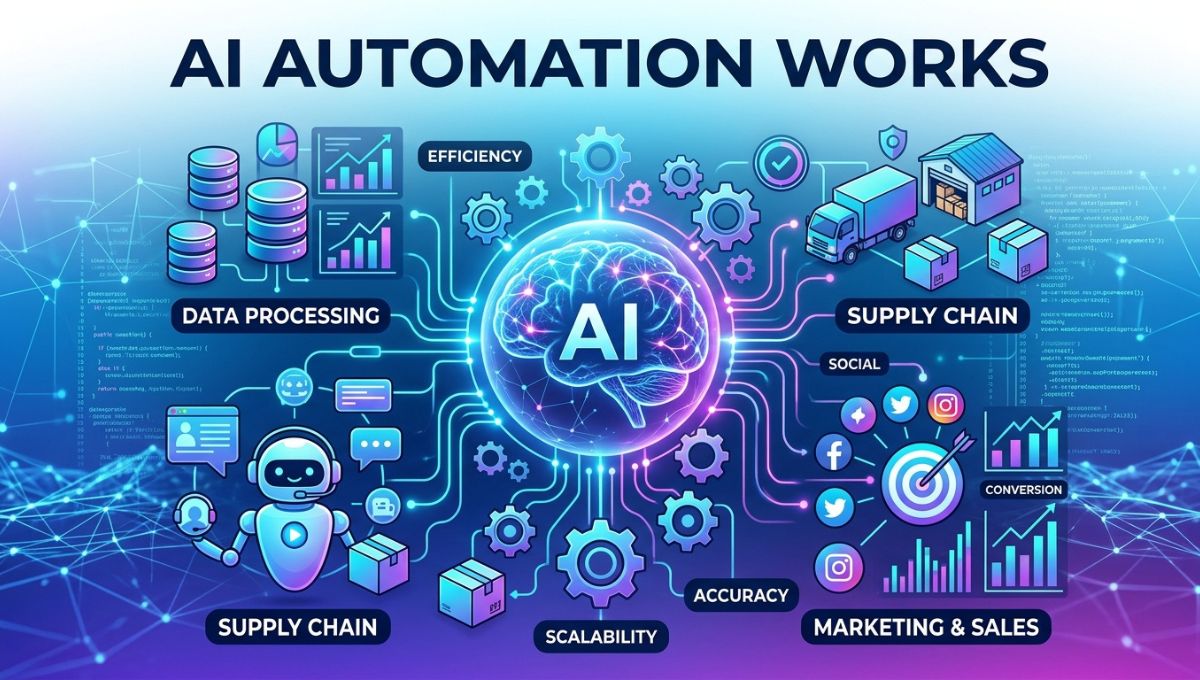
Artificial Intelligence (AI) has become one of the most influential technologies in the modern business world. Organizations of all sizes are using AI to automate repetitive tasks, improve decision-making, increase operational efficiency, and reduce manual workloads. From customer service and marketing to finance, human resources, manufacturing, and software development, AI-powered automation is helping businesses streamline operations while allowing employees to focus on more strategic and creative work.
Today, AI Automation Tools are used across almost every industry. These intelligent platforms can automate emails, generate reports, process documents, manage customer interactions, schedule meetings, analyze business data, monitor workflows, create content, and even assist with complex business processes. Instead of replacing human workers, AI automation complements their skills by handling repetitive and time-consuming tasks.
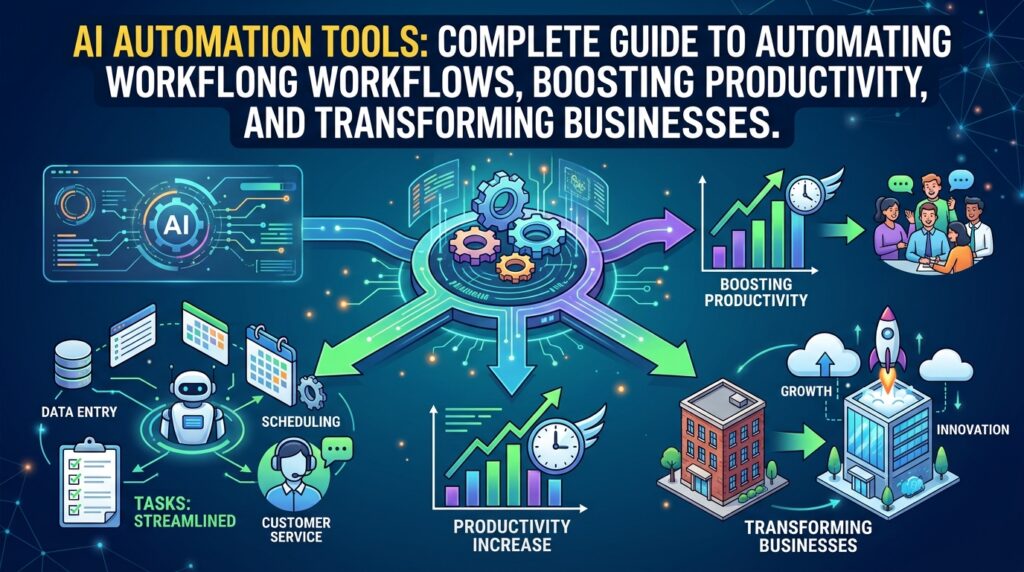
Businesses, freelancers, startups, educational institutions, healthcare organizations, financial companies, government agencies, and large enterprises are increasingly investing in AI automation technologies to improve productivity, reduce operational costs, and deliver better customer experiences. As AI continues to evolve, automation has become an essential strategy for organizations seeking to remain competitive in a rapidly changing digital landscape.
What Are AI Automation Tools?

AI Automation Tools are software platforms that combine artificial intelligence, machine learning, natural language processing (NLP), robotic process automation (RPA), and workflow automation technologies to perform tasks with minimal human intervention.
Unlike traditional automation systems that follow fixed rules, AI-powered automation tools can understand natural language, analyze data, recognize patterns, make intelligent recommendations, and continuously improve through learning algorithms. These capabilities enable organizations to automate both simple and complex business processes more effectively.
For example, an AI automation platform can automatically categorize emails, extract information from invoices, schedule appointments, generate reports, answer customer questions, analyze sales trends, and trigger follow-up actions without requiring constant manual input.
These tools are widely used in industries such as healthcare, banking, retail, education, logistics, manufacturing, legal services, marketing, customer support, software development, and human resources.
Why AI Automation Is Becoming Essential

Modern businesses generate enormous amounts of information every day. Employees often spend hours completing repetitive administrative tasks such as entering data, organizing files, responding to emails, creating reports, updating spreadsheets, processing invoices, and managing customer requests. While these tasks are necessary, they consume valuable time that could otherwise be used for strategic work.
AI automation solves this challenge by handling repetitive activities quickly and consistently. Instead of manually processing hundreds of documents or responding to common customer questions, organizations can automate these tasks using AI-powered systems.
Automation also reduces the risk of human error, improves response times, increases operational consistency, and allows teams to focus on innovation, creativity, customer relationships, and business growth.
As digital transformation accelerates across industries, AI automation is becoming a key component of modern business strategy.
How AI Automation Works
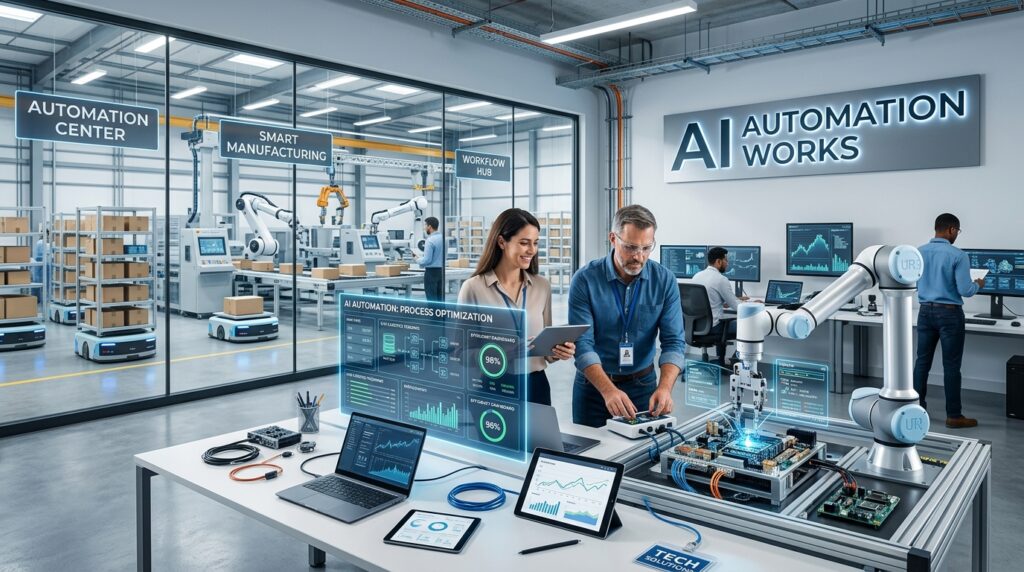
AI automation combines several advanced technologies that work together to automate workflows intelligently.
Machine learning enables systems to recognize patterns and improve performance over time. Natural language processing allows AI to understand written and spoken language. Computer vision helps AI analyze images, documents, and videos. Robotic Process Automation (RPA) automates repetitive digital tasks such as copying information between applications, filling forms, or generating reports.
When these technologies are integrated into business workflows, organizations can automate end-to-end processes with minimal human involvement while maintaining accuracy and efficiency.
Key Components of AI Automation
Most AI automation platforms include multiple technologies working together.
| Technology | Primary Function |
|---|---|
| Artificial Intelligence | Intelligent decision-making |
| Machine Learning | Pattern recognition and prediction |
| Natural Language Processing | Language understanding |
| Robotic Process Automation (RPA) | Rule-based task automation |
| Computer Vision | Image and document recognition |
| Workflow Automation | Business process management |
| Predictive Analytics | Forecasting future outcomes |
| Intelligent Document Processing | Extracting information from documents |
Each component plays an important role in creating efficient and scalable automation systems.
Types of AI Automation Tools
Different AI automation platforms focus on different business functions. Organizations often combine multiple tools to automate complete workflows.
| AI Automation Category | Primary Purpose |
|---|---|
| Workflow Automation | Automate business processes |
| Email Automation | Manage email communication |
| Marketing Automation | Campaign management and lead nurturing |
| Customer Support Automation | Chatbots and virtual assistants |
| Sales Automation | CRM updates and lead management |
| HR Automation | Recruitment and employee management |
| Finance Automation | Accounting, invoicing, and reporting |
| Document Automation | Document generation and processing |
| IT Automation | System monitoring and maintenance |
| Data Automation | Data collection, analysis, and reporting |
Selecting the right category depends on an organization’s operational requirements and business goals.
AI Workflow Automation
Workflow automation connects different business applications and automates routine processes across departments. Instead of manually transferring information between systems, AI automation platforms perform these actions automatically.
For example, when a customer submits an online form, the automation system can create a CRM record, notify the sales team, schedule a follow-up email, generate a task for the support department, and update project management software—all without manual intervention.
This level of automation improves operational efficiency while reducing delays and repetitive administrative work.
AI for Customer Support
Customer service is one of the most common applications of AI automation. AI-powered chatbots and virtual assistants provide instant responses to customer inquiries, answer frequently asked questions, assist with order tracking, schedule appointments, and guide users through troubleshooting processes.
When complex issues arise, AI can automatically transfer conversations to human agents while providing the conversation history to reduce response times.
This improves customer satisfaction while enabling support teams to focus on higher-priority cases.
AI Email Automation
Managing business emails manually can consume significant time. AI email automation tools classify incoming messages, prioritize important communications, generate suggested responses, schedule follow-ups, and organize inboxes automatically.
Sales teams, customer support departments, consultants, and freelancers use email automation to improve communication while reducing repetitive administrative tasks.
AI also helps personalize email campaigns based on customer behavior and engagement.
AI Marketing Automation
Marketing departments use AI automation to manage campaigns across multiple channels. AI platforms can schedule social media posts, personalize email marketing, optimize advertisements, generate content ideas, analyze campaign performance, and recommend improvements.
Automation also supports customer segmentation, lead scoring, audience targeting, and personalized marketing strategies that improve conversion rates.
These capabilities allow marketing teams to manage larger campaigns more efficiently while delivering more relevant customer experiences.
AI Sales Automation
Sales professionals use AI automation to organize customer information, prioritize leads, schedule follow-ups, update CRM systems, generate sales reports, and predict customer purchasing behavior.
AI also identifies high-value prospects based on historical data, helping sales teams focus their efforts on the most promising opportunities.
This improves productivity while supporting more effective sales strategies.
AI Document Automation
Organizations process thousands of documents every month, including invoices, contracts, purchase orders, tax forms, applications, and compliance reports.
AI-powered document automation extracts information, classifies documents, validates data, identifies errors, and routes documents through approval workflows automatically.
This reduces manual data entry while improving accuracy and compliance.
AI Automation for Human Resources
Human resource departments use AI to automate resume screening, interview scheduling, employee onboarding, attendance management, payroll processing, performance tracking, and internal communication.
AI also assists with employee engagement surveys, learning recommendations, and workforce analytics.
These tools allow HR professionals to focus on talent development and organizational culture rather than repetitive administrative work.
AI Automation in Finance
Finance teams benefit from AI-powered accounting, invoice processing, expense management, reconciliation, financial reporting, fraud detection, and budgeting.
Automation reduces manual bookkeeping while improving accuracy and accelerating financial operations.
Organizations also use AI to forecast cash flow, monitor spending patterns, and generate real-time financial insights.
AI Automation in Healthcare
Healthcare organizations use AI automation to schedule appointments, manage patient records, process insurance claims, assist with medical documentation, monitor patient data, and improve administrative efficiency.
Automating routine healthcare operations allows medical professionals to dedicate more time to patient care.
AI Automation in Software Development
Development teams use AI to automate testing, code review, deployment pipelines, bug tracking, documentation, and infrastructure monitoring.
These automation capabilities accelerate software delivery while improving code quality and reducing operational risks.
AI Automation in Manufacturing
Manufacturing companies use AI automation for quality inspection, predictive maintenance, production scheduling, inventory management, robotics, and supply chain optimization.
These systems improve operational efficiency while reducing downtime and production costs.
Popular AI Automation Tools
Numerous AI-powered platforms help businesses automate different aspects of their operations.
| AI Platform | Primary Use |
|---|---|
| Zapier AI | Workflow automation between applications |
| Make (formerly Integromat) | Business workflow automation |
| Microsoft Power Automate | Enterprise workflow automation |
| UiPath | Robotic Process Automation (RPA) |
| Automation Anywhere | Enterprise automation |
| Workato | Business integration and automation |
| Notion AI | Documentation and workflow management |
| ClickUp AI | Project management automation |
| Monday AI | Team collaboration and workflow automation |
| HubSpot AI | Marketing, CRM, and sales automation |
| Salesforce Einstein | CRM intelligence and automation |
| Google Workspace AI | Productivity automation |
| Microsoft Copilot | Office productivity automation |
| ChatGPT | Content generation and business assistance |
| Claude | Document processing and writing |
| Fireflies.ai | Meeting transcription and summaries |
Organizations typically evaluate these platforms based on integration capabilities, security, scalability, ease of use, and pricing.
Benefits of AI Automation Tools
AI automation offers numerous advantages across industries:
- Reduced manual work
- Faster business operations
- Improved employee productivity
- Better workflow efficiency
- Reduced operational costs
- Fewer human errors
- Improved customer experience
- Faster decision-making
- Enhanced collaboration
- Better resource utilization
- Scalable business processes
- Real-time reporting and analytics
- Increased business agility
These benefits enable organizations to improve performance while supporting long-term growth.
Challenges and Limitations
Although AI automation offers significant advantages, it also presents challenges. Initial implementation may require investment in software, employee training, and workflow redesign. AI systems also depend on high-quality data, and inaccurate information can affect automation results.
Organizations should also consider cybersecurity, privacy regulations, ethical AI practices, and compliance requirements when implementing automation solutions.
Human oversight remains essential for reviewing important business decisions, handling exceptions, and ensuring responsible AI use.
Best Practices for Implementing AI Automation
Businesses can maximize the value of AI automation by following these best practices:
- Identify repetitive tasks suitable for automation.
- Start with small pilot projects before expanding automation.
- Choose AI tools that integrate with existing systems.
- Train employees to work effectively with AI technologies.
- Monitor automation performance regularly.
- Protect sensitive business data through secure platforms.
- Continuously improve workflows based on performance insights.
- Maintain human oversight for critical business decisions.
These practices help organizations implement AI automation successfully while minimizing operational risks.
Future of AI Automation
The future of AI automation is expected to include more intelligent decision-making, autonomous business workflows, predictive business operations, advanced conversational AI, multimodal automation, and deeper integration across enterprise software platforms.
As AI technologies continue to advance, automation systems will become more adaptive, collaborative, and capable of handling increasingly complex business processes. Organizations that invest in AI automation today will be better positioned to improve efficiency, reduce costs, and remain competitive in an evolving digital economy.
Conclusion
Artificial intelligence is redefining how organizations operate by automating repetitive tasks, improving workflow efficiency, and supporting better business decisions. AI Automation Tools enable businesses to streamline operations, reduce manual effort, and enhance productivity across departments ranging from customer support and finance to marketing, HR, and software development.
The growing adoption of Workflow Automation Software demonstrates that AI is becoming an essential component of digital transformation. By combining intelligent automation with skilled employees and effective business strategies, organizations can improve operational performance, deliver better customer experiences, and prepare for future growth in an increasingly technology-driven world.