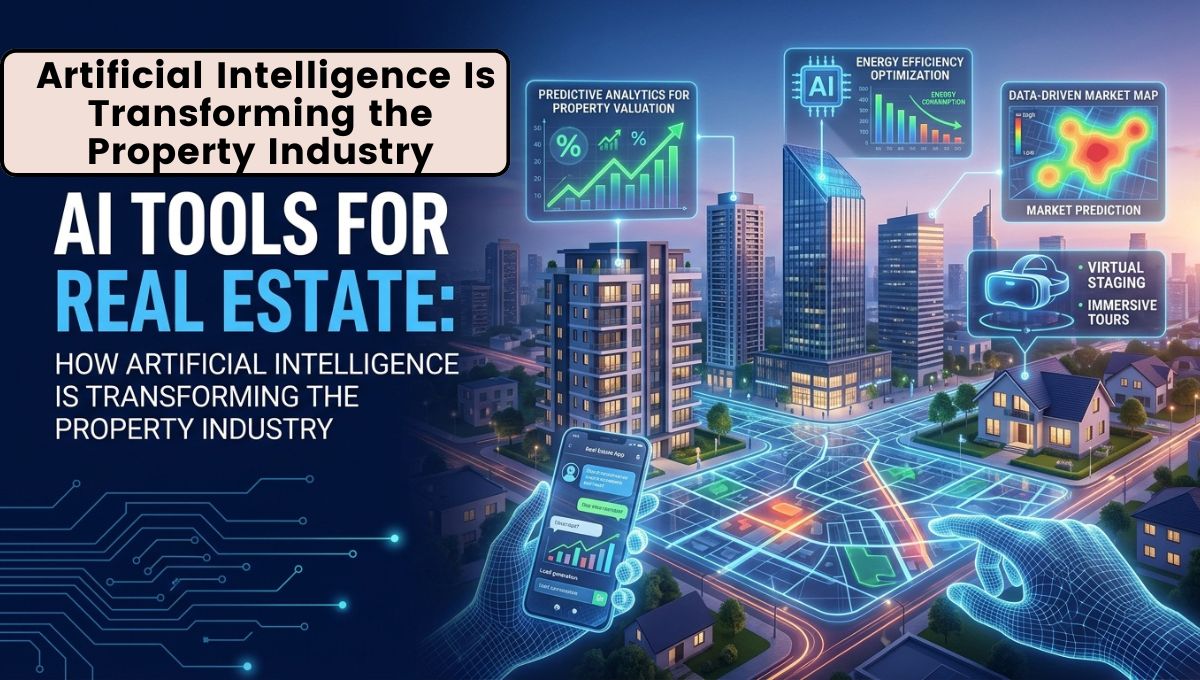
The real estate industry has experienced significant technological advancements over the past decade, and artificial intelligence has emerged as one of the most influential innovations. From property valuation and lead generation to customer engagement and market analysis, AI is changing how real estate professionals operate. Agents, brokers, developers, investors, and property managers are increasingly adopting AI-powered solutions to improve efficiency, enhance decision-making, and provide better experiences for clients.
The growing demand for AI Tools for Real Estate reflects the industry’s need for smarter and faster processes. Real estate professionals often handle large volumes of property data, customer inquiries, market research, and marketing activities. Artificial intelligence helps automate many of these tasks while providing valuable insights that support business growth.
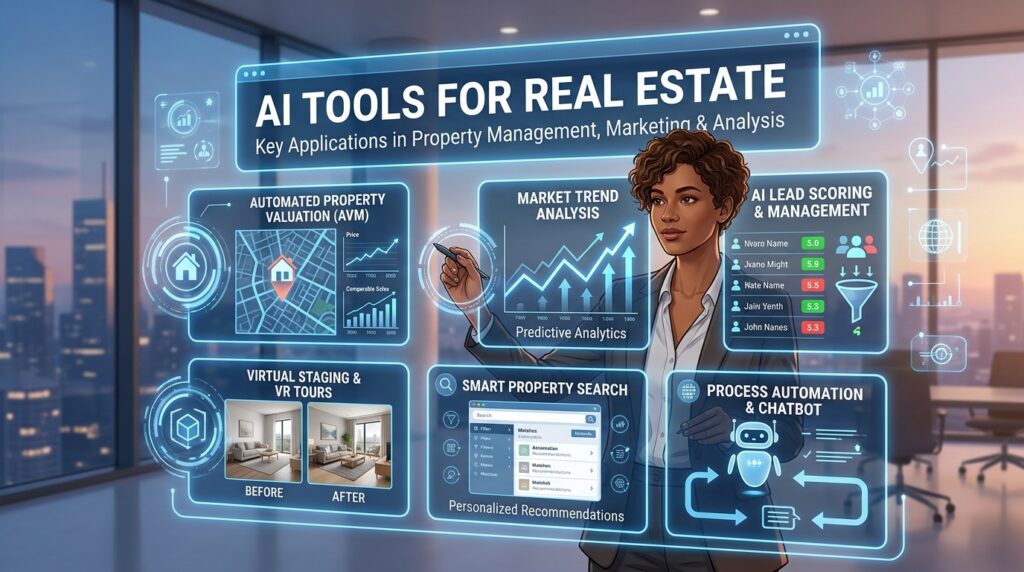
As competition in the property market continues to increase, AI-powered platforms are becoming essential tools for organizations seeking to improve productivity, identify opportunities, and deliver more personalized services. Whether the goal is finding qualified leads, predicting market trends, managing properties, or creating marketing campaigns, AI technology is transforming every aspect of the real estate sector.
Understanding the Role of AI in Real Estate

Artificial intelligence refers to computer systems that can perform tasks requiring human-like intelligence, such as analyzing data, recognizing patterns, making predictions, and automating processes. In real estate, AI helps professionals process large amounts of information quickly and make informed decisions based on data.
Modern AI systems can assist with:
- Property valuation
- Market analysis
- Lead generation
- Customer support
- Virtual property tours
- Predictive analytics
- Marketing automation
- Property management
- Investment research
These capabilities allow real estate businesses to streamline operations while improving service quality.
Why Real Estate Professionals Are Adopting AI
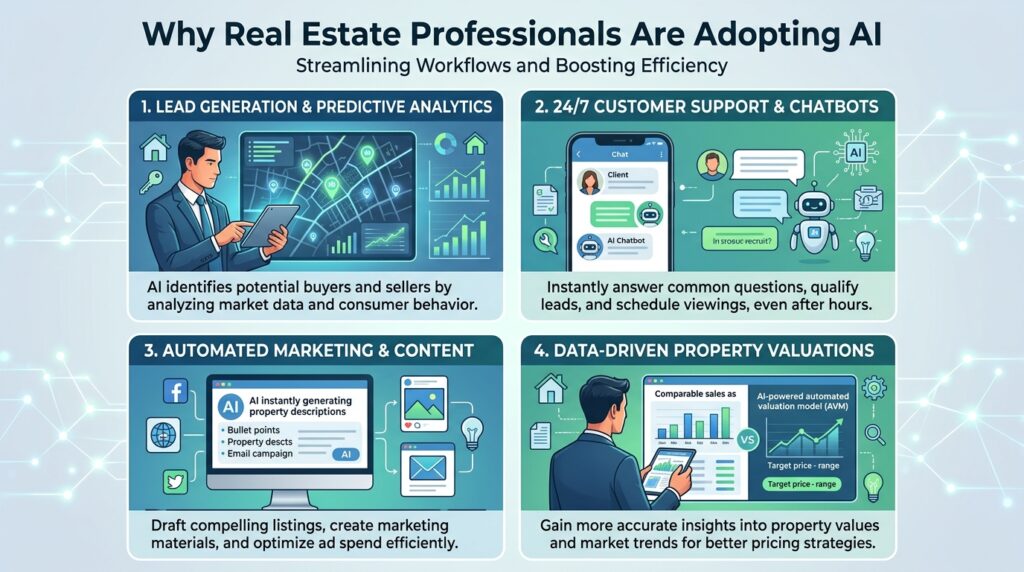
The real estate industry generates vast amounts of data, including property listings, market trends, pricing information, customer preferences, and investment opportunities. Analyzing this information manually can be time-consuming and inefficient.
AI tools help solve these challenges by automating data analysis and providing actionable insights. They can identify patterns that may not be immediately visible to humans and support faster decision-making.
Some common reasons for AI adoption include:
- Faster property research
- Improved customer engagement
- Better lead qualification
- More accurate property valuations
- Enhanced marketing effectiveness
- Increased operational efficiency
These advantages are encouraging more real estate businesses to integrate AI into their daily workflows.
Benefits of Using AI Tools for Real Estate
Artificial intelligence offers several practical benefits that can help professionals improve performance and remain competitive.
Some major advantages include:
| Benefit | Description |
|---|---|
| Improved Efficiency | Automates repetitive administrative tasks |
| Better Decision-Making | Provides data-driven insights |
| Enhanced Customer Service | Delivers faster responses to inquiries |
| Accurate Valuations | Supports property pricing decisions |
| Lead Generation | Identifies and prioritizes potential clients |
| Market Intelligence | Analyzes trends and opportunities |
These benefits help organizations improve productivity while delivering better experiences to buyers, sellers, investors, and tenants.
ChatGPT
ChatGPT has become a versatile AI assistant for real estate professionals. It can help create property descriptions, marketing content, client communications, email campaigns, and social media posts.
Real estate agents often use ChatGPT to:
- Write property listings
- Create marketing materials
- Generate social media captions
- Draft client emails
- Produce market update content
- Develop advertising copy
Its flexibility makes it useful for both independent agents and larger real estate firms seeking to streamline content creation.
Zillow’s AI-Powered Tools
Zillow uses artificial intelligence in various aspects of property search and valuation. The platform’s property estimate system analyzes large datasets to provide estimated property values based on market conditions and property characteristics.
AI-driven features help buyers and sellers gain insights into pricing trends, neighborhood information, and market activity. These capabilities support informed decision-making throughout the property transaction process.
The platform remains one of the most recognized examples of AI integration within the residential real estate sector.
HouseCanary
HouseCanary specializes in real estate analytics and valuation technology. The platform uses AI and machine learning to analyze property data, forecast market trends, and estimate property values.
Investors, lenders, and real estate professionals use HouseCanary to evaluate opportunities and understand market conditions more effectively. Its predictive analytics capabilities help users assess future property performance.
The platform focuses heavily on data-driven real estate decision-making.
Reonomy
Reonomy provides AI-powered commercial real estate intelligence. The platform helps users access property ownership information, market insights, and investment opportunities.
By analyzing large property databases, Reonomy enables professionals to identify potential leads and uncover valuable market opportunities. Its data-driven approach supports commercial real estate transactions and investment research.
The platform is particularly useful for brokers, investors, and developers.
Compass AI
Compass incorporates AI-powered tools to support agents with pricing recommendations, market analysis, and customer relationship management.
The platform helps agents organize client interactions, analyze market trends, and identify opportunities more efficiently. AI-generated insights support better decision-making while reducing administrative workloads.
Compass continues to expand its technology-focused approach to real estate services.
Skyline AI
Skyline AI focuses on commercial real estate investment analysis. The platform uses artificial intelligence to evaluate market data, identify investment opportunities, and predict asset performance.
Investors can leverage AI-driven insights to make more informed decisions regarding acquisitions and portfolio management. The platform’s analytical capabilities help reduce uncertainty in investment evaluations.
Its focus on predictive analytics makes it valuable for institutional investors and real estate professionals.
Localize
Localize provides AI-powered neighborhood insights and property recommendations. The platform analyzes various data points to help users identify locations that match their preferences and requirements.
Homebuyers can receive recommendations based on factors such as commute times, neighborhood characteristics, and lifestyle preferences. This personalized approach enhances the property search experience.
Localize demonstrates how AI can improve customer engagement within the residential real estate market.
Rex
REX Real Estate has utilized AI technologies to improve property marketing and customer acquisition processes. The platform focuses on data-driven marketing strategies that help connect buyers and sellers more effectively.
AI algorithms assist with audience targeting, property promotion, and lead generation. These capabilities help improve marketing efficiency while reducing costs associated with traditional advertising approaches.
The platform highlights the growing role of AI in real estate marketing.
Matterport
Matterport is widely known for creating immersive virtual property tours. Its technology enables users to generate digital representations of properties that can be explored remotely.
AI-powered features assist with property scanning, space measurement, and virtual tour creation. These capabilities allow potential buyers to view properties from anywhere, improving convenience and accessibility.
Matterport has become a valuable tool for real estate marketing and property showcasing.
Important Features to Look for in AI Real Estate Tools
Selecting the right AI platform depends on business goals, property focus, and operational requirements.
Some important features to consider include:
| Feature | Importance |
|---|---|
| Property Valuation | Supports pricing and investment decisions |
| Predictive Analytics | Helps forecast market trends |
| Lead Generation | Identifies potential clients |
| Marketing Automation | Streamlines promotional activities |
| Customer Relationship Management | Improves client interactions |
| Market Intelligence | Provides actionable market insights |
| Virtual Tour Capabilities | Enhances property presentation |
These features can significantly impact the effectiveness of AI adoption in real estate operations.
Best Practices for Using AI in Real Estate
Although AI offers substantial benefits, successful implementation requires thoughtful planning and oversight. Real estate professionals should use AI as a support tool rather than relying entirely on automation.
Recommended practices include:
- Verify AI-generated information before sharing it with clients.
- Combine AI insights with local market expertise.
- Maintain personal relationships with customers.
- Regularly review data quality and accuracy.
- Monitor AI-driven marketing performance.
- Use AI to enhance, not replace, human decision-making.
These approaches help organizations maximize the value of AI while maintaining professional standards.
Challenges of AI Adoption in Real Estate
Despite its growing popularity, AI implementation in real estate presents certain challenges.
Common concerns include:
- Data privacy and security.
- Dependence on data quality.
- Technology adoption costs.
- Integration with existing systems.
- Regulatory considerations.
- Need for employee training.
Organizations should address these challenges through proper planning, governance, and ongoing evaluation.
The Future of AI in Real Estate
Artificial intelligence is expected to become even more integrated into the property industry. Future developments may include advanced property valuation models, personalized property recommendations, automated transaction management, and deeper predictive analytics capabilities.
AI systems are also likely to improve their ability to analyze economic conditions, buyer preferences, and market behavior. These advancements could help professionals identify opportunities more quickly while improving customer experiences.
As technology continues to evolve, AI may become a standard component of nearly every real estate workflow.
AI Tools and Their Primary Real Estate Applications
| AI Tool | Primary Use |
|---|---|
| ChatGPT | Content creation and client communication |
| Zillow AI Features | Property valuation and market insights |
| HouseCanary | Property analytics and forecasting |
| Reonomy | Commercial real estate intelligence |
| Compass AI | Agent productivity and market analysis |
| Skyline AI | Investment opportunity analysis |
| Localize | Personalized property recommendations |
| Matterport | Virtual property tours |
| REX | AI-driven marketing and lead generation |
This overview highlights how different AI platforms serve specific functions within the real estate ecosystem.
Conclusion
The rapid growth of AI Tools for Real Estate is transforming how professionals manage property transactions, marketing, customer engagement, investment analysis, and market research. By automating routine tasks and providing valuable insights, artificial intelligence is helping organizations improve efficiency and make more informed decisions.
Platforms such as ChatGPT, Zillow, HouseCanary, Reonomy, Compass, Skyline AI, Localize, Matterport, and REX demonstrate the diverse ways AI can support real estate operations. Whether the objective is improving property valuations, generating leads, creating marketing content, or analyzing investment opportunities, these tools provide practical solutions for modern real estate professionals.
As artificial intelligence continues to evolve, its influence on the real estate industry is expected to grow further. Organizations that effectively adopt AI technologies may gain advantages in productivity, customer service, and strategic decision-making, positioning themselves for success in an increasingly competitive market.