Artificial Intelligence has become one of the most important technologies shaping modern businesses. From startups and freelancers to multinational corporations, companies across every industry are now using AI-powered tools to automate work, increase productivity, reduce operational costs, improve customer experiences, and accelerate business growth. What was once considered futuristic technology is now a daily business necessity.
The AI industry has expanded rapidly over the last few years. Businesses can now access AI-powered chatbots, content generators, image creators, coding assistants, SEO platforms, voice tools, video generators, customer service systems, and workflow automation software. Because of this rapid growth, companies are increasingly asking one major question: should businesses rely on free AI tools or invest in paid AI platforms?
This debate has become even more important in 2026 because AI software is now deeply integrated into digital marketing, content creation, software development, sales operations, customer support, and business management workflows. Free AI tools have improved dramatically and now offer impressive capabilities that were previously available only in expensive enterprise software. At the same time, premium AI systems continue to offer advanced features, stronger automation, faster performance, larger usage limits, and business-focused integrations.
For businesses, choosing between free and paid AI tools is not simply about saving money. The decision affects workflow efficiency, content quality, scalability, team collaboration, customer experience, and long-term business growth. Some businesses can operate successfully using mostly free AI systems, while others require advanced paid platforms to remain competitive in demanding markets.
Understanding the differences between free and paid AI software is now essential for business owners, agencies, marketers, creators, developers, and entrepreneurs trying to maximize productivity while managing operational costs effectively.
This detailed comparison explains the strengths, limitations, pricing models, business use cases, and long-term value of AI tools for business, helping organizations understand when free solutions are enough and when investing in premium AI platforms becomes necessary.
Why AI Tools Are Becoming Essential for Modern Businesses
Businesses today operate in highly competitive digital environments where speed, automation, efficiency, and scalability are becoming critical advantages. Companies are expected to create more content, provide faster customer support, analyze larger amounts of data, and manage increasingly complex online operations.
Traditional manual workflows often consume too much time and money. This is why AI-powered tools are now becoming central to modern business strategies.
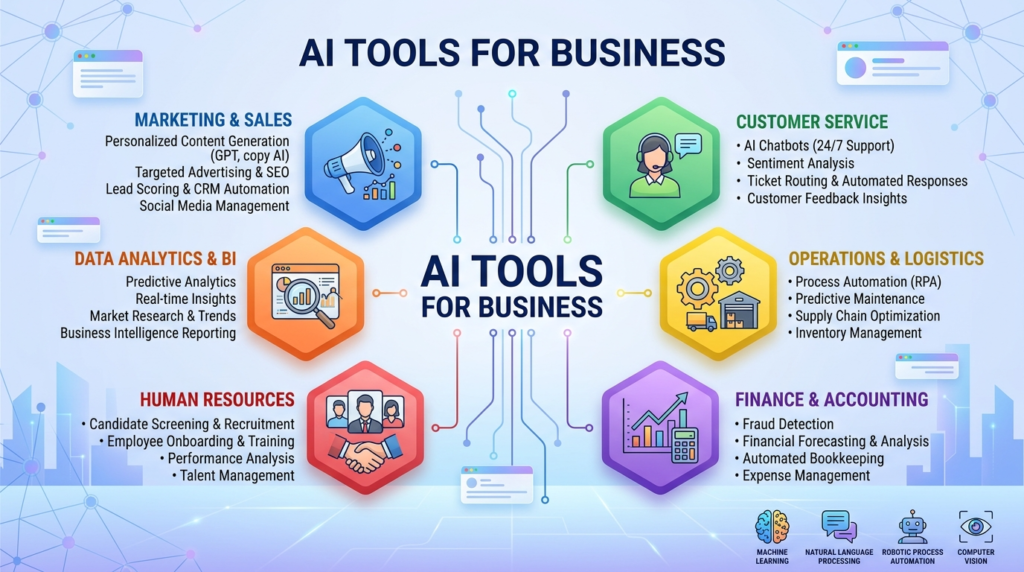
Businesses are currently using AI for:
- Blog writing and content generation
- Email marketing automation
- SEO optimization
- Customer service chatbots
- Video creation
- Graphic design
- Data analysis
- Coding assistance
- Sales automation
- Voice generation
- Translation and localization
- Research workflows
- Social media management
- Presentation creation
- Workflow automation
Recent industry studies suggest that businesses using AI effectively are improving productivity while reducing operational costs significantly. AI adoption is no longer limited to large technology companies. Small businesses, freelancers, agencies, e-commerce stores, educators, and creators are also integrating AI into daily workflows.
One major reason for rapid adoption is accessibility. Earlier, advanced software systems required expensive licenses and technical expertise. Today, businesses can access powerful AI platforms instantly through cloud-based tools with simple subscription models or even completely free plans.
As AI competition intensifies, software providers are increasingly offering both free and paid versions of their platforms to attract users. This has created a business environment where companies must carefully evaluate which tools genuinely provide value and which subscriptions may not be necessary.
Understanding Free AI Tools
Free AI tools are platforms that allow users to access AI-powered features without requiring paid subscriptions. Most major AI companies now offer free versions of their products because it helps them attract new users, expand market share, and encourage upgrades to premium plans later.
Popular free AI tools include:
- ChatGPT Free
- Claude Free
- Gemini Free
- Canva Free
- Perplexity Free
- Codeium
- CapCut AI tools
- Google AI systems
- Free AI image generators
- Free AI writing assistants
These platforms have improved dramatically in recent years. Earlier free AI systems often produced weak or inaccurate results. Modern free AI tools, however, are now capable of handling many serious business tasks effectively.
Businesses commonly use free AI tools for:
- Basic content writing
- Social media captions
- Research assistance
- Brainstorming ideas
- Simple design work
- Short-form copywriting
- Basic coding support
- Quick summaries
- Email drafting
- Small-scale automation
The accessibility of free AI tools has helped millions of businesses experiment with AI without financial risk.
Why Free AI Tools Became So Powerful
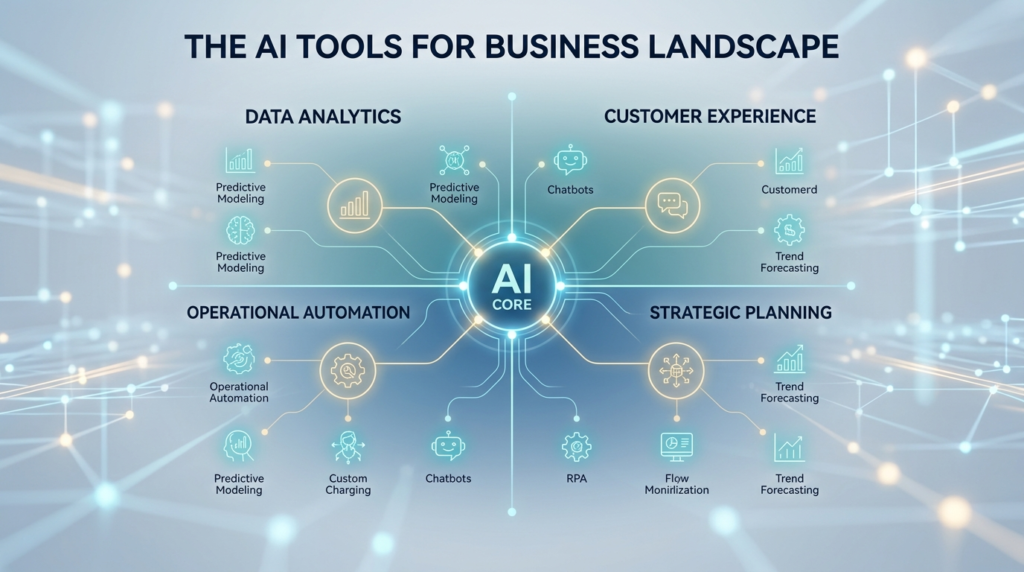
One major reason free AI tools have improved rapidly is intense competition among AI companies. OpenAI, Google, Anthropic, Microsoft, Meta, and many startups are competing aggressively for market dominance.
Because of this competition, companies are offering increasingly capable free plans to attract long-term users. Free AI systems in 2026 are often more powerful than premium software tools from only a few years ago.
This competition benefits businesses because they can now access advanced AI capabilities without immediate financial commitment.
For example:
- Free chatbots now support advanced reasoning
- Free image tools can generate professional visuals
- Free AI writing systems create long-form content
- Free coding assistants provide strong autocomplete
- Free SEO tools offer optimization insights
As a result, many businesses are questioning whether paid subscriptions are truly necessary for their workflows.
Advantages of Free AI Tools for Businesses
Free AI platforms offer several important benefits, especially for startups, freelancers, and small businesses operating on limited budgets.
Low Financial Risk
The biggest advantage of free AI tools is that businesses can experiment without spending money. Companies can test different workflows, evaluate output quality, and explore automation possibilities before committing to premium subscriptions.
This flexibility is particularly important for early-stage startups and independent creators who must manage expenses carefully.
Easy Accessibility
Most free AI tools require only a simple sign-up process. Businesses do not need enterprise contracts, technical onboarding, or complicated installations.
This accessibility has accelerated AI adoption across industries because companies can begin using AI almost instantly.
Useful for Everyday Tasks
Modern free AI tools are highly capable for many common business activities.
For example:
- A freelancer can generate client email drafts
- A blogger can brainstorm article ideas
- A small store can create Instagram captions
- A startup can research competitors
- A student entrepreneur can build presentations
For light daily workflows, free AI tools are often more than sufficient.
Strong Learning Opportunities
Free tools allow businesses and employees to learn AI workflows before investing heavily in advanced systems.
Many companies first experiment with free tools and later identify which premium features genuinely improve productivity.
This gradual adoption strategy helps businesses avoid unnecessary spending.
Reduced Software Costs
Small businesses often struggle with rising software subscription expenses. Free AI tools can significantly reduce operational costs by replacing or supporting expensive software categories.
For example:
- Free AI writers reduce copywriting costs
- Free design tools reduce graphic expenses
- Free coding assistants improve developer productivity
- Free chatbots automate customer support
This cost efficiency is especially valuable for smaller organizations.
Limitations of Free AI Tools
Although free AI platforms are powerful, they also come with limitations that businesses must understand carefully.
Usage Restrictions
Most free AI systems limit:
- Prompt usage
- Token counts
- Daily credits
- File uploads
- Video exports
- Image generation
- API access
Businesses using AI heavily may quickly hit these restrictions, interrupting workflows and reducing productivity.
For occasional users this may not matter, but for agencies and large-scale operations these limitations become major obstacles.
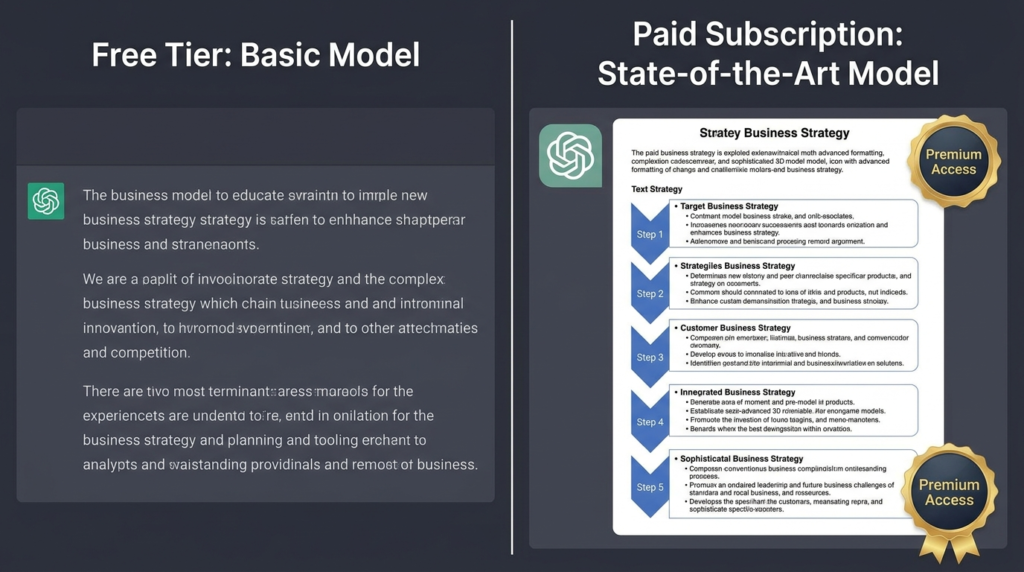
Lower AI Model Quality
Free AI plans often use smaller or less advanced models compared to premium subscriptions.
This can lead to:
- Generic responses
- Lower creativity
- Reduced reasoning accuracy
- Shorter context understanding
- Weaker long-form performance
The quality difference becomes more noticeable in professional business environments where precision and reliability matter.
Slower Performance
Free users are usually deprioritized during periods of heavy server demand.
This can result in:
- Slow response times
- Delayed image generation
- Queue systems
- Reduced availability
Businesses depending on AI for client work or time-sensitive operations may find these delays problematic.
Limited Commercial Rights
Some free AI tools place restrictions on commercial use.
Businesses using AI-generated:
- Images
- Videos
- Voiceovers
- Designs
- Templates
must carefully review licensing terms before using outputs for commercial projects.
Paid plans typically offer clearer commercial permissions.
Weak Collaboration Features
Free AI tools rarely support advanced team workflows such as:
- Shared workspaces
- Team permissions
- Centralized management
- Multi-user collaboration
- Workflow integration
As businesses scale, these missing features create operational inefficiencies.
Limited Security and Privacy
Enterprise businesses often require:
- Data encryption
- Compliance certifications
- Private environments
- Secure document handling
- Internal AI systems
Free AI tools may not provide sufficient security protections for sensitive business operations.
Understanding Paid AI Tools
Paid AI tools are subscription-based platforms designed for professional users, agencies, and enterprise teams requiring advanced features and higher performance.
Premium AI systems typically offer:
- Faster speeds
- Better AI models
- Higher usage limits
- Advanced automation
- API integrations
- Team collaboration
- Security compliance
- Commercial usage rights
- Priority customer support
Examples of paid AI tools include:
- ChatGPT Plus
- Claude Pro
- Midjourney
- Semrush
- Ahrefs
- Surfer SEO
- ElevenLabs
- Cursor Pro
- Runway
- GitHub Copilot
- Adobe Firefly premium
These tools are increasingly viewed as productivity investments rather than simple software subscriptions.
Why Businesses Upgrade to Paid AI Tools
Businesses usually move toward paid AI systems when free tools no longer support operational demands.
Common reasons for upgrading include:
- Scaling content production
- Managing client projects
- Improving automation
- Increasing reliability
- Supporting larger teams
- Accessing premium models
- Integrating APIs
- Handling enterprise workflows
For many companies, even small productivity improvements justify subscription costs because AI saves employee time.
For example:
- Faster content generation saves marketing hours
- Better coding assistance accelerates development
- AI automation reduces repetitive work
- Premium SEO tools improve rankings
These efficiency gains often outweigh monthly subscription fees.
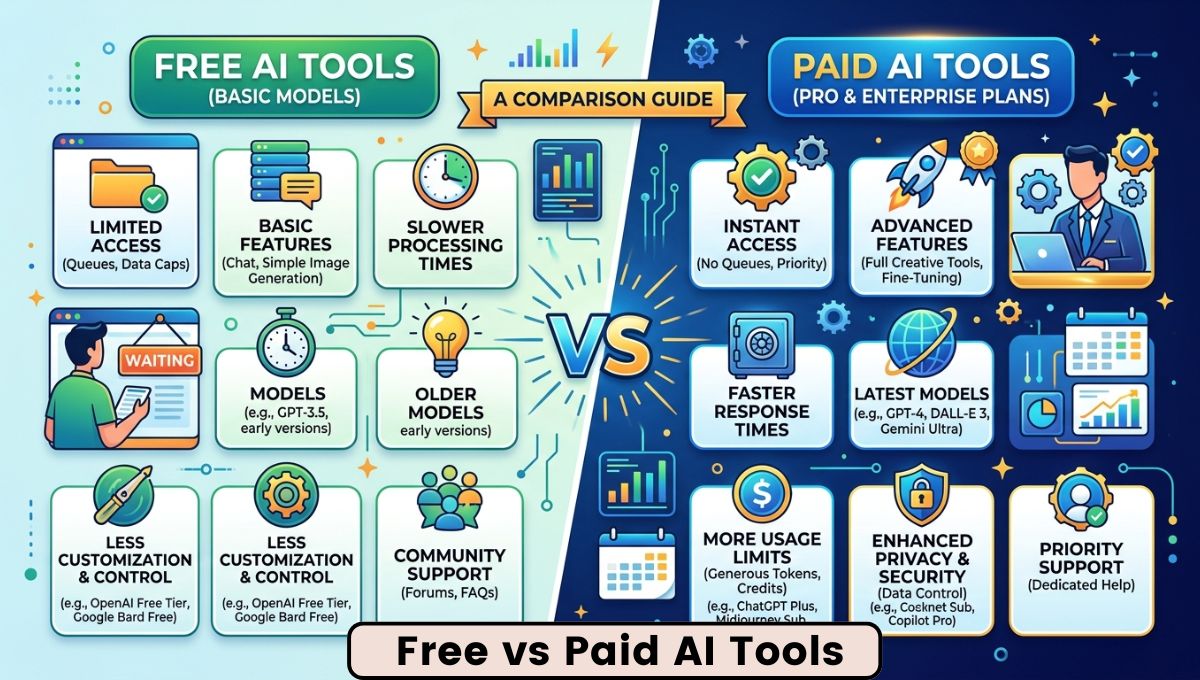
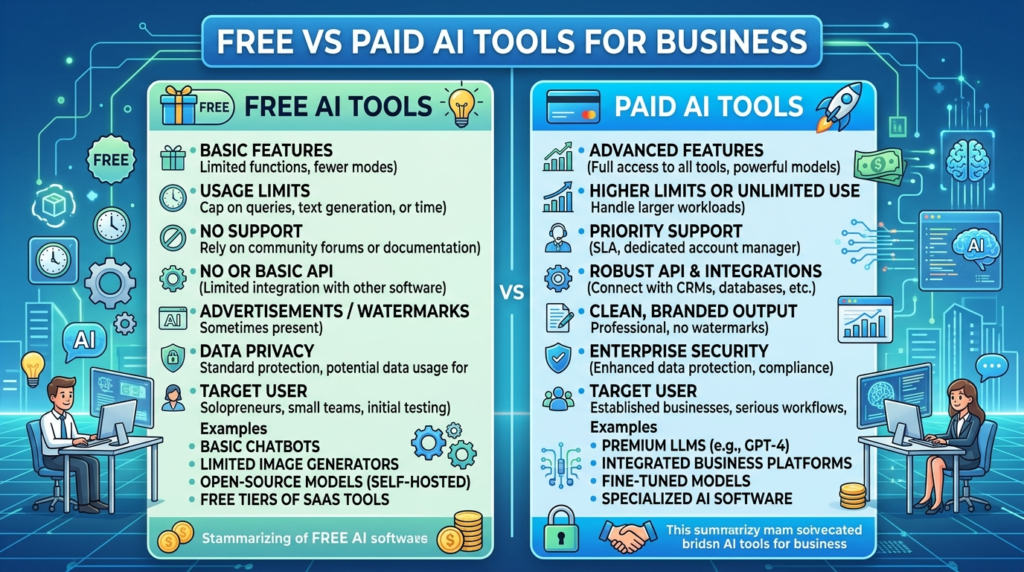
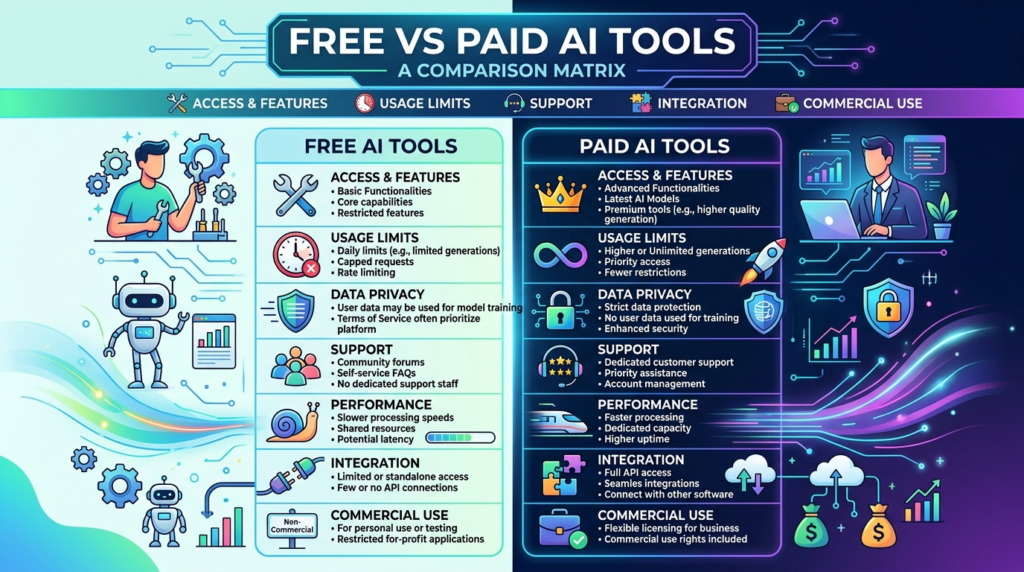
Free vs Paid AI Tools Comparison
| Feature | Free AI Tools | Paid AI Tools |
|---|---|---|
| Pricing | No cost | Monthly or yearly subscription |
| AI quality | Basic models | Advanced premium models |
| Speed | Slower during demand | Faster performance |
| Usage limits | Restricted | Higher or unlimited |
| Commercial rights | Sometimes limited | Usually included |
| Team collaboration | Rarely available | Advanced collaboration |
| Security | Basic | Enterprise-grade options |
| Automation | Limited | Advanced workflows |
| API access | Often unavailable | Commonly included |
| Support | Minimal | Priority customer service |
This comparison explains why businesses often begin with free tools but eventually upgrade as workflows become more complex.
Best Business Categories for Free AI Tools
Free AI tools work especially well in certain business categories.
Small Content Creation
Small businesses can use free AI systems for:
- Blog ideas
- Instagram captions
- Product descriptions
- Basic ad copy
- Social media planning
For low-volume content needs, free plans are often enough.
Research and Brainstorming
Free AI chatbots are excellent for:
- Idea generation
- Competitor research
- Quick summaries
- Learning topics
- Strategy discussions
These workflows usually do not require premium subscriptions.
Basic Graphic Design
Platforms like Canva Free allow businesses to create:
- Social media graphics
- Presentations
- Posters
- Flyers
- Basic marketing visuals
This is highly useful for small brands and startups.
Student and Educational Projects
Students and educators can use free AI tools for:
- Learning assistance
- Research
- Presentation building
- Writing support
- Educational planning
Free AI tools have become major educational resources.
Best Business Categories for Paid AI Tools
Some industries benefit much more from premium AI systems.
SEO and Digital Marketing
Professional SEO workflows often require premium platforms like:
- Semrush
- Ahrefs
- Surfer SEO
These tools provide advanced keyword research, technical audits, backlink tracking, and optimization capabilities unavailable in free systems.
Video Production
Paid AI video tools offer:
- Better quality exports
- Longer video durations
- Watermark-free outputs
- Advanced editing
Businesses producing professional video content usually require premium subscriptions.
Software Development
Professional developers benefit significantly from premium coding assistants because they provide:
- Better code reasoning
- Multi-file understanding
- Faster autocomplete
- Larger context windows
This improves engineering productivity substantially.
Enterprise Operations
Large organizations often require:
- Security compliance
- Workflow integration
- Team management
- Centralized administration
Paid enterprise AI systems are designed specifically for these requirements.
Hybrid AI Strategies Are Becoming Common
Interestingly, many businesses no longer rely entirely on either free or paid tools. Instead, they combine both systems strategically.
For example:
| Workflow | Free Tool | Paid Tool |
|---|---|---|
| Research | Perplexity Free | ChatGPT Plus |
| Graphics | Canva Free | Adobe Firefly |
| SEO | Google tools | Semrush |
| Coding | Codeium | Cursor Pro |
| Voice | Free TTS | ElevenLabs |
| Video | CapCut Free | Runway |
This hybrid strategy helps businesses reduce expenses while still accessing premium features where they matter most.
How Businesses Should Decide Between Free and Paid AI Tools
Businesses should evaluate several factors before choosing between free and premium AI systems.
Important considerations include:
- Daily usage volume
- Team size
- Revenue impact
- Workflow complexity
- Client expectations
- Security needs
- Scalability
- Automation requirements
A freelancer generating occasional content may not need paid tools, while an agency managing multiple clients likely requires advanced AI workflows.
The key question is whether premium AI subscriptions genuinely improve efficiency enough to justify costs.
The Future of AI Pricing and Business Software
The AI software industry is evolving rapidly, and pricing models are becoming more complex.
Companies are experimenting with:
- Usage-based pricing
- Ad-supported plans
- Enterprise subscriptions
- Hybrid payment models
- Credit systems
As competition increases, businesses may gain access to even stronger free AI capabilities in the future.
However, premium enterprise systems are also expected to become more advanced, offering deeper automation and specialized business workflows.
Conclusion
The debate between free and paid AI tools for business is becoming increasingly important as Artificial Intelligence continues transforming modern work environments. Both free and premium AI systems now provide significant value depending on business size, operational goals, and workflow complexity.
Free AI tools have improved dramatically and are now capable of handling many everyday business tasks such as content generation, brainstorming, research, basic design work, and small-scale automation. For startups, freelancers, students, and small businesses, free AI platforms often provide excellent value without financial risk.
However, paid AI tools become far more valuable when businesses begin scaling operations, managing teams, handling client work, automating workflows, or requiring higher reliability and advanced functionality. Premium platforms typically offer stronger AI models, faster performance, larger usage limits, better security, and more professional collaboration features.
For many organizations, the most effective approach is combining free and paid tools strategically. Businesses can use free AI systems for lighter tasks while investing in premium software for critical workflows that directly impact revenue and productivity.
As Artificial Intelligence continues evolving rapidly, companies that understand how to balance cost, automation, and operational efficiency will likely gain the strongest competitive advantage in the digital economy of the future.