
The way people create content has changed dramatically in recent years. Writing, which was once entirely dependent on manual effort, research, editing, and multiple rounds of revisions, has now entered a new era powered by artificial intelligence. In 2026, AI writing tools have become some of the most widely used digital platforms for individuals and businesses alike.
From students preparing assignments to bloggers publishing regular content, from marketing agencies creating large campaigns to companies managing communication workflows, artificial intelligence is helping people write faster, smarter, and more efficiently.
The growing popularity of these tools has created a highly competitive market. There are now dozens of platforms offering AI-powered writing assistance, each claiming to be the best solution for content creation. Some focus on long-form article generation. Others specialize in marketing copy, SEO writing, grammar correction, creative storytelling, or business automation.
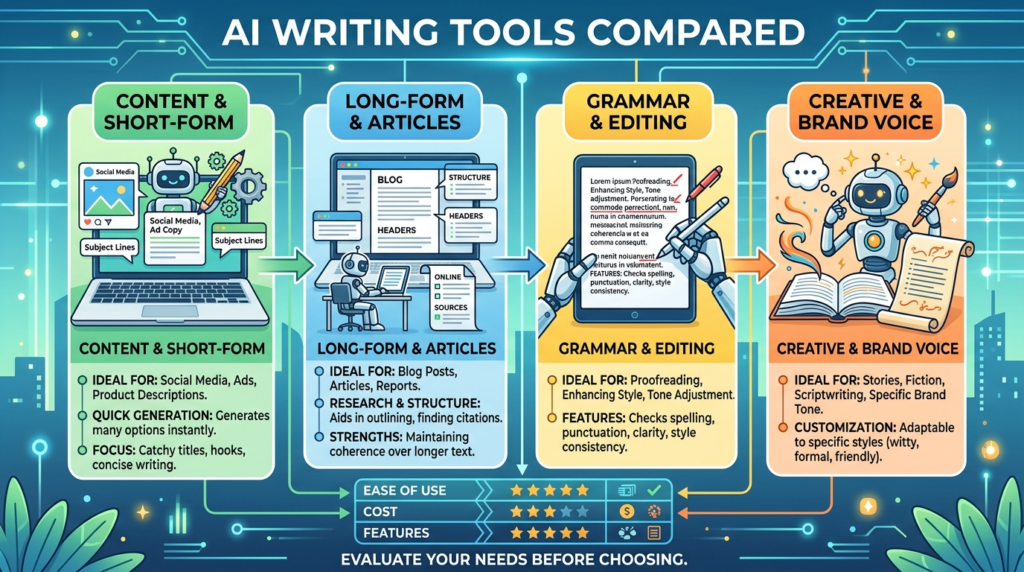
This has created an important question for users:
Which AI writing tool is actually worth using?
Choosing the right platform is no longer as simple as selecting the most popular name.
Different users have different needs.
A blogger writing weekly articles needs something different from a copywriter creating ad campaigns. A student working on assignments requires different features than a fiction writer creating stories.
That is why comparing the top AI writing tools is essential.
This detailed guide explains the strengths, weaknesses, features, pricing structures, use cases, and ideal audiences for the leading AI writing platforms available in 2026.
By understanding how each platform performs, users can make better decisions and choose the tool that fits their goals.
Why AI Writing Tools Have Become So Important
The internet runs on content. Every website, business, blog, online store, and digital platform depends on written communication.
Companies need product descriptions, landing pages, emails, ad copy, newsletters, customer responses, and SEO articles.
Creators need captions, scripts, blogs, and social posts. Students need summaries, explanations, and writing assistance. This constant demand has made writing one of the most time-consuming tasks in the digital world.
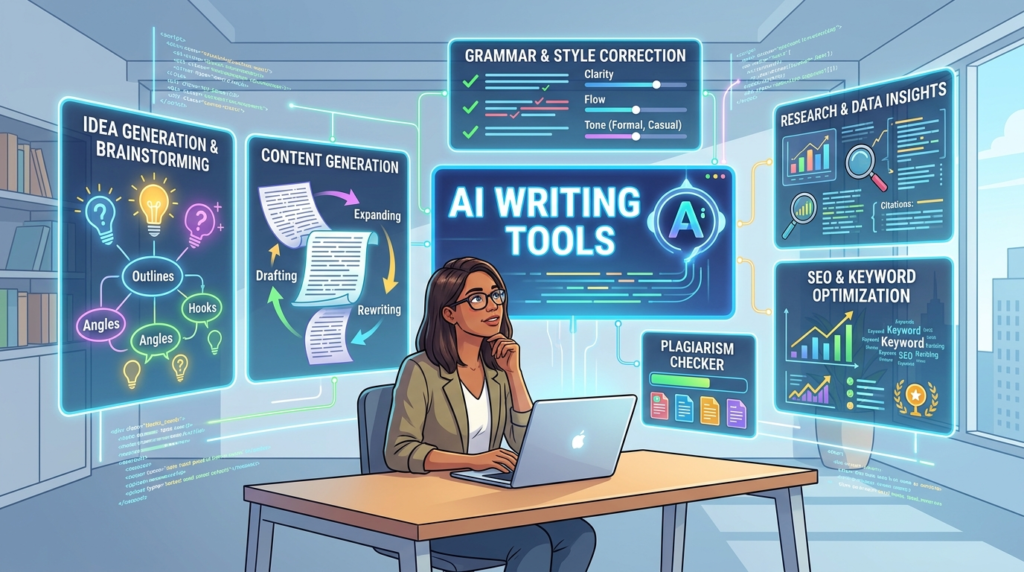
AI writing tools solve this problem by reducing the effort needed to create high-quality text.
They help users:
- Generate ideas quickly
- Create first drafts
- Improve grammar and readability
- Rewrite existing content
- Optimize for SEO
- Maintain consistency
- Save time
What once took hours can now often be completed in minutes.
This is why adoption has grown rapidly across industries.
Recent studies suggest that professionals using advanced AI writing tools regularly often report noticeable improvements in content production speed and workflow efficiency. (researchgate.net)
However, not every tool performs equally well.
That makes comparison essential.
What Makes a Great AI Writing Tool?

Before comparing specific platforms, it is important to understand what defines quality.
The best AI writing tools are not simply those that generate words.
They are platforms that create useful, accurate, readable, and adaptable content.
Several factors matter.
Writing Quality
The most important factor is output quality.
A strong AI tool should produce content that feels natural and coherent.
It should avoid robotic phrasing.
It should maintain logical flow.
Good writing quality reduces editing time.
Context Understanding
The platform must understand instructions accurately.
If users provide specific requirements, the AI should follow them correctly.
Strong context understanding leads to more relevant outputs.
Long-Form Consistency
Many tools perform well with short content but struggle with long articles.
A quality writing platform should maintain consistency throughout longer pieces.
Editing and Rewriting Support
Writing is rarely perfect on the first attempt.
The best tools provide rewriting, polishing, and editing features.
Speed
Fast response generation improves workflow efficiency.
Slow tools can interrupt productivity.
Customization
Users should be able to adjust:
- Tone
- Style
- Length
- Structure
- Formality
Customization is especially valuable for businesses maintaining brand consistency.
Pricing and Value
A platform should justify its cost.
The value should match the features offered.
Understanding these factors helps compare tools more effectively.
Comparison Table of Best AI Writing Tools in 2026

| Tool | Best For | Pricing Model | Main Strength |
|---|---|---|---|
| ChatGPT | General writing | Free / Paid | Versatility |
| Claude | Long-form writing | Free / Paid | Natural flow |
| Jasper | Marketing content | Paid | Brand consistency |
| Writesonic | SEO writing | Free / Paid | Search optimization |
| Copy.ai | Sales workflows | Paid | Automation |
| Grammarly | Editing | Free / Paid | Grammar correction |
| Rytr | Budget writing | Low-cost | Affordability |
| Sudowrite | Creative storytelling | Paid | Fiction support |
This comparison provides a quick overview, but understanding each tool in detail is necessary for making the right choice.
ChatGPT: The Most Versatile AI Writing Tool
ChatGPT remains one of the most widely used and flexible writing platforms available today.
Its biggest advantage is versatility.
Unlike highly specialized tools, ChatGPT can handle almost every writing task.
It can generate:
- Blog posts
- Articles
- Emails
- Reports
- Scripts
- Captions
- Product descriptions
- Summaries
- Brainstorming ideas
This flexibility makes it valuable for a wide range of users.
Students use it for learning support.
Writers use it for drafting.
Businesses use it for communication.
Bloggers use it for content creation.
Strengths of ChatGPT
One of ChatGPT’s strongest advantages is contextual understanding.
It can follow complex prompts and adapt output style effectively.
It also allows iterative improvement.
Users can refine outputs through conversation.
This makes it highly interactive.
Its broad capabilities reduce the need for multiple tools.
Limitations of ChatGPT
While versatile, outputs may sometimes feel generic if prompts lack specificity.
Users often need to provide detailed instructions for best results.
For highly specialized workflows, dedicated tools may perform better.
Best For
ChatGPT is ideal for:
- Freelancers
- Bloggers
- Students
- General content creators
- Businesses needing flexible writing support
Claude: Best for Long-Form Natural Writing
Claude has become highly respected for producing thoughtful and natural-sounding long-form content.
Its writing often feels smoother and more human-like.
This makes it especially useful for detailed articles and professional writing.
Claude performs strongly in:
- Research summaries
- Detailed reports
- Long-form blogs
- Analytical explanations
- Structured content
Its ability to maintain coherence across large content pieces is one of its biggest advantages.
Strengths of Claude
Claude often produces clearer flow than many competitors.
It handles nuance well.
Its outputs are typically polished and organized.
It also performs strongly with longer context windows.
This helps maintain continuity.
Limitations of Claude
Some users find it occasionally too verbose.
For short direct writing tasks, it may generate more detail than needed.
Heavy users often require premium plans.
Best For
Claude is best suited for:
- Professional writers
- Researchers
- Long-form bloggers
- Business documentation creators
Jasper: Best AI Tool for Marketing Teams
Jasper is one of the most recognized platforms for professional marketing content.
It was designed specifically for businesses.
Unlike broader conversational AI platforms, Jasper focuses heavily on structured content workflows.
It excels at generating:
- Ad copy
- Product marketing content
- Landing page text
- Campaign messaging
- Email sequences
Its biggest strength is brand voice management.
Businesses can train Jasper to follow specific style guidelines.
This ensures consistency.
Strengths of Jasper
Jasper offers strong marketing templates.
It supports collaboration.
Its workflow-focused design improves team productivity.
Brand consistency tools are especially useful.
Limitations of Jasper
Pricing is higher than many alternatives.
Its specialization can make it less flexible for unrelated writing tasks.
Best For
Jasper works best for:
- Marketing agencies
- Content teams
- Corporate communication departments
Writesonic: Best for SEO-Focused Writing
Writesonic is highly popular among SEO professionals and bloggers.
Its workflow is designed around search-focused content creation.
It helps generate:
- SEO blog articles
- Meta descriptions
- Website content
- Search-optimized copy
This focus makes it valuable for ranking-driven content strategies.
Strengths of Writesonic
Strong SEO guidance.
Structured article generation.
Fast output.
Helpful optimization suggestions.
Limitations of Writesonic
Generated content often requires editing for originality and depth.
Premium plans unlock stronger capabilities.
Best For
Writesonic is ideal for:
- Bloggers
- Affiliate marketers
- SEO agencies
- Website content creators
Copy.ai: Best for Sales and Business Writing
Copy.ai focuses on business communication.
Its workflow automation makes repetitive writing tasks easier.
It is commonly used for:
- Sales outreach
- Business messaging
- Lead generation copy
- Product communication
Its workflow automation capabilities are a major advantage.
Strengths of Copy.ai
Excellent for structured business communication.
Automation tools reduce manual effort.
Simple interface.
Limitations of Copy.ai
Less effective for long-form editorial content.
Best For
Copy.ai is ideal for:
- Sales teams
- Startups
- Business development professionals
Grammarly: Best Editing and Polishing Tool
Grammarly is not a full content generation platform in the traditional sense.
Its strength lies in improving existing writing.
It helps users refine content through:
- Grammar correction
- Clarity suggestions
- Tone improvements
- Readability enhancement
It remains one of the most trusted editing assistants.
Strengths of Grammarly
Highly reliable.
Easy integration.
Excellent correction accuracy.
Strong readability support.
Limitations of Grammarly
Limited full-content generation compared to broader AI tools.
Best For
Grammarly is ideal for:
- Editors
- Professionals
- Students
- Anyone polishing final drafts
Rytr: Best Budget-Friendly Option
Rytr offers useful writing support at an affordable price.
It provides strong value for users who need basic AI writing help.
It supports:
- Social captions
- Emails
- Product descriptions
- Short articles
Strengths of Rytr
Affordable.
Simple interface.
Quick learning curve.
Limitations of Rytr
Less advanced outputs.
Limited depth for complex writing.
Best For
Rytr is suitable for:
- Beginners
- Small creators
- Budget-conscious users
Sudowrite: Best for Creative Storytelling
Sudowrite is built specifically for fiction and storytelling.
It helps writers with:
- Character development
- Story expansion
- Dialogue generation
- Plot suggestions
Its niche focus makes it highly valuable for creative writers.
Strengths of Sudowrite
Excellent creativity support.
Unique fiction tools.
Helpful idea generation.
Limitations of Sudowrite
Not ideal for business writing.
Best For
Sudowrite works best for:
- Novelists
- Screenwriters
- Fiction creators
Free vs Paid AI Writing Tools
Most leading platforms offer both free and premium plans.
Free versions are useful for:
- Learning
- Experimentation
- Light tasks
Paid versions provide:
- Better output quality
- Faster speed
- Higher limits
- Advanced features
For daily users, paid plans often deliver better value.
Occasional users may find free plans sufficient.
Which AI Writing Tool Is Best for Different Users?
Choosing the best AI writing tools depends on individual needs.
Best for Bloggers
Claude or Writesonic
Best for Marketing Teams
Jasper
Best for Students
ChatGPT
Best for Editing
Grammarly
Best for Budget Users
Rytr
Best for Storytelling
Sudowrite
Best All-Round Tool
ChatGPT
Matching the platform to the workflow is the smartest approach.
Future of AI Writing Tools
The next phase of AI writing development will focus on deeper personalization.
Future improvements will likely include:
- Better factual accuracy
- Real-time collaboration
- Stronger source integration
- Improved memory
- More adaptive style matching
As competition grows, users will benefit from better tools at lower costs.
The market will continue becoming more specialized.
Conclusion
The rise of AI writing tools has transformed content creation in ways that were difficult to imagine just a few years ago.
These platforms now help individuals and businesses produce content faster, improve writing quality, and reduce the effort required for drafting and editing.
However, the best tool depends entirely on the user’s goals.
There is no universal winner.
ChatGPT stands out as the most flexible all-purpose writing assistant.
Claude offers excellent long-form quality.
Jasper dominates marketing-focused workflows.
Writesonic supports SEO writing effectively.
Copy.ai simplifies business communication.
Grammarly remains essential for editing.
Rytr offers affordable support.
Sudowrite empowers creative storytelling.
Choosing the right platform means understanding your writing needs clearly.
For casual use, versatile tools may be enough.
For specialized workflows, dedicated platforms often deliver better results.
As artificial intelligence continues evolving, these tools will become even more powerful.
Users who choose wisely today will be better positioned to work smarter, create faster, and stay ahead in the digital content landscape.