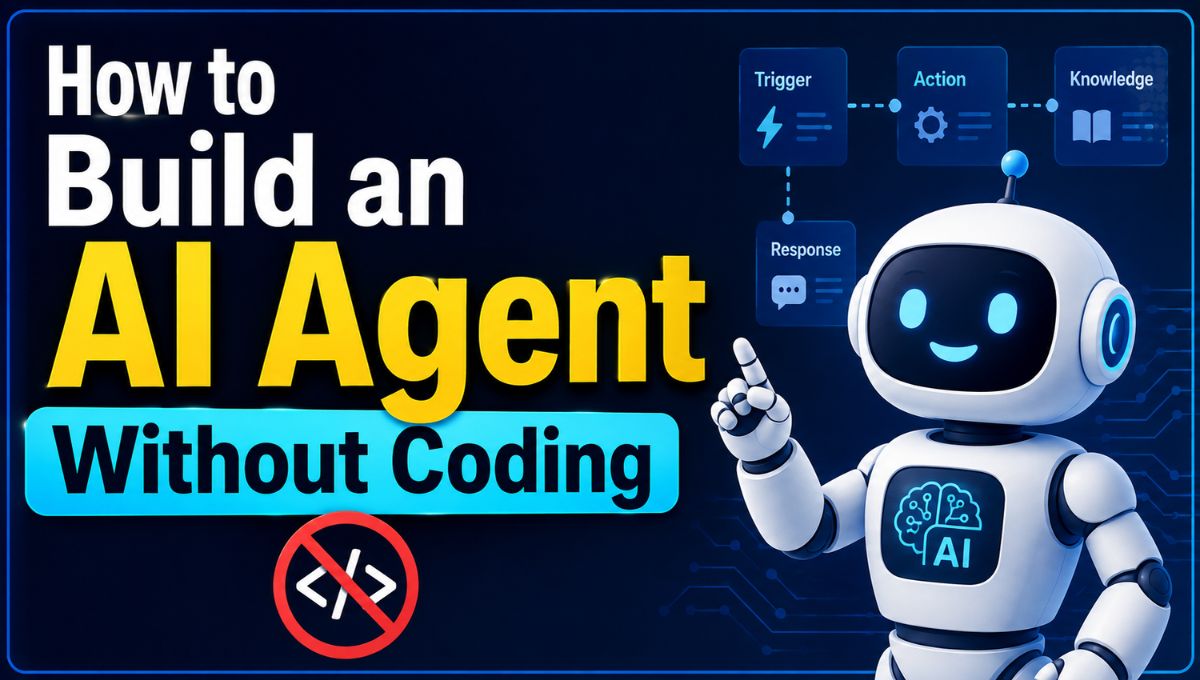
Artificial intelligence is no longer limited to programmers and large technology companies. In 2026, anyone with basic computer skills can create useful AI-powered assistants without writing a single line of code. This has become possible because of the rapid growth of no-code AI tools and automation platforms that provide visual interfaces for building intelligent workflows.
If you have ever wanted an AI assistant that can answer customer questions, organize tasks, summarize emails, schedule follow-ups, generate content, or automate repetitive business activities, you do not need to learn Python, JavaScript, or machine learning to get started.
This guide explains how to build an AI agent without coding, using beginner-friendly tools such as ChatGPT, Google Gemini, Zapier, Make, Notion AI, and other no-code platforms. By the end of this article, you will understand:
- What an AI agent is
- How no-code AI agents work
- Which tools you need
- Step-by-step methods for building one
- Practical examples for business, education, and personal productivity
- Common mistakes to avoid
The goal is to help complete beginners create a working AI agent using visual tools and simple automation workflows.
What Is an AI Agent?
An AI agent is a software system that can:
- Understand a goal or instruction
- Collect relevant information
- Make simple decisions
- Perform actions automatically
- Respond to changing situations
Unlike a basic chatbot that only answers questions, an AI agent can often handle multi-step tasks.
Simple Example
Suppose you say:
“When someone fills out my contact form, send a welcome email, save the lead in a spreadsheet, and remind me to follow up tomorrow.”
A traditional chatbot would only explain how to do this.
An AI agent can actually perform the workflow automatically by connecting multiple tools together.
Do You Really Need Coding?
For many common use cases, no.
You can build useful AI agents for:
- Customer support
- Appointment reminders
- Lead follow-up
- Social media content generation
- Email summarization
- Task management
- Study assistance
- Meeting note organization
- Personal productivity automation
No-code platforms provide drag-and-drop interfaces that replace programming with visual workflow building.
How No-Code AI Agents Work
A no-code AI agent usually has four parts:
| Component | Purpose |
|---|---|
| Trigger | Starts the workflow |
| AI Brain | Understands and generates responses |
| Action Tools | Perform tasks such as sending emails or updating spreadsheets |
| Storage | Saves data, notes, or conversation history |
Example Workflow
- Trigger: New customer inquiry arrives.
- AI Brain: Generates a personalized reply.
- Action: Sends the email automatically.
- Storage: Saves the customer details to a CRM or Google Sheet.
This entire process can be created visually without coding.
Best No-Code Tools for Building AI Agents
ChatGPT
Useful for:
- Generating responses
- Summarizing information
- Writing emails
- Creating content
- Answering questions
Google Gemini
Useful for:
- Research
- Information organization
- Document summarization
- Planning workflows
Zapier
Best for connecting apps and automating tasks between them.
Make (formerly Integromat)
Provides advanced visual automation with more flexibility than many beginner tools.
Notion AI
Excellent for organizing notes, tasks, knowledge bases, and AI-assisted workflows.
Airtable
Useful for storing structured data and building simple business databases.
The Easiest AI Agent to Build
A great beginner project is a Lead Follow-Up AI Agent.
What It Will Do
When someone submits a contact form:
- Capture the lead information.
- Generate a personalized welcome message.
- Send the email automatically.
- Save the lead in a spreadsheet.
- Create a follow-up reminder.
This is practical for freelancers, consultants, coaches, real estate agents, and small business owners.
Step-by-Step: Build an AI Agent Without Coding
Step 1: Choose Your Goal
Start with one repetitive task.
Good beginner examples:
- Answering FAQs
- Sending appointment reminders
- Creating social media captions
- Summarizing meeting notes
- Organizing new leads
- Generating daily task lists
For this tutorial, we will use lead follow-up automation.
Step 2: Create a Google Form
Create a simple form with fields such as:
- Name
- Phone number
- Service interested in
- Additional message
This form will act as the trigger for the AI agent.
Step 3: Connect the Form to Zapier
In Zapier:
- Create a new Zap.
- Choose Google Forms as the trigger.
- Select New Form Response.
Now every new submission will automatically start the workflow.
Step 4: Add the AI Step
Add an OpenAI / ChatGPT action.
Example Prompt
“Write a friendly and professional welcome email for a new customer who is interested in [Service]. Use the customer’s name [Name] and invite them to schedule a consultation.”
Zapier will automatically insert the form fields into the prompt.
Step 5: Send the Email
Add Gmail as the next action.
Configure:
- To: Customer email from the form
- Subject: Thank you for contacting us
- Body: AI-generated message from the previous step
Now the customer receives a personalized email automatically.
Step 6: Save the Lead
Add Google Sheets as another action.
Create columns such as:
- Date
- Name
- Service
- Status
- Follow-up date
Every new lead is stored automatically for future tracking.
Step 7: Create a Reminder
Add Google Calendar or Todoist as the final action.
Create a task such as:
“Follow up with John about website design inquiry.”
Congratulations—you have built a working AI agent without coding.
Visual Workflow
| Step | Tool |
|---|---|
| Form submitted | Google Forms |
| Trigger automation | Zapier |
| Generate response | ChatGPT |
| Send email | Gmail |
| Save data | Google Sheets |
| Create reminder | Google Calendar |
This entire workflow can usually be built in 15–30 minutes.
Example 2: AI Study Assistant for Students
You can also build a personal AI Study Agent.
Goal
Whenever you add lecture notes to Notion:
- Summarize the notes.
- Generate key concepts.
- Create 5 revision questions.
- Save the summary automatically.
Tools
- Notion
- Notion AI
- Zapier (optional)
This creates an automated revision system for exam preparation.
Example 3: AI Social Media Agent
Goal
When you add a new product to a spreadsheet:
- Generate an Instagram caption.
- Create a Facebook post.
- Suggest 5 hashtags.
- Save the content for approval.
Tools
- Google Sheets
- ChatGPT via Zapier
- Notion or Trello for content approval
This is extremely useful for small businesses and local shops.
Building an AI FAQ Agent
Another easy no-code project is a Frequently Asked Questions Agent.
Step 1: Prepare Your FAQ List
Create a document with common questions such as:
- Business hours
- Pricing information
- Service availability
- Delivery areas
- Appointment booking instructions
Step 2: Use a No-Code Chatbot Platform
Platforms such as:
- Tidio
- ManyChat
- Chatbase
- Botpress Cloud
allow you to upload your FAQ content and connect an AI model visually.
Result
Visitors can ask questions in natural language, and the AI agent responds using your uploaded information.
Best No-Code Platforms Compared
| Platform | Ease of Use | Best For |
|---|---|---|
| Zapier | Excellent | Simple business automation |
| Make | Good | Advanced visual workflows |
| Notion AI | Excellent | Personal productivity |
| Tidio | Excellent | Customer support chatbots |
| ManyChat | Very easy | Instagram and WhatsApp automation |
| Airtable + AI | Good | Data-driven workflows |
Tips for Better AI Agents
Write Clear Prompts
Bad prompt:
“Reply to the customer.”
Better prompt:
“Write a friendly 120-word email thanking the customer for their inquiry about home cleaning services, explain that we will contact them within 24 hours, and include a call-to-action to schedule a consultation.”
Clear prompts produce much more reliable results.
Keep Workflows Simple
Many beginners try to automate everything at once. Start with:
- 1 trigger
- 1 AI action
- 1 output action
Once that works reliably, add more steps.
Add Human Approval
For important tasks such as quotations, contracts, or public social media posts, add an approval step before the AI-generated content is published automatically.
Common Mistakes to Avoid
Overcomplicated Automation
Start with a single workflow before connecting multiple apps and conditions.
Ignoring Error Handling
Add backup actions such as notifications if an email fails to send or a spreadsheet row cannot be created.
Using Vague Instructions
AI performs best when given specific context, tone, and desired outcomes.
Sharing Sensitive Data
Avoid sending confidential financial, legal, medical, or personal information through AI services unless you fully understand the platform’s privacy policies.
Can You Build an AI Agent for Free?
Yes. A completely free beginner setup could use:
| Purpose | Free Tool |
|---|---|
| Trigger | Google Forms |
| AI generation | ChatGPT free tier |
| Automation | Zapier free plan |
| Storage | Google Sheets |
| Reminders | Google Calendar |
This is sufficient for learning the fundamentals of AI automation.
What Can You Build Next?
Once you understand the basics, you can create more advanced agents such as:
Business Agents
- Lead qualification agent
- Appointment booking agent
- Customer support agent
- Invoice reminder agent
- Social media scheduling agent
Personal Productivity Agents
- Daily planning assistant
- Email summarizer
- Meeting action-item tracker
- Habit reminder assistant
- Reading and note summarizer
Educational Agents
- Homework explanation assistant
- Quiz generator
- Lecture summarizer
- Revision planner
- Research organization assistant
Is No-Code AI Enough for Serious Business Use?
For many small and medium-sized businesses, yes.
No-code AI agents are already being used for:
- Customer inquiry handling
- Lead capture and follow-up
- Appointment scheduling
- Internal task management
- Marketing content generation
- Team notifications
- Report summarization
As long as the workflow is well-defined and monitored, no-code solutions can provide substantial productivity benefits without the cost of custom software development.
Conclusion
Learning how to build an AI agent without coding is much easier than most beginners expect. Thanks to modern no-code platforms such as Zapier, Make, Notion AI, ChatGPT, and Google Gemini, you can create useful AI-powered workflows using simple visual interfaces rather than programming languages.
The easiest way to start is to automate one repetitive task, such as sending follow-up emails, organizing leads, summarizing notes, or creating social media content. A basic no-code AI agent typically requires only:
- A trigger (such as a form submission),
- An AI step (such as ChatGPT generating a response),
- And an action (such as sending an email or updating a spreadsheet).
This approach is ideal for students, freelancers, small business owners, teachers, consultants, and anyone who wants to save time on routine digital tasks.
The most important lesson is that you do not need to be a developer to benefit from AI automation. By starting with simple workflows, writing clear prompts, and gradually adding more automation, you can build powerful AI agents that improve productivity, reduce repetitive work, and help you focus on the tasks that truly require human creativity and judgment.