Artificial intelligence is changing the way people work, learn, communicate, and manage daily tasks. Over the last few years, AI-powered chatbots, writing assistants, image generators, and automation tools have become common across businesses and households. However, a more advanced technology is now attracting significant attention: AI Agents.
AI agents represent the next stage of intelligent automation. Instead of simply answering questions or performing one specific task, they can understand goals, make decisions, plan multiple steps, interact with software applications, and complete entire workflows with minimal human supervision. This ability makes them far more powerful than traditional automation tools.
Businesses are increasingly using AI agents to improve productivity, reduce repetitive work, and streamline operations. From customer support and marketing to healthcare, finance, education, and e-commerce, AI agents are helping organizations work faster and more efficiently.
This guide explains AI Agents in simple, easy-to-understand language. You will learn what they are, how they work, their types, benefits, limitations, real-world uses, and why they are becoming an important part of the future of work and Intelligent Automation.
What Are AI Agents?
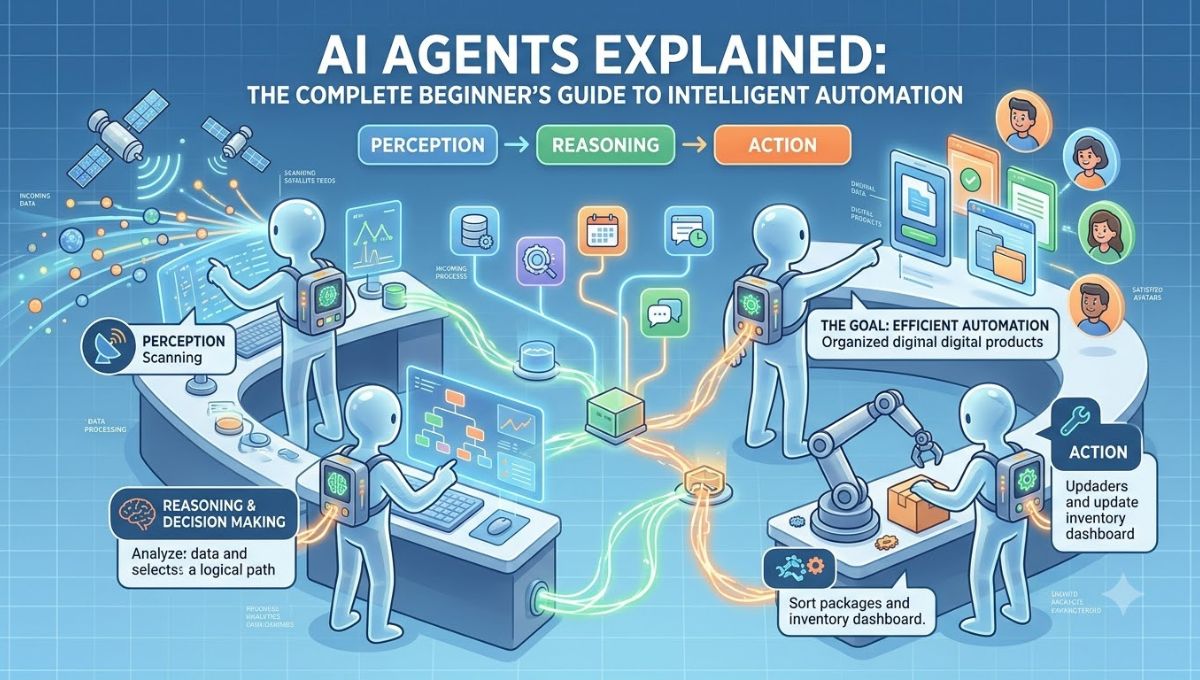
An AI Agent is a software system that can observe information, understand a goal, make decisions, and take actions to achieve that goal. It acts as an intelligent assistant that can perform tasks on behalf of a user or organization.
Unlike a basic chatbot that only responds to questions, an AI agent can:
- Understand complex instructions
- Gather information from different sources
- Plan a sequence of actions
- Execute tasks automatically
- Monitor progress
- Adjust its behavior if conditions change
For example, if you ask a chatbot, “What meetings do I have tomorrow?” it may simply display your schedule. An AI agent, however, could check your calendar, identify conflicts, reschedule appointments, send updated invitations, and remind participants automatically.
This ability to think, plan, and act is what makes AI agents different from ordinary automation tools.
Why AI Agents Matter
Modern workplaces involve thousands of repetitive tasks every day. Employees spend significant time managing emails, updating spreadsheets, scheduling meetings, organizing files, preparing reports, and responding to routine customer requests.
AI agents help reduce this workload by handling repetitive and structured tasks automatically. This allows people to focus on:
- Creative work
- Problem-solving
- Strategy and planning
- Customer relationships
- Innovation and growth
As businesses generate more digital information, the need for intelligent systems that can manage and process that information efficiently continues to grow. AI agents are becoming valuable because they combine automation with decision-making.
How AI Agents Work

Although different AI agents use different technologies, most follow a similar process.
1. Receive a Goal
The user provides an instruction such as:
- “Create a weekly sales report.”
- “Schedule interviews for shortlisted candidates.”
- “Respond to customer inquiries about delivery status.”
2. Gather Information
The agent collects relevant data from connected systems such as:
- Email accounts
- Calendars
- Databases
- CRM software
- Documents
- Websites
- Cloud storage platforms
3. Analyze the Data
Using artificial intelligence techniques such as machine learning and natural language processing, the agent understands the information and identifies what needs to be done.
4. Create a Plan
The agent determines the sequence of actions required to complete the task.
5. Execute Actions
It performs the necessary steps, such as sending emails, updating records, generating reports, or interacting with other software applications.
6. Monitor and Improve
Some advanced agents can evaluate the results, detect errors, and adjust their actions if needed.
This continuous cycle of observe → analyze → plan → act → evaluate is the foundation of Intelligent Automation.
Core Technologies Behind AI Agents
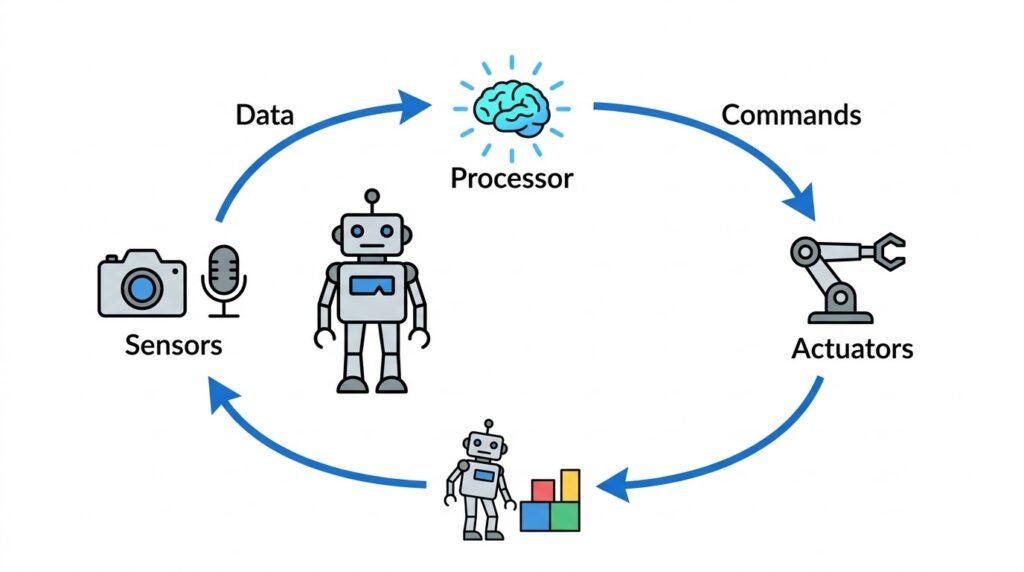
AI agents rely on several important technologies working together.
| Technology | Purpose |
|---|---|
| Machine Learning | Learns patterns from data and improves performance over time |
| Natural Language Processing (NLP) | Understands and generates human language |
| Reasoning Models | Helps make decisions and solve problems |
| Computer Vision | Interprets images, documents, or visual information |
| APIs and Integrations | Connects the agent to external software and services |
| Workflow Automation | Coordinates multiple tasks across different systems |
These technologies allow AI agents to perform much more complex tasks than traditional rule-based software.
Types of AI Agents
AI agents can be classified based on how they make decisions.
Simple Reflex Agents
These agents follow predefined rules. They respond directly to specific conditions.
Example: If an email contains the word “invoice,” move it to the finance folder.
Model-Based Agents
These agents maintain an internal understanding of their environment before deciding what to do.
Example: A warehouse agent tracking inventory levels and predicting stock shortages.
Goal-Based Agents
These agents focus on achieving a specific objective by planning actions.
Example: Booking the cheapest available flight that matches a user’s travel preferences.
Utility-Based Agents
These agents evaluate multiple possible outcomes and choose the one that provides the best overall result.
Example: Selecting the most efficient delivery route based on traffic, distance, and fuel costs.
Learning Agents
These agents improve through experience and feedback.
Example: A customer support agent that becomes better at answering questions by learning from previous interactions.
AI Agents vs Traditional Automation
Many people confuse AI agents with ordinary automation software. The difference is significant.
| Feature | Traditional Automation | AI Agents |
| Decision Making | Fixed rules | Intelligent and adaptive |
| Learning Ability | No | Yes |
| Natural Language Understanding | Very limited | Advanced |
| Multi-Step Planning | Rare | Common |
| Adaptability | Low | High |
| Suitable Tasks | Simple repetitive tasks | Simple and complex workflows |
Traditional automation works well for tasks that never change. AI agents are useful when tasks involve language, decisions, changing conditions, or multiple steps.
Real-World Examples of AI Agents
Customer Support Agents
Modern support agents can:
- Answer common questions
- Check order status
- Process refund requests
- Escalate complex issues to human staff
- Provide support 24/7
This reduces waiting times and improves customer satisfaction.
Sales and CRM Agents
AI agents help sales teams by:
- Capturing leads from websites
- Qualifying potential customers
- Scheduling follow-up meetings
- Updating CRM records automatically
- Generating sales summaries
Human Resources Agents
HR departments use AI agents for:
- Resume screening
- Interview scheduling
- Employee onboarding
- Attendance tracking
- Responding to common employee questions
Finance and Accounting Agents
These agents can:
- Process invoices
- Match payments with records
- Detect unusual transactions
- Generate financial reports
- Send payment reminders
Personal Productivity Agents
Individuals can use AI agents to:
- Organize tasks
- Manage calendars
- Summarize meetings
- Draft emails
- Set reminders
- Research information
Benefits of AI Agents
The growing popularity of AI Agents is driven by their ability to deliver measurable business value.
Higher Productivity
AI agents can perform repetitive tasks much faster than humans, allowing employees to focus on more valuable work.
Reduced Errors
Automated systems follow consistent processes, reducing mistakes caused by manual data entry or oversight.
24/7 Availability
Unlike human workers, AI agents can operate continuously without breaks, making them useful for customer support and monitoring tasks.
Faster Decision-Making
By processing large amounts of information quickly, AI agents help organizations respond to situations more rapidly.
Cost Efficiency
Automation reduces the amount of manual effort required for routine operations, lowering operational costs over time.
Better Customer Experience
Customers receive faster responses, more consistent information, and improved service availability.
Scalability
AI agents can handle increasing workloads without requiring proportional increases in staffing.
AI Agents in Different Industries
Healthcare
Healthcare organizations use AI agents for:
- Appointment scheduling
- Patient record management
- Medical documentation assistance
- Insurance verification
- Follow-up reminders
Banking and Finance
Financial institutions apply AI agents to:
- Fraud detection
- Transaction monitoring
- Customer verification
- Loan application processing
- Compliance reporting
Education
Educational institutions use AI agents to:
- Answer student questions
- Organize learning materials
- Manage admissions inquiries
- Schedule classes
- Provide study assistance
E-Commerce
Online stores use AI agents for:
- Product recommendations
- Inventory monitoring
- Order tracking
- Customer support
- Marketing personalization
Manufacturing
Manufacturers use AI agents to:
- Monitor equipment performance
- Schedule maintenance
- Track production workflows
- Manage supply chains
- Detect quality issues
The Role of Natural Language Processing
One of the most important capabilities of modern AI agents is Natural Language Processing (NLP).
NLP allows agents to:
- Understand written instructions
- Interpret customer questions
- Extract information from documents
- Generate human-like responses
- Summarize long texts
- Translate between languages
This makes AI agents much easier to use because people can communicate with them using normal everyday language instead of complex programming commands.
Multi-Agent Systems
In advanced environments, multiple AI agents can work together.
For example:
- One agent collects customer data.
- Another analyzes purchasing behavior.
- A third prepares personalized marketing messages.
- A fourth monitors campaign performance.
This collaborative approach is called a multi-agent system, where specialized agents coordinate to achieve larger business goals.
Challenges and Limitations
Despite their advantages, AI agents are not perfect.
Data Quality
Poor or incomplete data can lead to inaccurate decisions.
Integration Complexity
Connecting AI agents with existing business software may require technical expertise.
Security and Privacy
Agents often access sensitive information, so strong cybersecurity measures are essential.
Human Oversight
AI agents can make mistakes, especially when dealing with unusual situations. Human supervision remains important for critical tasks.
Ethical Concerns
Organizations must ensure that AI systems are used fairly, transparently, and responsibly.
Best Practices for Implementing AI Agents
Businesses can improve their chances of success by following several best practices.
Start Small
Begin with a simple, repetitive workflow such as email sorting or meeting scheduling.
Define Clear Goals
Specify exactly what the agent should accomplish and how success will be measured.
Train Employees
Staff should understand how to work effectively with AI systems rather than viewing them as replacements.
Monitor Performance
Regularly review the agent’s accuracy, efficiency, and impact on business operations.
Protect Data
Use secure access controls, encryption, and compliance policies to safeguard sensitive information.
Continuously Improve
AI systems should be updated and refined as business needs change.
AI Agents and the Future of Work
AI agents are expected to become increasingly common in everyday work environments. Future agents will likely be able to:
- Handle more complex reasoning tasks
- Work across multiple software platforms seamlessly
- Collaborate with other AI agents
- Learn continuously from real-world interactions
- Provide proactive recommendations before users ask for help
Rather than replacing all human jobs, AI agents are more likely to change the nature of work. Routine administrative tasks will become increasingly automated, while human workers will focus more on creativity, leadership, communication, and strategic thinking.
How Beginners Can Start Learning About AI Agents
If you are new to the topic, you can begin by exploring simple AI tools that already include agent-like features.
Step 1: Use AI Assistants
Experiment with tools that can:
- Draft emails
- Summarize documents
- Organize tasks
- Generate reports
Step 2: Learn Workflow Automation
Understand how applications can connect through automation platforms.
Step 3: Explore Prompting
Practice giving clear instructions to AI systems and observe how different prompts produce different results.
Step 4: Study Real Use Cases
Look at how businesses use AI agents in customer support, marketing, HR, and finance.
Step 5: Build Simple Automations
Start with small personal productivity workflows before moving to more advanced business processes.
Common Misconceptions About AI Agents
“AI Agents Are Just Chatbots”
Chatbots are usually designed for conversation. AI agents can take actions and complete tasks, not just provide answers.
“They Work Without Any Human Input”
Most AI agents still require human-defined goals, supervision, and monitoring, especially for important business decisions.
“Only Large Companies Can Use Them”
Many modern AI tools are cloud-based and affordable, making them accessible to small businesses, freelancers, and individual users.
“They Replace Human Creativity”
AI agents are strongest at handling repetitive, structured, and data-driven tasks. Human creativity, empathy, judgment, and strategic thinking remain essential.
The Connection Between AI Agents and Intelligent Automation
Intelligent Automation combines three major elements:
- Artificial Intelligence
- Workflow Automation
- Data-Driven Decision Making
AI agents are a central component of this approach because they can:
- Understand information
- Make decisions
- Coordinate multiple tasks
- Adapt to changing situations
- Improve over time
This combination enables organizations to automate not only simple repetitive tasks but also complex business processes that previously required significant human involvement.
Conclusion
AI Agents represent a major step forward in the evolution of artificial intelligence and Intelligent Automation. Unlike traditional automation tools that follow fixed rules, AI agents can understand goals, analyze information, plan multiple actions, make decisions, and complete complex workflows with minimal supervision.
Their applications already span customer support, sales, marketing, human resources, finance, healthcare, education, e-commerce, and personal productivity. By reducing repetitive work, improving accuracy, increasing efficiency, and enabling faster decision-making, AI agents are helping organizations transform the way they operate.
However, successful adoption requires more than just installing new software. Businesses must focus on clear goals, high-quality data, employee training, security, ethical AI practices, and ongoing human oversight. When implemented responsibly, AI agents can serve as powerful partners that enhance human capabilities rather than simply replacing them.
As artificial intelligence continues to advance, AI agents are likely to become an essential part of everyday digital life. Understanding how they work today is an important step toward preparing for a future where humans and intelligent software collaborate closely to achieve better productivity, better services, and smarter business operations.