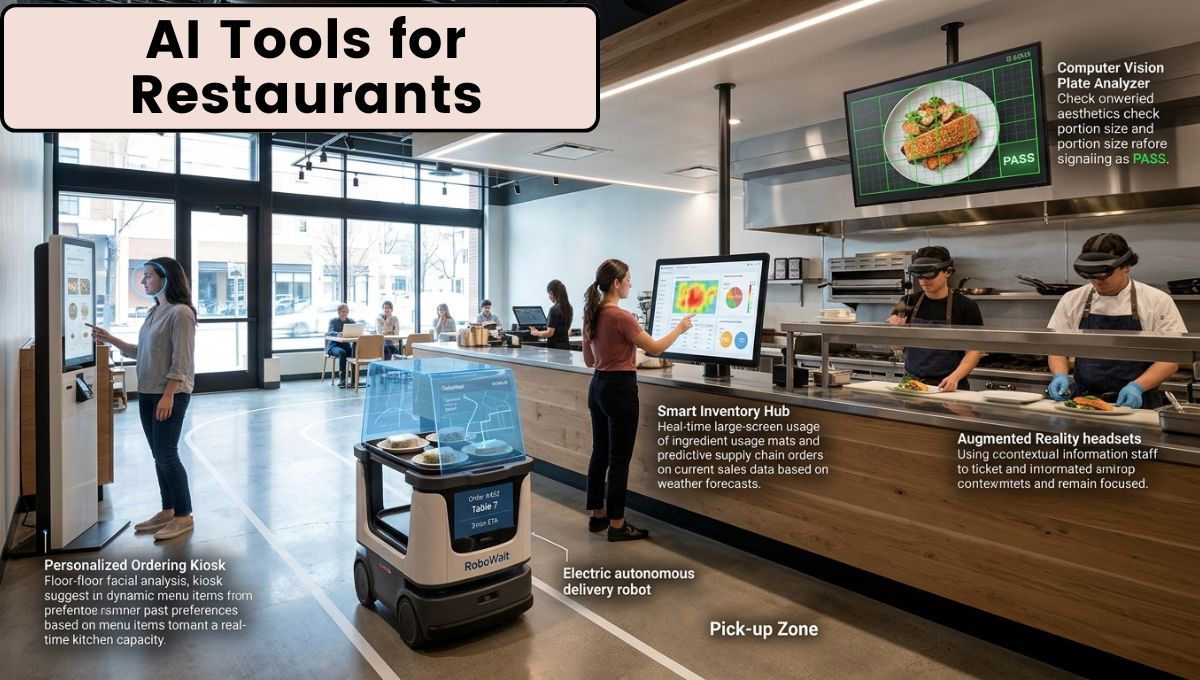
The restaurant industry is evolving faster than ever before. Customer expectations have changed significantly over the last decade, and restaurant owners are now expected to provide exceptional food, seamless customer service, convenient online ordering, fast delivery, personalized marketing, and memorable dining experiences. At the same time, restaurants are facing rising labor costs, increasing competition, food inflation, inventory challenges, and changing consumer behavior.
To remain competitive in this demanding environment, many businesses are turning to AI Tools for Restaurants. Artificial intelligence is no longer limited to large technology companies or global restaurant chains. Today, affordable AI-powered solutions are helping independent restaurants, cafés, cloud kitchens, bakeries, food trucks, and multi-location restaurant brands improve efficiency, reduce costs, and increase revenue.
From customer support chatbots and automated reservation systems to inventory forecasting and marketing automation, AI is transforming nearly every aspect of restaurant management. Restaurant owners can now leverage data-driven insights to make smarter decisions, improve customer experiences, and optimize daily operations.
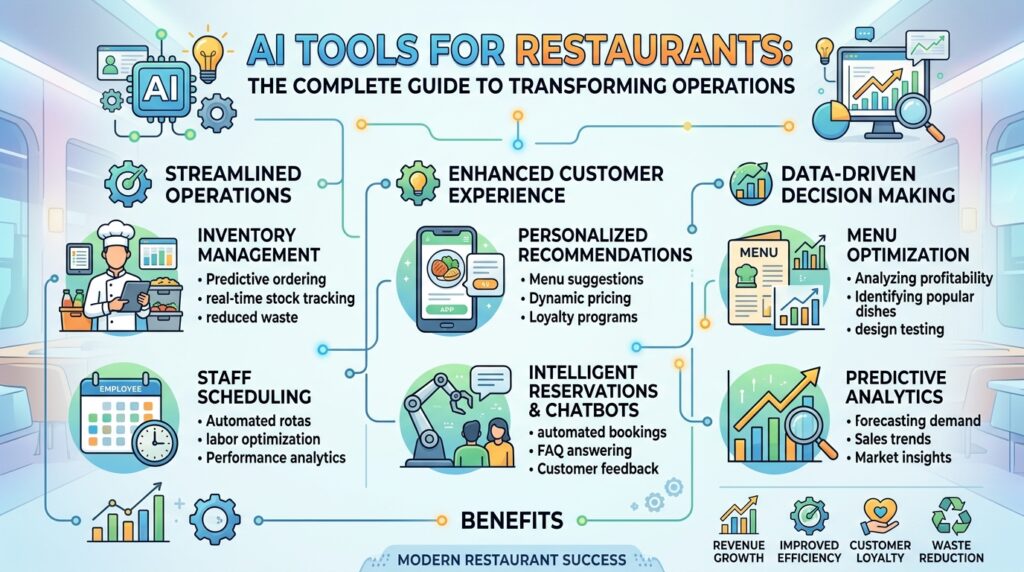
This comprehensive guide explores the best AI Tools for Restaurants, their features, benefits, limitations, implementation strategies, industry trends, and practical use cases that can help restaurant businesses succeed in an increasingly digital world.
What Are AI Tools for Restaurants?
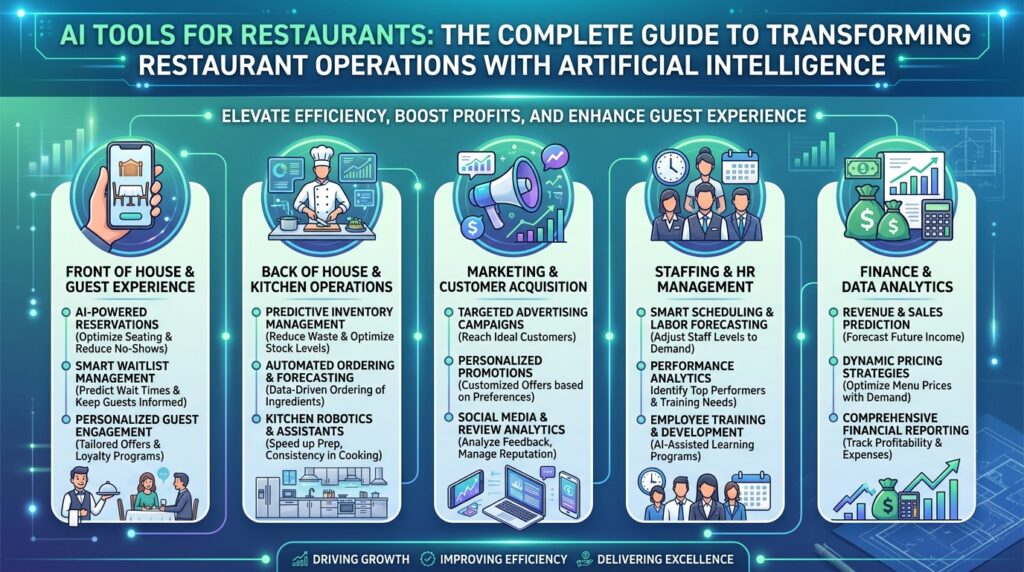
AI tools for restaurants are software solutions that use artificial intelligence, machine learning, automation, predictive analytics, and natural language processing to improve restaurant operations.
These tools can automate routine tasks, analyze customer behavior, forecast demand, optimize staffing, manage inventory, generate marketing content, and provide personalized customer experiences.
Unlike traditional restaurant software, AI-powered platforms continuously learn from data and improve their recommendations over time. This enables restaurant owners to make informed decisions based on real-time information rather than relying solely on intuition.
Today, AI can support restaurants in areas such as:
- Customer service
- Reservation management
- Online ordering
- Inventory control
- Staff scheduling
- Marketing automation
- Menu optimization
- Customer loyalty programs
- Sales forecasting
- Financial reporting
The result is a more efficient and profitable restaurant operation.
Why AI Is Becoming Important in the Restaurant Industry
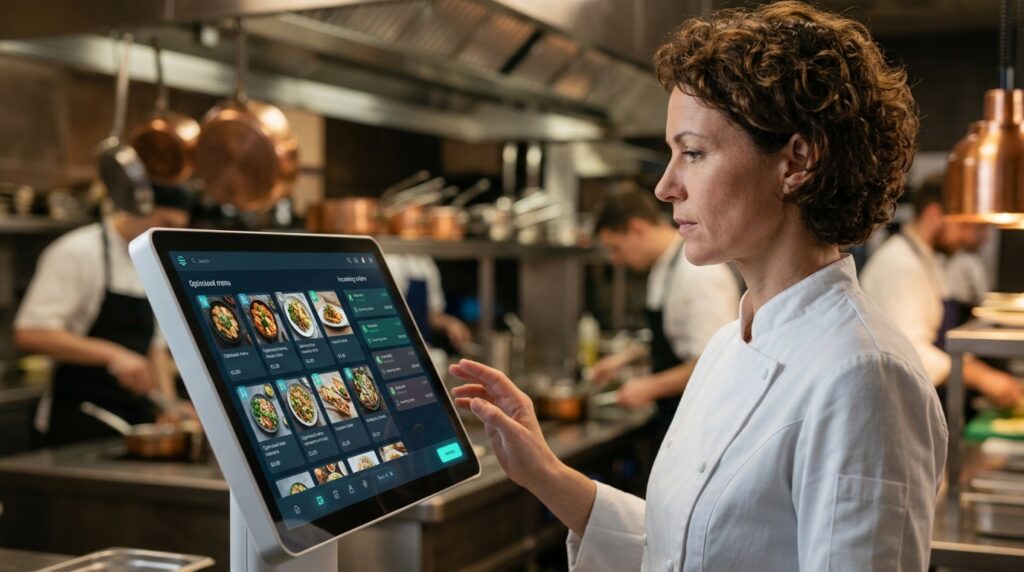
The modern restaurant industry operates on extremely tight margins. Even small improvements in efficiency can have a significant impact on profitability. Artificial intelligence provides restaurant owners with tools that help identify opportunities, reduce waste, and improve customer satisfaction.
Consumer behavior has also shifted toward digital interactions. Customers increasingly expect online reservations, mobile ordering, personalized recommendations, and immediate responses to inquiries. Meeting these expectations manually can be difficult, especially for smaller businesses with limited staff.
AI allows restaurants to automate many of these interactions while maintaining a high level of service. It also provides valuable insights into customer preferences, purchasing patterns, and operational performance.
As competition continues to increase, restaurants that adopt AI technologies are often better positioned to attract customers, streamline operations, and improve profitability.
Current Restaurant Industry Adoption and Market Trends
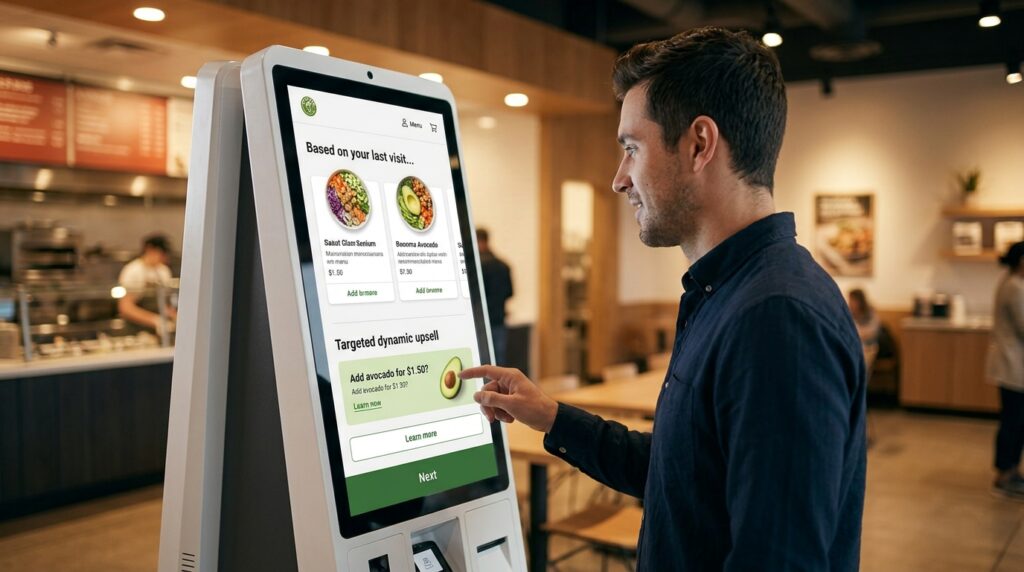
Artificial intelligence adoption within the restaurant sector is accelerating rapidly. Major restaurant chains have invested heavily in AI-powered ordering systems, predictive analytics, and customer engagement platforms. However, advancements in technology have also made these solutions accessible to small and medium-sized businesses.
Several trends are driving AI adoption in restaurants:
| Trend | Impact on Restaurants |
|---|---|
| Online Ordering Growth | Increased demand for digital ordering systems |
| Delivery Expansion | Need for operational efficiency |
| Labor Shortages | Greater reliance on automation |
| Personalized Marketing | Better customer targeting |
| Data Analytics | Improved decision-making |
| Customer Experience Focus | Enhanced guest engagement |
Restaurants that embrace these trends often gain a competitive advantage by improving efficiency and delivering superior customer experiences.
Benefits of Using AI Tools for Restaurants
The benefits of AI extend far beyond automation. When implemented correctly, AI can improve nearly every aspect of restaurant performance.
One of the biggest advantages is operational efficiency. Restaurant owners can automate repetitive tasks such as reservation management, customer inquiries, and reporting, allowing staff to focus on customer service and food preparation.
Another major benefit is inventory optimization. Food waste is one of the largest expenses in the restaurant industry. AI-powered forecasting tools can predict demand more accurately, helping restaurants purchase the right amount of inventory.
Customer engagement also improves significantly. AI helps restaurants personalize marketing campaigns, recommend menu items, and create loyalty programs based on customer behavior.
Financial performance often benefits as well. Better forecasting, improved efficiency, and increased customer retention can contribute directly to higher profitability.
ChatGPT for Restaurant Marketing and Customer Communication
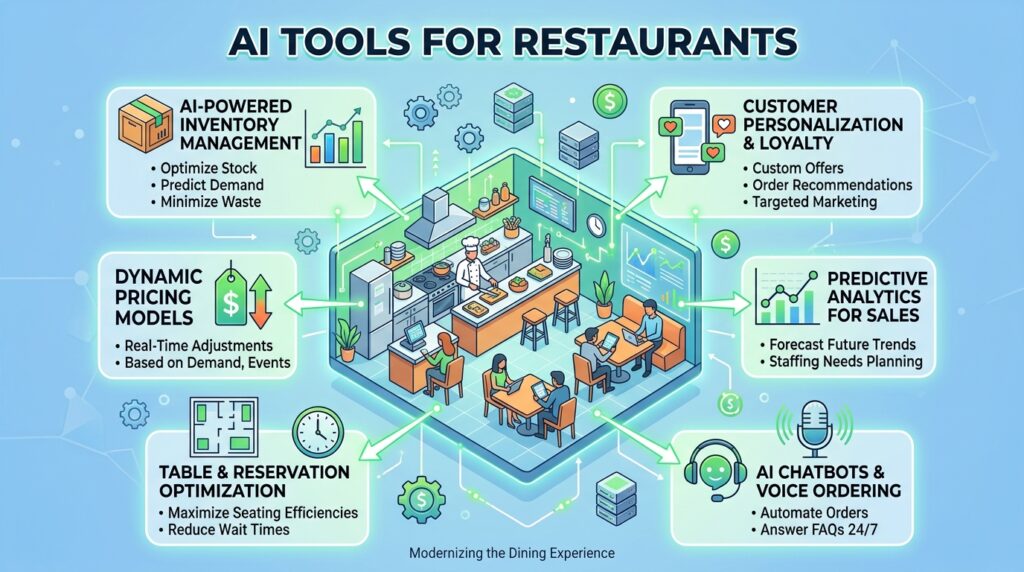
ChatGPT has become one of the most versatile AI tools available to restaurant owners. Its flexibility allows it to support marketing, customer service, content creation, and operational planning.
Restaurant businesses can use ChatGPT to generate social media content, write promotional emails, create menu descriptions, develop loyalty campaigns, and produce blog articles that improve local SEO.
For example, a restaurant launching a new seasonal menu can use ChatGPT to generate social media announcements, email newsletters, website content, and promotional advertisements within minutes.
Key Features
| Feature | Benefit |
|---|---|
| Content Creation | Faster marketing production |
| Email Writing | Improved customer communication |
| Menu Descriptions | More appealing menu presentation |
| Social Media Support | Consistent online presence |
| Marketing Ideas | Creative campaign generation |
Pros
- Affordable and scalable
- Easy to use
- Supports multiple business functions
- Saves marketing time
Cons
- Requires human review
- Can produce generic content if prompts are weak
- Not connected directly to restaurant data
Toast: AI-Powered Restaurant Management
Toast has become one of the most recognized restaurant technology platforms. It combines point-of-sale functionality with advanced analytics and operational management features.
The platform helps restaurants manage orders, process payments, track sales, and analyze performance metrics. Its AI-driven insights provide restaurant owners with valuable information about customer behavior and sales trends.
Toast also integrates with online ordering and delivery services, creating a centralized system for restaurant operations.
Key Features
- Point-of-sale management
- Online ordering integration
- Sales analytics
- Customer insights
- Restaurant reporting
Pros
- Comprehensive restaurant platform
- Strong reporting capabilities
- Easy integration with restaurant operations
Cons
- Can be costly for smaller restaurants
- Learning curve for new users
SevenRooms for Guest Experience Management
SevenRooms focuses on customer relationship management and guest experience enhancement. Restaurants use the platform to understand customer preferences and deliver personalized service.
The system tracks dining history, reservation behavior, and guest preferences. This information allows restaurants to create customized experiences that encourage repeat visits.
For example, a restaurant can automatically recognize returning guests and offer personalized recommendations based on previous orders.
Key Features
- Guest profiles
- Reservation management
- Personalized marketing
- Customer analytics
- Automated communication
Pros
- Strong customer insights
- Improved guest retention
- Personalized service capabilities
Cons
- Best suited for restaurants with established customer bases
- Higher cost than basic reservation systems
OpenTable and AI-Driven Reservation Management
OpenTable remains one of the most widely used reservation platforms in the restaurant industry. Beyond reservations, it provides valuable customer data and performance insights.
The platform helps restaurants optimize table utilization, reduce no-shows, and improve customer engagement.
By analyzing reservation patterns, restaurants can make better staffing and scheduling decisions.
Key Features
- Reservation tracking
- Guest management
- Dining analytics
- Customer engagement tools
- Waitlist management
Pros
- Strong brand recognition
- Large customer network
- Useful reservation analytics
Cons
- Reservation fees
- Dependence on platform visibility
Popmenu for Restaurant Marketing Automation
Popmenu helps restaurants manage digital marketing and customer engagement. The platform combines website management, online ordering, review monitoring, and AI-powered marketing tools.
Restaurants can automate promotional campaigns and improve their online visibility while reducing marketing workloads.
Popmenu is particularly valuable for restaurants seeking to attract new customers through digital channels.
Key Features
- Website management
- AI-assisted marketing
- Review monitoring
- Online ordering
- Customer messaging
Pros
- Comprehensive marketing solution
- Strong online visibility tools
- Easy campaign management
Cons
- May overlap with other marketing tools
- Monthly subscription costs
Tidio for Restaurant Customer Support
Customer inquiries can consume significant time for restaurant staff. Tidio addresses this challenge through AI-powered chatbots and live chat solutions.
Restaurants can use Tidio to answer common questions about menus, operating hours, reservations, delivery options, and promotions.
The platform helps improve response times while reducing workloads for employees.
Key Features
- AI chatbots
- Live chat support
- Automated responses
- Customer engagement
Pros
- 24/7 availability
- Improved customer satisfaction
- Reduced support burden
Cons
- Complex inquiries still require human intervention
Canva Magic Studio for Restaurant Branding
Visual marketing is critical for restaurant success. Canva helps restaurants create professional graphics without hiring designers.
Restaurants can produce menu designs, promotional posters, social media content, and event advertisements using AI-assisted design tools.
The platform’s ease of use makes it ideal for independent restaurant owners with limited marketing resources.
Key Features
- AI design assistance
- Social media templates
- Menu design tools
- Promotional graphics
Pros
- Affordable
- User-friendly
- Extensive template library
Cons
- Advanced customization may be limited
Mailchimp AI for Restaurant Email Marketing
Email marketing remains one of the most effective channels for customer retention. Mailchimp uses AI to optimize email campaigns and improve engagement.
Restaurants can send personalized promotions, event announcements, loyalty rewards, and seasonal offers to targeted customer groups.
Key Features
- Email automation
- Customer segmentation
- Performance analytics
- Campaign recommendations
Pros
- High ROI marketing channel
- Strong automation capabilities
Cons
- Requires email list growth for effectiveness
Hootsuite for Social Media Management
Restaurants often struggle to maintain active social media profiles. Hootsuite helps automate content scheduling and engagement monitoring.
The platform allows restaurants to manage multiple social channels from a single dashboard.
Key Features
- Post scheduling
- Engagement tracking
- Performance reporting
- Content planning
Pros
- Saves time
- Centralized management
Cons
- Subscription costs may increase with additional accounts
MarketMan for Inventory Management
Inventory control directly impacts restaurant profitability. MarketMan uses predictive analytics to help restaurants manage stock levels more effectively.
The platform tracks purchases, inventory usage, supplier performance, and food costs.
Key Features
- Inventory tracking
- Food cost monitoring
- Waste reduction
- Supplier management
Pros
- Reduces waste
- Improves inventory accuracy
Cons
- Requires consistent data entry
Restaurant365 for Complete Restaurant Operations
Restaurant365 combines accounting, payroll, scheduling, inventory management, and reporting into a single platform.
Its AI-supported insights help restaurant operators understand performance across multiple locations.
Key Features
- Accounting
- Payroll
- Scheduling
- Inventory management
- Reporting
Pros
- Comprehensive business management
- Strong analytics
Cons
- More suitable for larger operations
Pricing Comparison Table
| Tool | Typical Pricing Level |
|---|---|
| ChatGPT | Low to Medium |
| Canva | Low |
| Mailchimp | Low to Medium |
| Hootsuite | Medium |
| Tidio | Low to Medium |
| Toast | Medium to High |
| SevenRooms | Medium to High |
| OpenTable | Medium |
| MarketMan | Medium |
| Restaurant365 | High |
Comparison Table of Best AI Tools for Restaurants
| Tool | Primary Use | Best For |
|---|---|---|
| ChatGPT | Marketing & Content | All Restaurants |
| Toast | Operations | Full-Service Restaurants |
| SevenRooms | Guest Experience | Fine Dining |
| OpenTable | Reservations | Casual & Fine Dining |
| Popmenu | Marketing | Local Restaurants |
| Tidio | Customer Support | Small Businesses |
| Canva | Design | Marketing Teams |
| Mailchimp | Email Marketing | Customer Retention |
| Hootsuite | Social Media | Brand Awareness |
| MarketMan | Inventory | Cost Control |
| Restaurant365 | Operations Management | Multi-Location Chains |
Real-World Use Cases of AI in Restaurants
A local café can use ChatGPT to generate social media content, Canva to design promotional graphics, and Mailchimp to send weekly offers. Together, these tools can significantly improve marketing output without hiring additional staff.
A fine-dining restaurant may use SevenRooms and OpenTable to manage reservations and guest preferences. This allows staff to provide personalized service and improve customer loyalty.
A cloud kitchen can rely on Toast for order management and MarketMan for inventory forecasting. These tools help reduce waste while improving operational efficiency.
A restaurant chain can implement Restaurant365 to centralize financial reporting and operational management across multiple locations.
Step-by-Step Guide for Beginners
The best way to adopt AI is gradually rather than implementing multiple systems simultaneously.
Step 1: Identify the biggest operational challenge.
Step 2: Choose one AI tool that addresses that challenge.
Step 3: Train staff on how to use the platform.
Step 4: Monitor performance improvements.
Step 5: Expand AI usage to other areas once initial success is achieved.
This phased approach reduces complexity and improves adoption success.
Common Mistakes Restaurants Make When Using AI
Many restaurant owners expect AI to solve every operational problem immediately. In reality, AI works best when combined with strong business processes.
Another common mistake is failing to review AI-generated content. Marketing materials should always be checked before publication.
Restaurants also sometimes adopt too many platforms at once, creating unnecessary complexity.
Finally, ignoring staff training can limit the effectiveness of AI implementation.
Best Practices for Successful AI Adoption
Successful restaurants use AI as a support system rather than a replacement for human expertise.
Businesses should focus on solving specific problems first, measure performance improvements, and continuously optimize workflows.
Regularly reviewing AI-generated insights and maintaining data quality are also essential for achieving the best results.
ROI and Business Impact of AI Tools
The return on investment from AI often comes from increased efficiency, reduced waste, improved customer retention, and stronger marketing performance.
For example, reducing food waste by even a small percentage can significantly improve profit margins. Similarly, better customer retention often generates higher revenue than constantly acquiring new customers.
Marketing automation can save dozens of hours each month, allowing restaurant owners to focus on operations and customer service.
Future Trends in AI for Restaurants
Several emerging trends are expected to shape the future of restaurant technology.
AI-powered voice ordering systems are becoming more sophisticated and may become common in quick-service restaurants.
Predictive analytics will improve demand forecasting and inventory management.
Personalized dining experiences will become more advanced as AI systems gain access to richer customer data.
Robotics and kitchen automation may also become more affordable, helping restaurants address labor shortages.
Integrated platforms that combine marketing, operations, inventory, and customer management into a single ecosystem are likely to become increasingly popular.
Expert Recommendations
Restaurants just beginning their AI journey should start with tools that provide immediate value, such as ChatGPT, Canva, and Mailchimp. These solutions are affordable, easy to implement, and capable of producing noticeable results quickly.
As businesses grow, they can expand into more specialized platforms such as Toast, SevenRooms, MarketMan, and Restaurant365.
The key is to align AI adoption with specific business goals rather than implementing technology simply because it is available.
Conclusion
The adoption of AI Tools for Restaurants is transforming the food service industry by helping businesses improve efficiency, reduce costs, enhance customer experiences, and increase profitability. Artificial intelligence is no longer limited to large restaurant chains. Independent restaurants, cafés, bakeries, cloud kitchens, and food trucks can now access affordable tools that streamline operations and support growth.
Solutions such as Restaurant AI Tools like ChatGPT, Toast, SevenRooms, OpenTable, Popmenu, Tidio, Canva, Mailchimp, Hootsuite, MarketMan, and Restaurant365 provide powerful capabilities across marketing, customer service, inventory management, reservations, and business operations. Each tool serves a specific purpose, allowing restaurants to build a technology stack that meets their unique needs.
As AI technology continues to evolve, restaurants that embrace intelligent automation are likely to gain significant advantages in customer satisfaction, operational efficiency, and financial performance. By combining AI-powered insights with exceptional hospitality and quality food, restaurant businesses can position themselves for long-term success in an increasingly competitive marketplace.