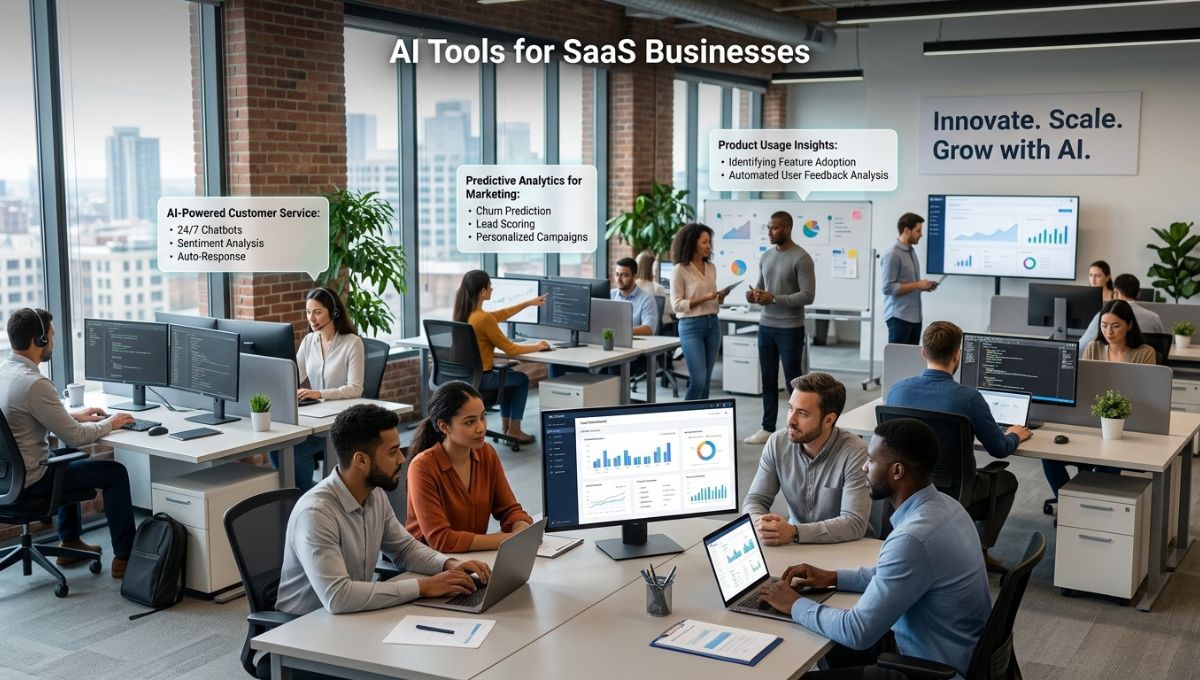
The Software-as-a-Service (SaaS) industry has become one of the fastest-growing sectors in the global technology market. From project management platforms and CRM solutions to cybersecurity software and productivity tools, SaaS businesses are transforming how organizations operate. However, growing a SaaS company comes with unique challenges, including customer acquisition, product development, user retention, customer support, marketing, and operational efficiency.
To address these challenges, many companies are adopting AI Tools for SaaS Businesses. Artificial intelligence is helping SaaS companies automate repetitive tasks, improve customer experiences, optimize marketing campaigns, analyze user behavior, enhance product functionality, and accelerate growth. Whether a startup is launching its first software product or an established SaaS company is scaling globally, AI has become a critical component of modern business strategy.
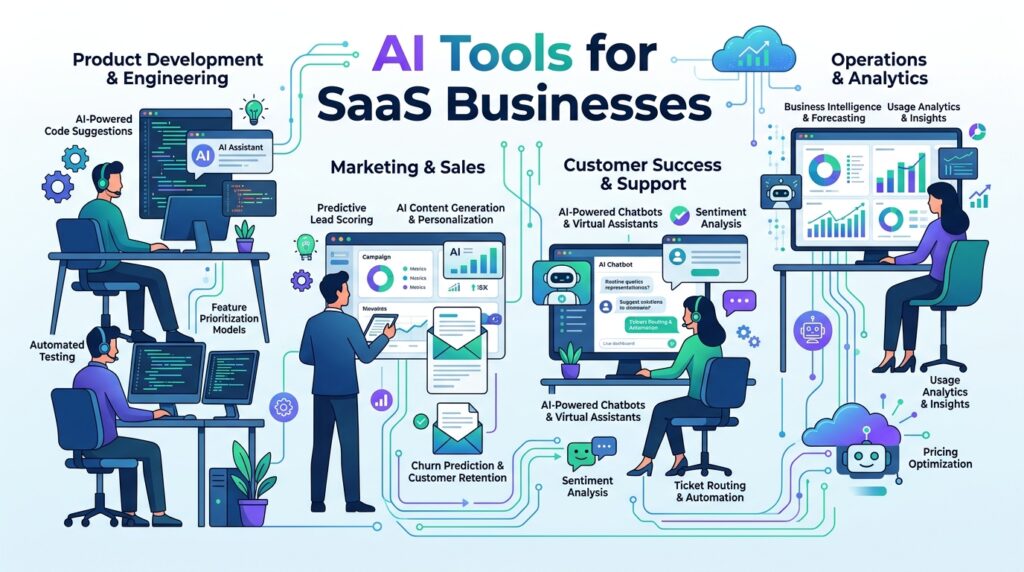
The increasing accessibility of AI-powered platforms has enabled SaaS businesses of all sizes to leverage advanced technology without requiring large internal AI teams. From customer service automation and predictive analytics to content generation and sales intelligence, AI tools are helping software companies compete more effectively in an increasingly crowded marketplace.
Why AI Is Becoming Essential for SaaS Businesses
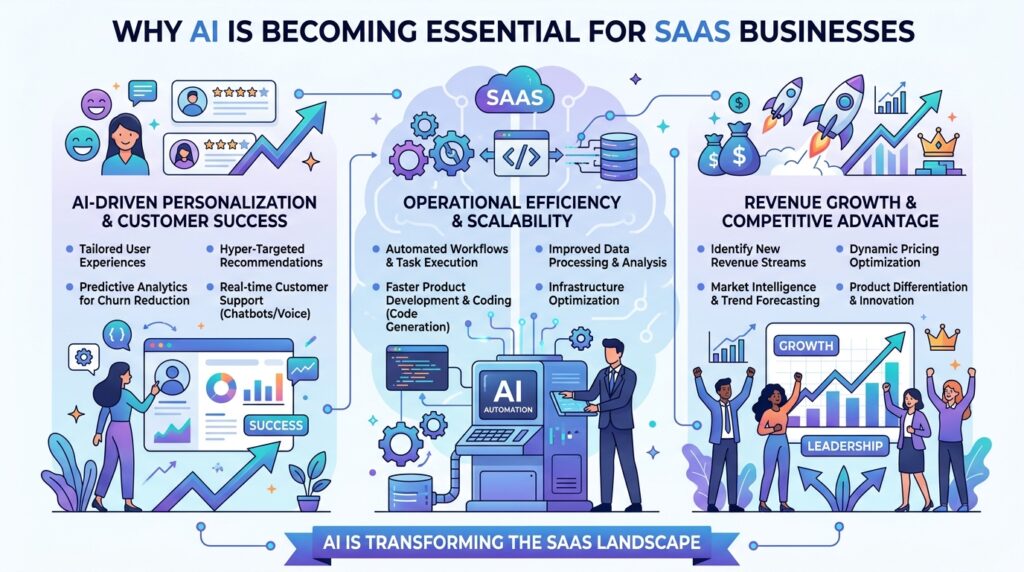
SaaS companies operate in highly competitive environments where customer expectations are constantly increasing. Users expect seamless onboarding experiences, instant support, personalized recommendations, and continuous product improvements.
Traditional manual processes often struggle to keep up with these demands. Artificial intelligence helps bridge this gap by automating workflows, analyzing large datasets, and generating insights that support business decisions.
Modern AI solutions can assist SaaS businesses with:
- Customer acquisition
- Lead qualification
- Product development
- User onboarding
- Customer support
- Marketing automation
- Data analysis
- Sales forecasting
- Customer retention
- Revenue optimization
By integrating AI into these areas, SaaS companies can improve efficiency while delivering better experiences to customers.
The Growing Role of AI in the SaaS Industry
Over the past few years, AI has evolved from a specialized technology into a mainstream business tool. Many SaaS companies are now embedding AI directly into their products while also using AI internally to streamline operations.
Businesses that successfully adopt AI often gain advantages such as:
- Faster decision-making
- Improved customer satisfaction
- Higher conversion rates
- Better retention metrics
- Reduced operational costs
- Increased productivity
As competition intensifies, AI adoption is becoming less of a competitive advantage and more of a business necessity.
Benefits of Using AI Tools for SaaS Businesses
Artificial intelligence offers numerous benefits that can support growth at every stage of a SaaS company’s lifecycle.
| Benefit | Description |
|---|---|
| Operational Efficiency | Automates repetitive business processes |
| Improved Customer Support | Provides instant responses and assistance |
| Better Marketing Performance | Optimizes campaigns and targeting |
| Enhanced User Experience | Delivers personalization and recommendations |
| Increased Revenue | Improves conversions and customer retention |
| Data-Driven Decisions | Provides actionable business insights |
| Scalability | Supports growth without proportional increases in staffing |
These advantages make AI one of the most valuable investments for modern SaaS organizations.
ChatGPT
ChatGPT has become one of the most widely used AI tools in the SaaS industry. Its flexibility allows businesses to use it across multiple departments, including marketing, customer success, product management, sales, and support.
Common SaaS use cases include:
- Writing blog content
- Creating onboarding emails
- Generating support documentation
- Drafting knowledge base articles
- Producing sales copy
- Conducting market research
- Creating feature descriptions
Many SaaS companies also integrate AI assistants powered by large language models into their products to improve customer experiences.
Key Benefits
- Versatile across multiple departments
- Supports content production at scale
- Improves customer communication
- Reduces documentation workload
Potential Limitations
- Requires human review
- May generate inaccurate information
- Needs proper prompts for best results
HubSpot AI
HubSpot has become a popular platform among SaaS businesses due to its combination of customer relationship management, marketing automation, sales enablement, and AI-powered tools.
The platform helps businesses manage the entire customer lifecycle from lead generation to customer retention.
Major Features
- AI-assisted content creation
- Automated email marketing
- Lead scoring
- Sales forecasting
- Customer segmentation
- Workflow automation
Why SaaS Companies Use It
SaaS businesses often deal with long sales cycles and complex customer journeys. HubSpot’s AI-powered insights help teams understand customer behavior and optimize interactions throughout the funnel.
Jasper AI
Jasper AI specializes in marketing content generation and is widely used by SaaS companies looking to scale content marketing efforts.
Content marketing is a major customer acquisition channel for SaaS businesses, making tools like Jasper particularly valuable.
Common Use Cases
- Blog writing
- Landing page creation
- Product marketing
- Ad copy generation
- Email campaigns
- Social media content
Benefits
- Faster content production
- Consistent brand messaging
- Reduced marketing workload
Many SaaS companies use Jasper alongside SEO tools to build large-scale content strategies.
Intercom AI
Intercom provides AI-powered customer support and communication solutions designed specifically for digital businesses.
Customer support is a crucial part of SaaS success because user satisfaction directly impacts retention and recurring revenue.
AI Features
- Automated customer support
- AI chatbots
- Help center automation
- Personalized messaging
- Ticket management
Impact on SaaS Businesses
By automating common support requests, Intercom helps companies reduce response times while improving customer satisfaction.
Zendesk AI
Zendesk AI enables SaaS businesses to manage customer service operations more efficiently.
The platform uses artificial intelligence to assist support teams, automate workflows, and improve customer experiences.
Core Capabilities
- Intelligent ticket routing
- Automated responses
- Sentiment analysis
- Customer insights
- Support workflow optimization
These features help support teams handle growing customer bases without dramatically increasing staffing requirements.
Notion AI
Notion AI enhances team productivity and knowledge management.
Many SaaS businesses use Notion as their central workspace for documentation, planning, and collaboration.
Applications
- Product documentation
- Meeting summaries
- Project planning
- Knowledge management
- Internal communication
As SaaS teams grow, maintaining organized information becomes increasingly important. Notion AI helps simplify these processes.
Salesforce Einstein
Salesforce Einstein is an AI-powered solution integrated within the Salesforce ecosystem.
It helps SaaS businesses improve sales performance through predictive analytics and intelligent automation.
Key Features
- Predictive lead scoring
- Opportunity forecasting
- Customer insights
- Automated data analysis
- Revenue forecasting
These capabilities help sales teams focus on high-value opportunities and improve conversion rates.
Gong
Gong uses AI to analyze sales conversations and customer interactions.
For SaaS businesses with outbound sales teams, understanding customer conversations can provide valuable insights.
Benefits
- Call analysis
- Deal forecasting
- Sales coaching
- Customer sentiment analysis
- Performance tracking
Gong helps sales teams identify successful strategies and improve overall effectiveness.
Surfer SEO
Surfer SEO is a valuable tool for SaaS companies investing in organic growth.
Search engine optimization remains one of the most cost-effective customer acquisition channels for SaaS businesses.
Features
- Keyword research
- Content optimization
- SEO audits
- Competitor analysis
- Ranking recommendations
Many SaaS companies use Surfer SEO alongside AI writing tools to create optimized content at scale.
Canva Magic Studio
Canva helps SaaS marketing teams create visual content efficiently.
Visual assets are needed for:
- Product launches
- Social media campaigns
- Presentations
- Advertising creatives
- Customer onboarding materials
AI-powered design assistance allows teams to produce professional-quality visuals without extensive design expertise.
Zapier AI
Zapier enables workflow automation by connecting different software platforms.
Automation is especially valuable for SaaS businesses that use multiple tools across departments.
Examples
- Lead routing automation
- Customer onboarding workflows
- Marketing automation
- CRM updates
- Reporting processes
Zapier helps reduce manual work and improve operational efficiency.
Comparison of Popular AI Tools for SaaS Businesses
| Tool | Primary Purpose | Best For |
|---|---|---|
| ChatGPT | Content and communication | Multiple departments |
| HubSpot AI | CRM and marketing | Customer lifecycle management |
| Jasper AI | Content creation | Marketing teams |
| Intercom AI | Customer support | Customer success teams |
| Zendesk AI | Support automation | Help desk operations |
| Notion AI | Productivity | Internal collaboration |
| Salesforce Einstein | Sales intelligence | Revenue teams |
| Gong | Conversation analysis | Sales optimization |
| Surfer SEO | Search optimization | Organic growth |
| Canva | Design creation | Marketing assets |
| Zapier | Workflow automation | Operational efficiency |
How SaaS Businesses Use AI Across Departments
Marketing
Marketing teams use AI to generate content, optimize campaigns, analyze performance, and personalize messaging.
Sales
Sales departments leverage AI for lead scoring, forecasting, outreach personalization, and performance analysis.
Customer Support
Support teams use AI chatbots, ticket automation, and intelligent routing to improve customer service.
Product Development
Product teams analyze user behavior, gather feedback, and identify improvement opportunities through AI-powered analytics.
Operations
Operations teams automate workflows and improve efficiency through integrations and process automation.
Common Mistakes SaaS Companies Make When Using AI
Although AI offers many benefits, implementation challenges still exist.
Common mistakes include:
- Overreliance on automation
- Publishing AI-generated content without review
- Ignoring data quality
- Failing to train teams properly
- Choosing too many tools simultaneously
- Not measuring ROI
Avoiding these mistakes can improve the effectiveness of AI adoption.
Best Strategy for Implementing AI in a SaaS Company
A successful AI strategy typically follows several steps:
- Identify repetitive processes.
- Define measurable business goals.
- Select appropriate tools.
- Train employees.
- Monitor performance metrics.
- Continuously optimize workflows.
Gradual implementation often produces better results than attempting large-scale changes all at once.
Future Trends in AI for SaaS Businesses
The future of AI in SaaS looks promising. Several trends are expected to shape the industry over the coming years.
AI-Powered SaaS Products
More companies will embed AI features directly into their software offerings.
Hyper-Personalization
AI will provide increasingly personalized experiences for individual users.
Predictive Analytics
Businesses will rely more heavily on predictive models to forecast customer behavior and business outcomes.
Autonomous Workflows
Automation will become more sophisticated, reducing the need for manual intervention.
AI Copilots
Many SaaS products will include built-in AI assistants that help users complete tasks more efficiently.
These trends are expected to influence how software products are built, marketed, and supported.
Conclusion
The growing adoption of AI Tools for SaaS Businesses is reshaping how software companies acquire customers, develop products, provide support, and scale operations. Artificial intelligence enables businesses to automate repetitive tasks, improve customer experiences, generate insights, and operate more efficiently in increasingly competitive markets.
Platforms such as ChatGPT, HubSpot AI, Jasper AI, Intercom AI, Zendesk AI, Notion AI, Salesforce Einstein, Gong, Surfer SEO, Canva, and Zapier offer powerful capabilities that support different aspects of SaaS growth. Whether the objective is marketing automation, customer support optimization, sales forecasting, or workflow efficiency, AI tools provide practical solutions that can drive measurable business results.
As AI technology continues to evolve, SaaS companies that successfully integrate these solutions into their operations may gain significant advantages in productivity, scalability, customer satisfaction, and revenue growth. By combining artificial intelligence with strong business strategy and human expertise, software companies can position themselves for long-term success in the rapidly changing digital economy.