
The e-commerce industry has experienced remarkable growth over the past decade, driven by changing consumer behavior, digital transformation, and advancements in technology. As online competition continues to increase, businesses are constantly looking for innovative ways to improve customer experiences, optimize operations, and increase sales. One of the most significant developments in recent years has been the adoption of AI Tools for E-commerce.
Artificial intelligence is helping online retailers automate processes, personalize shopping experiences, analyze customer behavior, manage inventory, improve marketing campaigns, and provide better customer support. From small online stores to global retail brands, businesses are using AI-powered solutions to improve efficiency and remain competitive in an increasingly crowded marketplace.
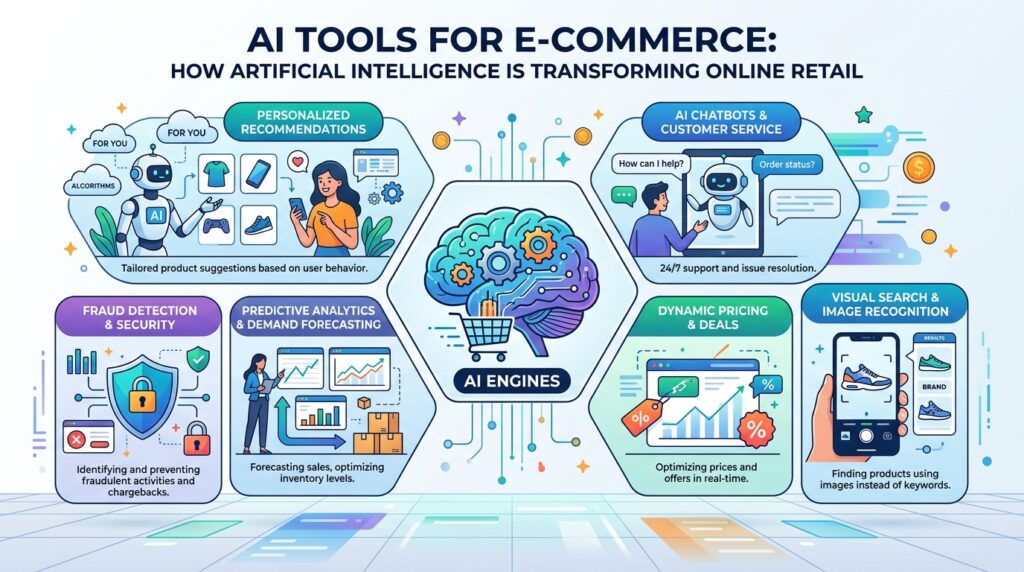
The growing availability of AI tools has made advanced technology accessible to businesses of all sizes. Whether an organization wants to generate product descriptions, automate customer service, forecast demand, or create personalized recommendations, AI is becoming an essential component of modern e-commerce strategies.
Understanding the Role of AI in E-commerce
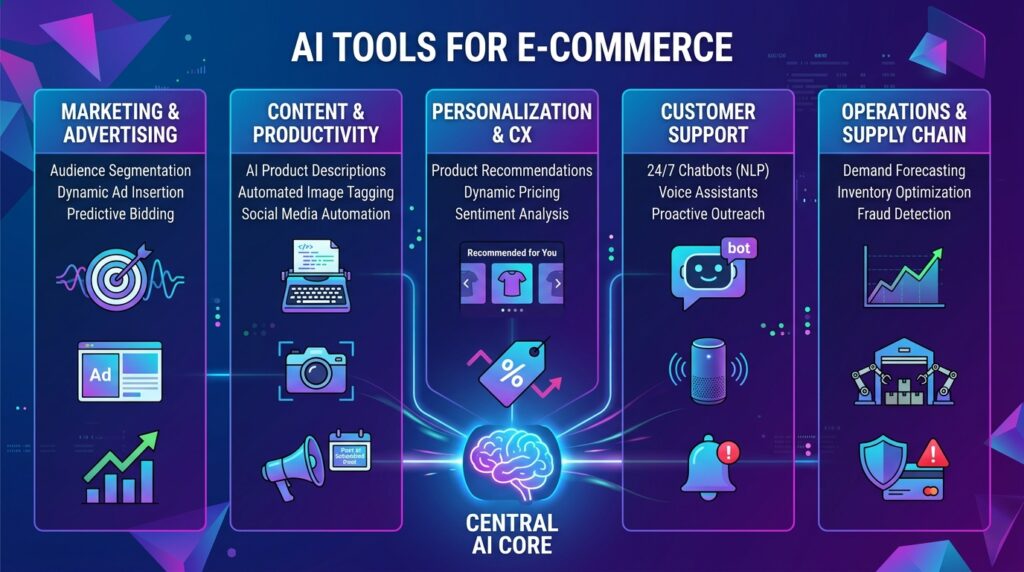
Artificial intelligence refers to technology that enables computer systems to perform tasks that traditionally require human intelligence. In e-commerce, AI is used to analyze data, automate workflows, predict customer behavior, and enhance the overall shopping experience.
Modern AI systems can support various e-commerce activities, including:
- Product recommendations
- Customer service automation
- Inventory management
- Demand forecasting
- Marketing optimization
- Product content creation
- Fraud detection
- Pricing analysis
- Sales forecasting
These capabilities help businesses operate more efficiently while delivering better experiences to customers.
Why E-commerce Businesses Are Adopting AI
Online retailers manage large volumes of customer data, product information, transactions, and marketing activities. Handling these tasks manually can be time-consuming and may limit growth opportunities.
AI helps businesses process information more effectively and make data-driven decisions. By automating routine tasks and identifying patterns in customer behavior, AI enables companies to improve efficiency and focus on strategic growth initiatives.
Some common reasons for AI adoption include:
- Improving customer experiences
- Increasing sales conversions
- Enhancing marketing performance
- Reducing operational costs
- Automating repetitive tasks
- Managing large product catalogs efficiently
These benefits are driving widespread AI adoption across the e-commerce industry.
Benefits of Using AI Tools for E-commerce
Artificial intelligence offers several advantages that help online retailers improve performance and scalability.
Some key benefits include:
| Benefit | Description |
|---|---|
| Personalized Shopping | Delivers customized recommendations to customers |
| Increased Efficiency | Automates routine operational tasks |
| Better Customer Support | Provides faster responses through AI assistants |
| Improved Marketing | Optimizes campaigns using customer insights |
| Accurate Forecasting | Helps predict demand and sales trends |
| Higher Conversion Rates | Enhances customer engagement and purchasing decisions |
These benefits make AI a valuable investment for businesses seeking sustainable growth.
ChatGPT
ChatGPT is widely used by e-commerce businesses for content creation, customer communication, and marketing support. Online retailers use it to generate product descriptions, create promotional content, draft email campaigns, and develop customer support responses.
Common use cases include:
- Writing product descriptions
- Creating blog content
- Generating marketing copy
- Developing social media posts
- Drafting customer service replies
- Producing email marketing campaigns
Its versatility makes it useful for businesses of all sizes looking to streamline content-related tasks.
Shopify Magic
Shopify Magic is Shopify’s AI-powered suite of tools designed specifically for online store owners. It helps merchants create product descriptions, generate marketing content, and automate various store management activities.
The platform uses artificial intelligence to simplify content creation and improve productivity. Store owners can generate product information quickly while maintaining consistency across their online catalogs.
Its integration with Shopify makes it particularly useful for businesses operating on the platform.
Klaviyo AI
Klaviyo provides AI-driven marketing automation solutions for e-commerce businesses. The platform helps companies create personalized email campaigns, customer segments, and targeted marketing strategies.
AI capabilities analyze customer behavior and engagement patterns to improve campaign effectiveness. Businesses can use these insights to deliver more relevant content and increase customer retention.
Klaviyo is widely used by online retailers focused on customer relationship management and email marketing.
Nosto
Nosto specializes in personalized shopping experiences. The platform uses artificial intelligence to recommend products based on customer preferences, browsing behavior, and purchase history.
Personalized recommendations can help increase conversion rates and average order values by showing customers products that align with their interests.
Many e-commerce businesses use Nosto to improve customer engagement and drive sales growth.
Dynamic Yield
Dynamic Yield provides AI-powered personalization and optimization tools for digital commerce. The platform helps businesses deliver customized experiences across websites, mobile applications, and marketing channels.
AI-driven recommendations, product suggestions, and content personalization enable retailers to tailor experiences for individual users. This approach helps improve customer satisfaction and purchasing behavior.
Dynamic Yield is commonly used by larger retail organizations seeking advanced personalization capabilities.
Prisync
Prisync focuses on competitor pricing analysis and dynamic pricing strategies. The platform monitors market prices and helps businesses make informed pricing decisions.
AI-powered insights enable retailers to remain competitive while protecting profit margins. Businesses can track competitor activity and adjust pricing strategies based on market conditions.
This capability is particularly valuable in highly competitive e-commerce sectors.
Tidio
Tidio offers AI-powered customer service solutions that combine live chat, chatbots, and automation features. The platform helps businesses respond to customer inquiries quickly and efficiently.
AI chatbots can handle common questions, assist with product recommendations, and provide order-related information. This improves customer support while reducing the workload on human support teams.
Tidio is widely used by small and medium-sized online retailers.
Algolia
Algolia provides AI-enhanced search and discovery capabilities for e-commerce websites. The platform helps customers find products quickly through intelligent search functionality.
Its algorithms analyze user behavior to improve search relevance and product discovery. Better search experiences can contribute to higher customer satisfaction and increased conversions.
Many online retailers use Algolia to enhance navigation and product accessibility.
Jasper
Jasper AI helps e-commerce businesses generate marketing content, advertising copy, product descriptions, and social media posts.
The platform offers AI-assisted writing tools that help retailers create consistent messaging across various channels. This can significantly reduce the time required for content production.
Jasper is especially useful for businesses managing large product catalogs and extensive marketing campaigns.
Inventory and Demand Forecasting AI Solutions
Many e-commerce businesses use specialized AI tools to manage inventory and predict future demand. These systems analyze historical sales data, seasonal trends, and customer behavior patterns.
Key applications include:
- Demand forecasting
- Inventory optimization
- Stock replenishment planning
- Supply chain management
- Sales trend analysis
These capabilities help reduce stock shortages and minimize excess inventory.
Important Features to Look for in AI E-commerce Tools
Choosing the right AI solution depends on business goals, store size, and operational requirements.
Some essential features include:
| Feature | Importance |
|---|---|
| Product Recommendations | Improves customer experience and sales |
| Marketing Automation | Enhances campaign efficiency |
| Customer Support Automation | Provides faster service |
| Demand Forecasting | Supports inventory management |
| Personalization Features | Increases customer engagement |
| Content Generation | Speeds up product and marketing content creation |
| Analytics and Reporting | Supports data-driven decision-making |
Evaluating these features helps businesses select tools that align with their growth strategies.
Best Practices for Implementing AI in E-commerce
Successful AI adoption requires a strategic approach. Businesses should integrate AI solutions gradually while monitoring performance and customer feedback.
Recommended practices include:
- Define clear business objectives.
- Maintain high-quality customer data.
- Monitor AI-generated outputs regularly.
- Test personalization strategies carefully.
- Review customer feedback frequently.
- Combine automation with human oversight.
These practices help ensure that AI investments deliver meaningful results.
Challenges of AI Adoption in E-commerce
Although AI provides many benefits, businesses may encounter certain challenges during implementation.
Common concerns include:
- Data privacy and security requirements.
- Initial implementation costs.
- Integration with existing systems.
- Dependence on data quality.
- Need for employee training.
- Ongoing performance monitoring.
Addressing these challenges through proper planning can improve the success of AI initiatives.
AI Tools and Their Primary E-commerce Applications
| AI Tool | Primary Application |
|---|---|
| ChatGPT | Content creation and customer communication |
| Shopify Magic | Store management and product content |
| Klaviyo AI | Marketing automation and personalization |
| Nosto | Product recommendations |
| Dynamic Yield | Customer experience personalization |
| Prisync | Pricing optimization |
| Tidio | Customer support automation |
| Algolia | Search and product discovery |
| Jasper | Marketing and product content creation |
This comparison highlights how different AI tools address specific aspects of e-commerce operations.
The Future of AI in E-commerce
Artificial intelligence is expected to play an even larger role in online retail over the coming years. Future advancements may include more sophisticated personalization, predictive shopping experiences, automated inventory management, and enhanced customer support systems.
AI systems are also likely to become better at understanding customer preferences and adapting experiences in real time. These improvements could help retailers strengthen customer relationships while increasing operational efficiency.
As consumer expectations continue to evolve, businesses that successfully integrate AI technologies may gain significant competitive advantages.
Conclusion
The growing adoption of AI Tools for E-commerce is transforming how online retailers manage operations, engage customers, and drive sales. From personalized product recommendations and intelligent search capabilities to automated customer support and content generation, artificial intelligence is helping businesses operate more efficiently and deliver better shopping experiences.
Platforms such as ChatGPT, Shopify Magic, Klaviyo, Nosto, Dynamic Yield, Prisync, Tidio, Algolia, and Jasper demonstrate the wide range of AI solutions available to modern e-commerce businesses. These tools support various functions, including marketing, customer service, pricing, inventory management, and personalization.
As artificial intelligence continues to advance, its role in e-commerce is expected to expand further. Businesses that strategically adopt AI technologies can improve efficiency, enhance customer satisfaction, and position themselves for long-term success in an increasingly competitive digital marketplace.