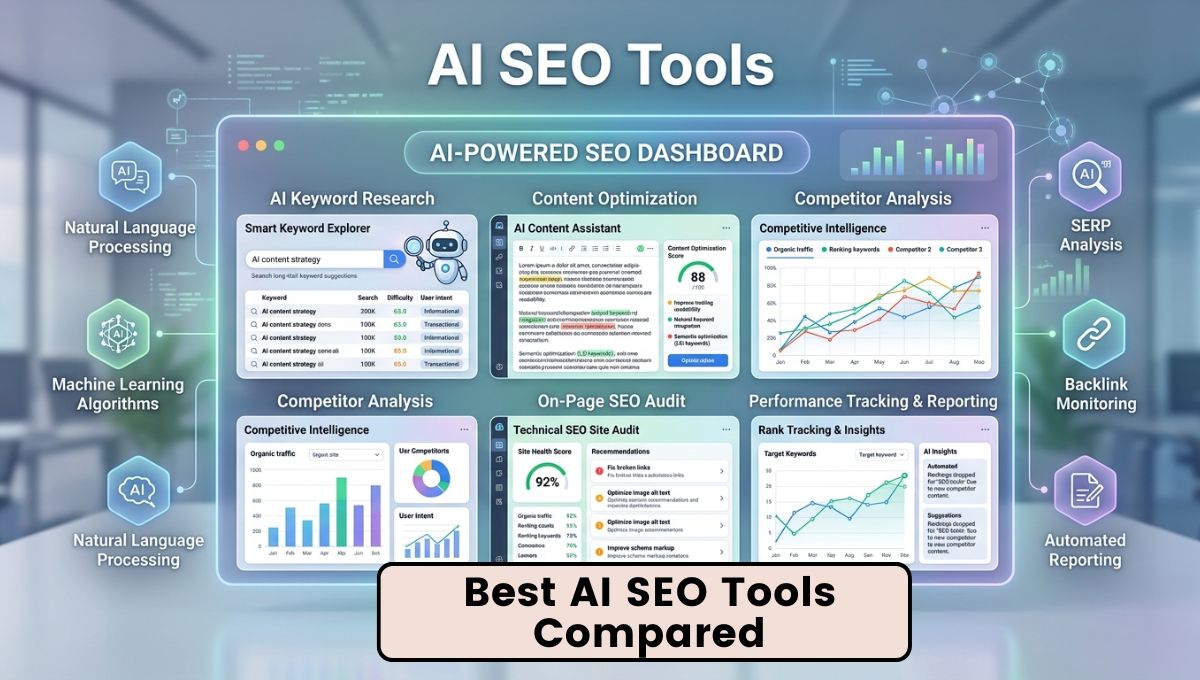
Search Engine Optimization has evolved rapidly over the last few years, and Artificial Intelligence is now playing a major role in how websites rank on search engines. Traditional SEO methods that depended heavily on manual keyword research, backlink building, and repetitive optimization tasks are no longer enough in today’s competitive digital landscape. Businesses, bloggers, agencies, e-commerce stores, and publishers are now relying on advanced AI SEO tools to improve rankings, increase organic traffic, automate workflows, and create search-optimized content at scale.
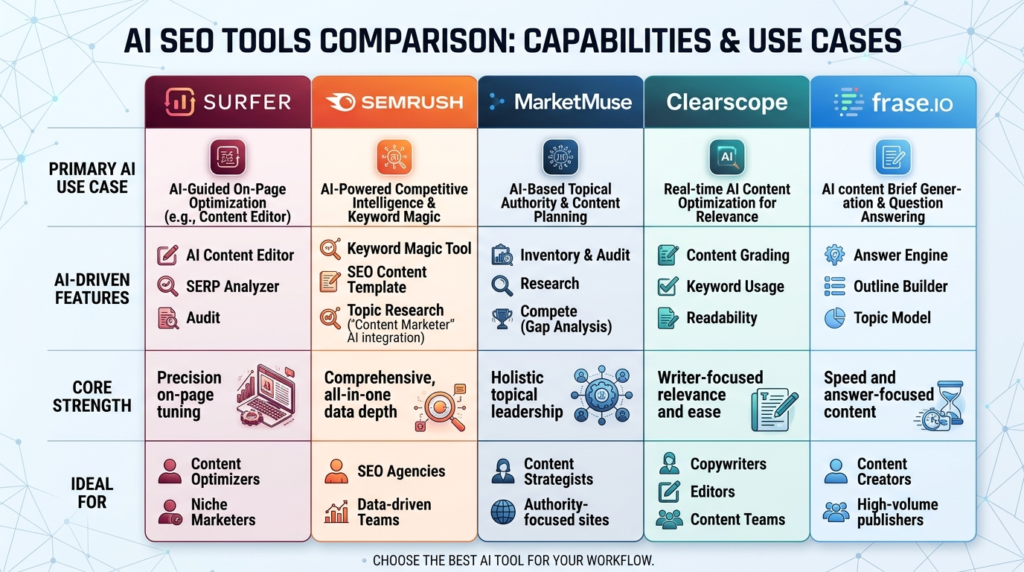
The rise of AI-powered search experiences, including Google AI Overviews and AI-driven answer engines, has also changed the way users discover information online. Modern SEO is no longer focused only on ranking websites on Google search pages. It is also becoming increasingly important to optimize content for AI-generated summaries, conversational search systems, and intelligent recommendation engines. Because of this shift, AI-powered SEO platforms are becoming essential for marketers who want to stay competitive in 2026 and beyond.
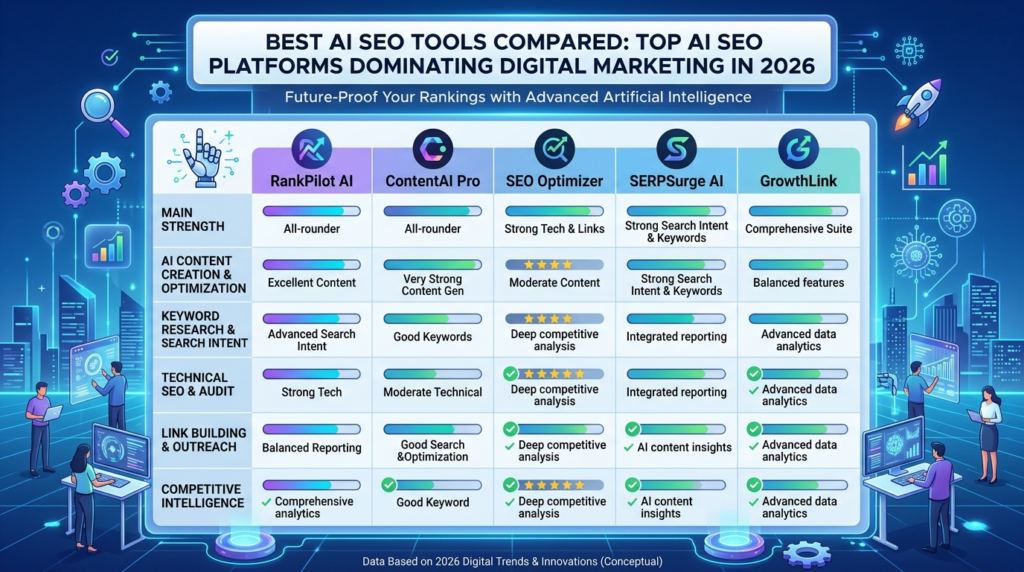
Today, there are dozens of SEO tools available in the market, but only a few platforms dominate the industry because of their advanced features, data quality, automation capabilities, and AI integrations. Tools like Semrush, Ahrefs, Surfer SEO, Frase, Clearscope, NeuronWriter, SE Ranking, and Screaming Frog are among the leading names currently shaping the future of AI-assisted search optimization.
This detailed comparison explores the best SEO optimization tools, their features, strengths, limitations, pricing structures, and ideal use cases so readers can better understand which platform fits their needs.
Why AI SEO Tools Have Become So Important
SEO has become much more complex than it was a few years ago. Earlier, websites could rank by targeting a few keywords and building backlinks. Today, search engines evaluate multiple factors, including content quality, topical authority, user intent, semantic relevance, website performance, mobile optimization, internal linking, structured data, and user engagement signals.
Managing all these SEO elements manually is time-consuming and difficult, especially for websites publishing large volumes of content. This is where AI SEO tools are transforming the industry. These platforms use machine learning, natural language processing, and automation systems to simplify SEO tasks and improve efficiency.
Modern AI-powered SEO platforms can now:
- Generate keyword clusters automatically
- Analyze competitor strategies
- Suggest semantic keywords
- Create AI-driven content briefs
- Audit technical SEO problems
- Optimize articles in real time
- Monitor backlinks and authority
- Track search rankings
- Identify content gaps
- Improve internal linking structures
- Analyze user intent
- Detect ranking opportunities
As AI technology improves, these tools are becoming more intelligent and capable of helping marketers make faster and more accurate SEO decisions.
How AI Is Changing Modern Search Optimization
The SEO industry is going through one of its biggest transformations because of AI-powered search systems. Search engines are increasingly focusing on understanding user intent instead of matching exact keywords. AI models can now evaluate whether content is genuinely useful, relevant, and trustworthy.
At the same time, AI-generated answers are changing user behavior. Instead of clicking multiple websites, users are increasingly getting summarized answers directly through AI systems. This has created a new challenge for publishers and marketers because content must now be optimized not only for traditional search rankings but also for visibility inside AI-generated responses.
Because of these changes, SEO professionals are focusing more on:
- Topic authority
- Semantic optimization
- Content depth
- User intent alignment
- Structured information
- AI visibility
- High-quality content strategies
The rise of SEO optimization tools powered by AI is helping marketers adapt to this rapidly changing environment.
Top AI SEO Tools Compared
| AI SEO Tool | Best For | Main Strength | Ideal Users |
|---|---|---|---|
| Semrush | Full SEO ecosystem | All-in-one marketing platform | Agencies, enterprises |
| Ahrefs | Backlink research | Massive backlink database | SEO professionals |
| Surfer SEO | Content optimization | Real-time SEO scoring | Bloggers, marketers |
| Frase | AI content briefs | Search intent analysis | Writers, freelancers |
| Clearscope | Semantic SEO | High-quality optimization | Publishers, brands |
| SE Ranking | Budget SEO workflows | Affordable SEO suite | SMBs, freelancers |
| NeuronWriter | AI content optimization | Budget-friendly NLP analysis | Bloggers |
| Screaming Frog | Technical SEO audits | Deep website crawling | Technical SEO experts |
Semrush Remains the Most Complete SEO Platform
Among all AI SEO tools, Semrush continues to be one of the most comprehensive platforms available. It combines keyword research, backlink analysis, competitor tracking, content optimization, PPC insights, site audits, social media management, and AI-powered marketing tools inside one ecosystem.
Semrush is especially popular among agencies and large businesses because it allows teams to manage multiple marketing activities from a single dashboard. The platform provides detailed competitor analysis, helping businesses understand which keywords competitors rank for, where they get backlinks from, and how their content performs in search results.
One of Semrush’s biggest strengths is its extensive keyword database. Users can identify high-volume keywords, long-tail opportunities, trending topics, and keyword gaps quickly. The platform also includes AI-driven recommendations for improving search visibility and optimizing content structure.
Recent updates have also introduced AI visibility tracking, helping users understand how their brand appears inside AI-generated search summaries and answer engines. This feature has become increasingly important as AI-powered search experiences grow across the internet.
Semrush also performs strongly in technical SEO. Its site audit tools can identify crawl errors, broken links, duplicate content, missing metadata, page speed issues, and mobile usability problems. This makes it a complete SEO management solution for businesses looking to scale organic traffic.
However, one common concern among smaller businesses is pricing. Semrush can become expensive as users add projects, keywords, and reporting requirements. Despite this, many professionals still consider it one of the best overall SEO platforms available today.
Ahrefs Continues to Lead in Backlink Intelligence
Ahrefs has built a strong reputation as one of the most trusted SEO tools for backlink analysis and competitor research. Many SEO experts rely heavily on Ahrefs because of its massive backlink index and accurate keyword tracking systems.
Backlinks remain one of the most important ranking signals in SEO, and Ahrefs excels in helping users understand link-building opportunities. The platform allows users to analyze:
- Competitor backlinks
- Domain authority
- Referring domains
- Broken link opportunities
- Anchor text profiles
- Link growth patterns
Ahrefs is especially useful for businesses focusing on authority building and long-term SEO growth strategies. The platform’s Site Explorer tool provides detailed competitor insights, allowing users to discover which pages drive the most traffic and backlinks for competitors.
Another major advantage of Ahrefs is keyword analysis. Users can evaluate keyword difficulty, search volume, click potential, and ranking opportunities more accurately. This helps marketers target keywords with realistic ranking potential instead of chasing highly competitive phrases.
Ahrefs also includes content research tools that identify trending topics and popular content formats across industries. This feature is particularly useful for bloggers and publishers looking to create high-performing articles.
Although Ahrefs has expanded its AI capabilities in recent years, its strongest advantage still remains backlink intelligence and competitor analysis.
Surfer SEO Dominates Content Optimization
Surfer SEO has become one of the most popular platforms for AI-assisted content optimization. Unlike tools focused mainly on backlinks or technical SEO, Surfer specializes heavily in helping users optimize content for rankings.
The platform analyzes top-ranking pages for a target keyword and provides real-time recommendations for:
- Keyword usage
- Heading structure
- Content length
- Semantic keywords
- NLP terms
- Internal linking
- Content relevance
One of the most useful features inside Surfer SEO is the Content Editor. Writers receive a live optimization score while writing articles, helping them improve search relevance in real time.
Surfer SEO is especially useful for content marketers, bloggers, affiliate websites, and agencies producing large volumes of articles. The platform helps teams standardize optimization workflows and improve ranking consistency across content campaigns.
Many marketers use Surfer alongside AI writing tools to speed up article creation while maintaining SEO quality. However, experienced SEO professionals often recommend balancing optimization scores with natural readability to avoid robotic content.
Another strong feature is Surfer’s topical mapping and keyword clustering system, which helps users build authority around entire topics rather than isolated keywords.
Frase Simplifies AI Content Research
Frase focuses heavily on AI-driven content briefs and research workflows. The platform is particularly popular among freelance writers, bloggers, and smaller content teams because it simplifies article planning and SERP analysis.
One of Frase’s strongest advantages is search intent analysis. Instead of simply suggesting keywords, the platform examines what users actually want when searching for a topic. It identifies common questions, related terms, and ranking patterns directly from search results.
This helps content creators build articles that better align with user expectations and Google’s ranking preferences.
Frase also speeds up content production by automatically generating article briefs. Writers can quickly create structured outlines containing headings, questions, competitor insights, and semantic keyword recommendations.
For smaller publishers and solo creators, Frase offers an efficient and affordable way to improve SEO workflows without requiring enterprise-level budgets.
Clearscope Focuses on Premium Semantic SEO
Clearscope is widely respected among enterprise publishers and premium content teams because of its clean optimization system and semantic SEO capabilities.
The platform analyzes high-ranking pages and recommends related terms and content improvements that help articles appear more comprehensive and relevant to search engines.
Unlike some AI content tools that focus heavily on automation, Clearscope emphasizes quality optimization and readability. Many editorial teams use Clearscope to refine existing content and improve ranking performance rather than generate bulk articles.
One reason businesses prefer Clearscope is its simple interface and accurate semantic analysis. Writers can understand optimization opportunities clearly without feeling overwhelmed by excessive data.
Although Clearscope is more expensive than some competitors, it remains popular among businesses prioritizing high-quality content production.
SE Ranking Provides Strong Value for Small Businesses
SE Ranking has grown significantly as a budget-friendly alternative to larger SEO suites like Semrush and Ahrefs. The platform offers keyword tracking, competitor analysis, site audits, backlink monitoring, and AI-powered optimization tools at more affordable pricing levels.
Small businesses and freelancers often prefer SE Ranking because it balances functionality and affordability effectively.
The platform includes:
- Keyword position tracking
- Website audits
- Backlink monitoring
- Competitor analysis
- Local SEO tools
- Marketing reports
Its AI-powered features continue improving, helping users automate reporting and identify ranking opportunities more efficiently.
For businesses with limited budgets, SE Ranking offers one of the strongest overall SEO toolsets available.
NeuronWriter Is Popular Among Bloggers
NeuronWriter has become increasingly popular among bloggers and affiliate marketers because of its affordable AI-driven content optimization capabilities.
The platform focuses mainly on NLP analysis and semantic SEO recommendations. It helps writers identify related terms, content structures, and optimization opportunities that improve topical relevance.
Many users compare NeuronWriter to Surfer SEO because of similar optimization workflows, but NeuronWriter is often viewed as more affordable for individual creators.
This makes it particularly attractive for:
- Affiliate marketers
- Niche bloggers
- Small websites
- Solo content creators
While it may not include advanced enterprise-level features, NeuronWriter provides strong value for users focused mainly on content rankings.
Screaming Frog Remains Essential for Technical SEO
Screaming Frog continues to be one of the most important technical SEO tools in the industry. Unlike content-focused platforms, Screaming Frog specializes in deep website crawling and technical analysis.
SEO professionals use Screaming Frog to identify:
- Broken links
- Redirect chains
- Missing metadata
- Duplicate content
- Crawl errors
- Indexing issues
- Page speed problems
- Structured data errors
The platform can crawl thousands of pages quickly, making it essential for large websites and enterprise SEO audits.
Recent integrations with AI systems have also improved automation workflows for analyzing website data and generating recommendations.
Although the interface may appear technical for beginners, experienced SEO professionals still consider Screaming Frog an industry-standard tool for technical optimization.
Important Factors to Consider Before Choosing an AI SEO Tool
Choosing the right SEO optimization tools depends heavily on business goals, content strategy, and technical requirements.
Before selecting a platform, users should evaluate:
| Feature | Importance |
|---|---|
| Keyword research quality | Essential for ranking strategy |
| Backlink analysis | Important for authority building |
| Content optimization | Helps improve relevance |
| Technical SEO audits | Detects site issues |
| AI integration | Improves automation |
| Ease of use | Important for beginners |
| Reporting capabilities | Useful for agencies |
| Pricing structure | Impacts scalability |
| Competitor analysis | Helps identify opportunities |
| Local SEO support | Important for location-based businesses |
A solo blogger may only need content optimization and keyword research, while an enterprise agency may require technical audits, reporting systems, and large-scale competitor analysis.
The Future of AI in SEO
The role of AI in SEO is expected to grow even further over the next few years. Search engines are becoming smarter at understanding context, intent, and content quality. As a result, SEO tools are also evolving beyond basic optimization features.
Future AI SEO platforms are expected to offer:
- Automated content strategies
- Predictive ranking analysis
- Real-time AI visibility tracking
- Automated internal linking
- AI-driven competitor monitoring
- Voice search optimization
- Conversational search analytics
- Autonomous SEO workflows
Businesses that adopt intelligent SEO systems early may gain significant advantages in search visibility and content scalability.
At the same time, experts continue emphasizing that AI should support high-quality human content rather than replace it entirely. Search engines still prioritize usefulness, originality, expertise, and trustworthiness.
Conclusion
The rapid growth of AI SEO tools has transformed the way businesses, marketers, bloggers, and agencies approach search optimization. Platforms like Semrush, Ahrefs, Surfer SEO, Frase, Clearscope, SE Ranking, NeuronWriter, and Screaming Frog each provide unique strengths depending on user needs and SEO goals.
Some tools focus heavily on backlink intelligence and competitor analysis, while others specialize in AI content optimization, semantic SEO, technical audits, or workflow automation. Among current industry leaders, Semrush remains one of the strongest all-in-one SEO ecosystems, Ahrefs continues dominating backlink research, and Surfer SEO leads in AI-powered content optimization workflows.
As AI-driven search experiences continue expanding, the importance of intelligent SEO strategies will only increase. Businesses that invest in advanced SEO optimization tools and high-quality content workflows are likely to maintain stronger visibility in both traditional search engines and AI-powered answer systems.
The future of SEO is becoming increasingly connected to Artificial Intelligence, automation, and semantic search understanding. For marketers and publishers, adapting to these changes is no longer optional—it is becoming essential for long-term digital growth and online visibility.