Artificial intelligence has changed the way people work, learn, create, and solve problems. In just a few years, AI tools have moved from being advanced technology used by experts to becoming everyday digital assistants for millions of people around the world. Today, students use AI to simplify research, content creators use it to generate ideas, businesses use it to automate repetitive tasks, and professionals rely on it to improve productivity.
As the AI industry grows rapidly, users are faced with an important decision: should they stick with free AI tools, or invest in paid AI platforms?
This question matters because the number of AI tools available today is larger than ever. Almost every category now offers both free and premium options. There are AI tools for writing, image generation, video editing, coding, business automation, research, customer service, and marketing.
At first glance, free tools may seem enough for everyone. Many of them now provide impressive performance and useful features. However, paid tools promise faster speed, better output quality, more advanced capabilities, and fewer restrictions.
Choosing the wrong option can either limit your productivity or make you spend money on features you may never need.
Understanding the difference between free AI tools and paid AI tools is essential for making a smart decision in 2026. This guide explains the major differences, advantages, limitations, and ideal use cases for both, helping users choose the right platform based on their needs.
Understanding the Growth of AI Tools in 2026
Artificial intelligence tools have become one of the most competitive sectors in technology.
In 2026, AI platforms are no longer limited to generating text or answering questions. They now perform advanced tasks such as:
- Writing long-form content
- Creating realistic images
- Editing videos
- Generating code
- Conducting deep research
- Automating workflows
- Building presentations
- Managing business tasks
- Translating content
- Assisting with customer communication
Because of this rapid growth, many companies now offer free versions to attract users and paid plans to monetize advanced features.
This has created a competitive market where users have more options than ever before.
The main challenge is identifying whether a free tool is enough or whether premium access offers enough value to justify the cost.
What Are Free AI Tools?
Free AI tools are platforms that provide users access to artificial intelligence features without requiring payment.
These tools are often designed to allow users to test the platform, explore its capabilities, and complete basic tasks.
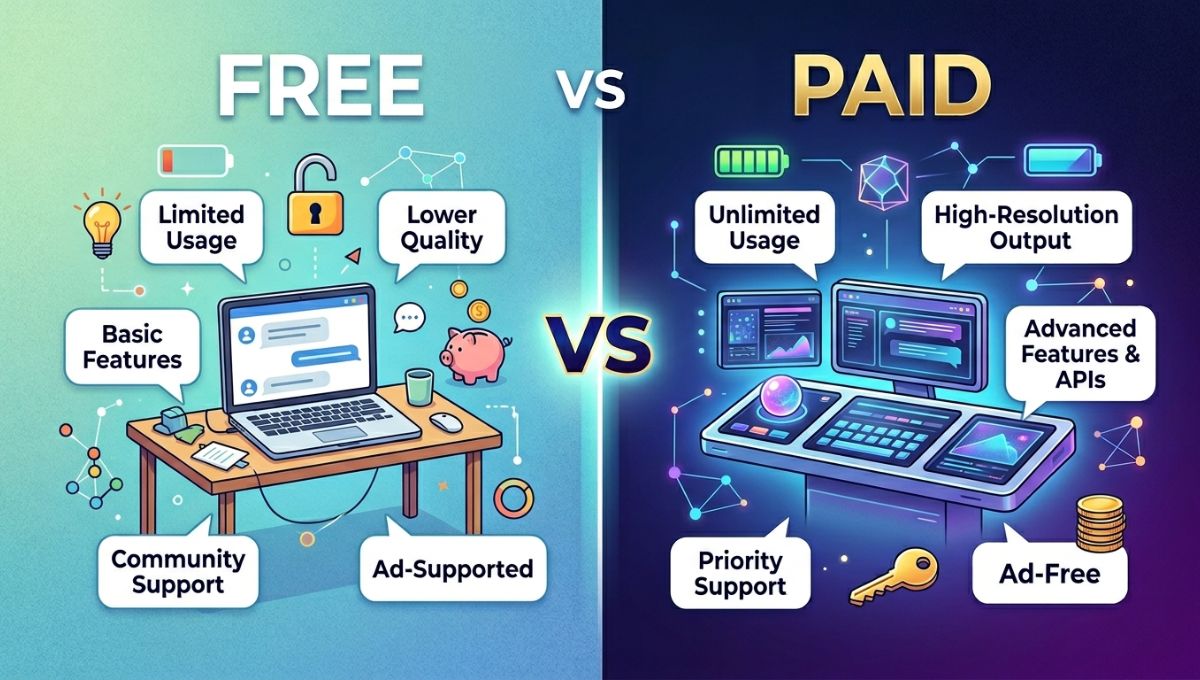
Free AI plans are usually supported by certain restrictions.
These limitations often include:
- Daily message caps
- Slower processing during busy hours
- Limited file uploads
- Restricted access to advanced models
- Fewer templates
- Basic output quality
- Limited integrations
Despite these restrictions, free tools have improved significantly.
Many free AI platforms now offer enough functionality for everyday users to complete common tasks effectively.
These tools are especially useful for:
- Students
- Beginners
- Casual users
- Hobby creators
- Small personal projects
Free plans allow users to experiment without financial risk.
This makes them an ideal starting point for anyone new to artificial intelligence.
What Are Paid AI Tools?
Paid AI tools are subscription-based versions of AI platforms that unlock advanced capabilities.
These plans are built for users who depend on AI regularly and require better performance, larger usage limits, and professional-grade outputs.
Paid AI tools generally offer:
- Access to advanced models
- Faster response times
- Higher daily or monthly usage
- Better contextual understanding
- Improved output quality
- Priority access
- Larger file support
- Team collaboration features
- API access
- Advanced automation
These features are designed for serious users who need AI for productivity, business operations, or content generation.
Paid plans often save significant time by producing more accurate and refined outputs.
For users who rely on AI daily, this time-saving advantage can justify the subscription cost.
Major Differences Between Free and Paid AI Tools
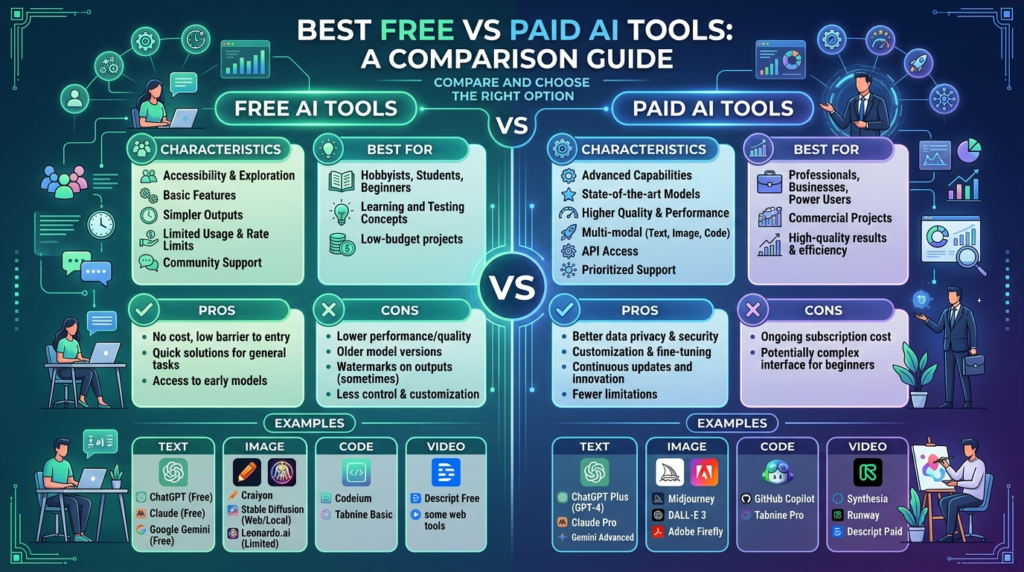
The difference between free and paid tools goes beyond pricing.
The real distinction lies in performance, reliability, and capability.
| Feature | Free AI Tools | Paid AI Tools |
|---|---|---|
| Monthly Cost | Free | Subscription-based |
| Response Speed | Standard | Faster priority speed |
| Usage Limits | Restricted | Higher or unlimited |
| AI Models | Basic models | Advanced premium models |
| Output Depth | Moderate | More detailed |
| Accuracy | Good for simple tasks | Better for complex tasks |
| Features | Limited access | Full feature access |
| Support | Basic help resources | Priority support |
| Collaboration | Usually unavailable | Often included |
| Best Users | Beginners and casual users | Professionals and businesses |
This comparison clearly shows that paid tools are designed for heavy users, while free tools serve general needs.
Benefits of Using Free AI Tools
Free AI tools offer several strong advantages.
No Financial Commitment
The biggest benefit is cost.
Users can explore AI without spending money.
This makes experimentation easy and risk-free.
Great for Learning
Beginners can understand how prompts work, how AI responds, and how different platforms perform.
This helps users build practical experience.
Useful for Basic Daily Tasks
Free AI tools can handle many simple tasks effectively.
Examples include:
- Writing emails
- Summarizing text
- Brainstorming ideas
- Creating captions
- Answering general questions
For occasional use, this is often enough.
Access to Multiple Platforms
Instead of paying for one premium tool, users can combine several free tools.
For example:
One free tool for writing
Another for image generation
Another for research
This combination can create a powerful workflow without cost.
Limitations of Free AI Tools
Although free tools are impressive, they have limitations.
Daily Usage Restrictions
Many free plans limit how many prompts users can submit.
Heavy users often hit these limits quickly.
Slower Response Times
Free users may experience delays, especially during peak hours.
This can slow down workflows.
Basic Model Access
Free plans often provide access to older or smaller AI models.
These models may produce less accurate or less detailed outputs.
Feature Restrictions
Advanced capabilities are usually locked behind paid plans.
Examples include:
- File analysis
- Automation tools
- Deep research features
- Large context windows
These missing features can affect professional workflows.
Advantages of Paid AI Tools
Paid AI tools are designed to maximize efficiency.
Better Output Quality
Premium models often generate:
- More accurate responses
- Better structure
- Improved creativity
- Stronger contextual understanding
This is essential for professional work.
Faster Performance
Speed matters for productivity.
Paid plans usually provide faster responses, reducing waiting time.
Higher Usage Limits
Heavy users can work without interruptions.
This is especially important for:
- Writers
- Developers
- Designers
- Researchers
Advanced Features
Paid tools often unlock premium capabilities such as:
- Long document analysis
- Workflow automation
- Team collaboration
- API integration
- Commercial usage rights
These features provide significant value.
Best Use Cases for Free AI Tools
Free AI tools work best in several situations.
Students and Learners
Students can use free AI for:
- Research summaries
- Study notes
- Essay planning
- Language practice
These tasks usually do not require premium features.
Casual Content Creation
People creating occasional social media posts, captions, or simple graphics can rely on free tools.
Personal Productivity
Free tools are useful for:
- Drafting emails
- Creating lists
- Organizing tasks
- Quick problem-solving
For light personal use, they are highly effective.
Best Use Cases for Paid AI Tools
Paid AI tools are ideal when reliability and advanced output matter.
Professional Content Writing
Writers benefit from premium tools because they provide:
- Better long-form generation
- Stronger structure
- More consistent quality
This improves efficiency.
Business Automation
Companies use paid AI for:
- Customer support automation
- Workflow optimization
- Marketing campaigns
- Data processing
These use cases demand premium reliability.
Development and Coding
Paid AI coding assistants offer:
- Better debugging
- Larger code understanding
- Faster suggestions
Developers often save hours.
Creative Professionals
Designers and video creators benefit from:
- High-resolution outputs
- Faster rendering
- Better editing tools
These features are often locked behind subscriptions.
Cost vs Value: Is Paying Worth It?
The value of paid AI depends on how often it is used.
If AI saves several hours each month, the subscription often becomes worthwhile.
For example:
If a writer saves 10 hours monthly using premium AI, the productivity gain may outweigh the subscription cost.
However, if someone only uses AI once or twice a week, free tools are usually enough.
The key question is simple:
Does the paid tool save enough time or improve quality enough to justify the expense?
If yes, paying makes sense.
If not, free tools remain the smarter option.
How to Choose the Right AI Tool
Choosing between free AI tools and paid AI tools depends on your personal needs.
Ask yourself these questions:
How often do you use AI?
Occasional use usually means free tools are enough.
Daily heavy use often justifies premium access.
What tasks do you perform?
Simple tasks work well on free plans.
Complex professional tasks often require paid features.
Do speed and consistency matter?
If yes, paid tools offer clear advantages.
Are advanced features necessary?
If you need automation, large uploads, integrations, or premium generation, paid tools are likely better.
Start free whenever possible. Upgrade only when limitations affect your work.
Future of Free and Paid AI Tools
The competition among AI companies is increasing rapidly. This means both free and paid plans will continue improving. Free tools will likely become more powerful. Paid tools will continue adding advanced capabilities.
The difference between them may become smaller for casual users. However, premium tools will likely remain ahead in speed, depth, and specialized features. Users will have more choices, making it easier to find tools that match their exact needs.
Conclusion
The decision between free AI tools and paid AI tools depends entirely on your goals, usage habits, and work requirements.
Free AI tools have become incredibly capable in 2026. They provide excellent value for students, beginners, hobby users, and anyone exploring artificial intelligence without wanting to spend money.
They are powerful enough for basic writing, research, brainstorming, and simple creative tasks. Paid AI tools, however, offer clear advantages for professionals. They provide better speed, stronger output quality, advanced features, higher limits, and greater reliability.
For businesses and regular users, these benefits often justify the monthly subscription. The smartest approach is to begin with free tools.
Learn how they fit into your workflow.
If you eventually face limitations that slow your work or reduce output quality, upgrading becomes a practical investment. The best AI tool is not always the most expensive one. It is the one that matches your real needs and helps you work more effectively.