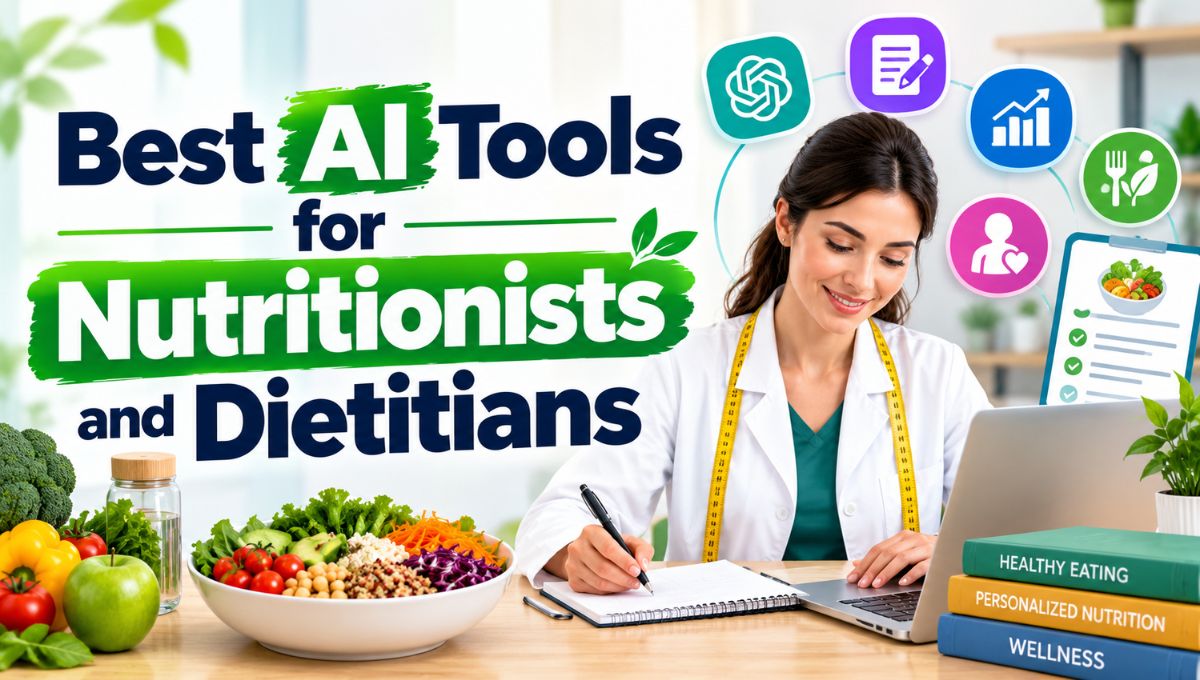
Artificial intelligence is becoming a practical assistant for nutritionists and dietitians, helping professionals reduce administrative work, analyze food intake, create meal plans, document consultations, monitor clients, and deliver more personalized nutrition support.
The best AI tools for nutritionists and dietitians in 2026 are not necessarily general-purpose chatbots. The most useful solutions combine AI with nutrition databases, client records, meal-planning systems, food tracking, practice management, and clinical documentation.
Tools such as Practice Better, Nutrium, Cronometer, Healthie, Foodzilla, That Clean Life, ChatGPT, and AI-powered nutrition tracking platforms can support different parts of a nutrition professional’s workflow. For example, Practice Better now offers AI-assisted charting, session preparation, session insights, and writing assistance, while Nutrium combines nutrition analysis, meal planning, client tracking, and practice-management features.
AI can save significant time, but nutrition professionals should not treat AI-generated recommendations as an automatic replacement for professional judgment. Dietary advice can involve allergies, medications, medical conditions, nutrient deficiencies, pregnancy, eating disorders, chronic disease, and other factors that require qualified human assessment.
The most effective approach is therefore AI-assisted nutrition practice, where technology handles repetitive tasks while the nutritionist or dietitian remains responsible for assessment, personalization, verification, and final recommendations.
Best AI Tools for Nutritionists and Dietitians at a Glance
| AI Tool | Best For | Key Features |
|---|---|---|
| Practice Better | AI charting and practice management | AI notes, session prep, client records, scheduling |
| Nutrium | All-in-one nutrition practice | Meal planning, nutrient analysis, client tracking |
| Cronometer | Detailed nutrition tracking | AI photo logging, voice logging, nutrient analysis |
| Healthie | Client engagement | Food journaling, messaging, telehealth, practice tools |
| Foodzilla | Meal planning | Nutrition coaching, meal plans, recipes |
| That Clean Life | Recipe-based meal planning | Large recipe library, meal plans, client resources |
| ChatGPT | General AI assistant | Research, drafting, brainstorming, client education |
| Perplexity | Nutrition research | Web research, source discovery, summaries |
| Canva | Nutrition content creation | Social posts, guides, presentations, visual content |
| NotebookLM | Research and reference work | Source-based summaries and document analysis |
| Google Gemini | Productivity and research | Brainstorming, document work, analysis |
| AI Nutrition Trackers | Client food logging | Photo-based logging, meal tracking, nutrition insights |
1. Practice Better — Best Overall AI Platform for Nutrition Professionals
Practice Better is one of the strongest choices for nutritionists and dietitians who want AI integrated into their practice-management workflow rather than using separate AI tools.
Practice Better’s current AI features include AI Charting Assistant, AI Session Prep, AI Session Insights, AI Writing Assistant, and AI Program Content Generator. The company says its AI charting supports formats including SOAP, ADIME, and GROW.
This is particularly useful for dietitians because documentation can consume a significant portion of the working day.
What Practice Better can help with
Nutrition professionals can use it for:
- Client intake
- Scheduling
- Session documentation
- AI-assisted charting
- Client communication
- Meal-plan management
- Progress tracking
- Automated reminders
- Program creation
- Practice administration
Its AI Session Prep feature can summarize previous client-session information before a new session, while AI Writing Assistant can rewrite or improve text inside the platform.
Practice Better also emphasizes that AI-generated notes are drafts for practitioner review rather than automatically finalized clinical records.
Why it stands out
The biggest advantage is integration.
Instead of:
AI scribe → copy note → open EHR → paste note → update client record
an embedded system can keep documentation inside the practice-management environment.
That matters even more for group practices where multiple practitioners need access to shared client records and review workflows.
Best for
- Registered dietitians
- Nutritionists
- Health coaches
- Private practices
- Telehealth nutrition businesses
- Multi-practitioner clinics
2. Nutrium — Best All-in-One Nutrition Software
Nutrium is designed specifically for dietitians and nutrition professionals and combines nutrition analysis, meal planning, client management, progress tracking, and communication.
Nutrium provides nutrient analysis using multiple food-composition databases and supports more than 27,000 foods and 100 nutritional components according to its current product information.
The platform can analyze client food diaries, create meal plans, develop recipes, calculate nutritional information, and generate nutrient reports.
It also provides tools for:
- Client records
- Appointment management
- Reminders
- Food diaries
- Meal plans
- Recipe development
- Nutrient analysis
- Progress tracking
- Client communication
- Video consultations
Nutrium has also introduced AI-generated summaries for virtual consultations. Its current product page says video consultations can automatically generate a structured summary covering assessment, eating behavior, anthropometric data, goals, meal plans, guidance, and next steps, with practitioner review before anything is saved.
Best for
- Clinical nutrition practices
- Private dietitians
- Meal-plan-based practices
- European nutrition professionals
- Professionals wanting one integrated platform
3. Cronometer — Best for Detailed Nutrition Tracking
Cronometer is particularly useful when detailed nutrient analysis is more important than simply tracking calories.
Cronometer currently uses AI for features including Photo Logging, Voice Logging, and Coach, while emphasizing that its underlying nutrition data is not generated by AI. The company says its food data comes from scientific sources and human review.
This distinction is important for nutrition professionals.
AI can help make food logging easier, but the underlying nutrient database still needs reliable data.
Useful features
A client can:
- Photograph a meal
- Use voice to log food
- Search foods manually
- Scan barcodes
- Track calories
- Track macronutrients
- Track micronutrients
- Monitor nutrition patterns
Cronometer Pro is also designed for professionals working with clients and is now available on mobile, making client-data review easier while away from a desktop.
Best for
- Clinical dietitians
- Sports nutrition professionals
- Micronutrient analysis
- Weight-management practices
- Clients who track food consistently
4. Healthie — Best for Client Engagement
Healthie is another strong platform for nutrition professionals who want to combine client engagement with practice-management features.
Healthie’s nutrition-oriented workflow includes features such as food journaling, secure messaging, scheduling, telehealth, forms, and client tracking. Practice Better’s 2026 comparison of nutrition software also highlights Healthie’s photo-based food journaling and client-engagement capabilities.
For nutritionists, client adherence is often as important as the original meal plan.
A sophisticated nutrition plan is not very useful if the client never follows it.
Tools that make it easier for clients to record meals, communicate with practitioners, and monitor progress can therefore improve the overall workflow.
Best for
- Telehealth nutrition practices
- Nutrition coaching
- Client communication
- Food journaling
- Group practices
5. Foodzilla — Best for AI-Assisted Meal Planning
Foodzilla focuses on meal planning and nutrition coaching.
It can help professionals create meal plans and recipes while managing nutrition-coaching workflows.
For a dietitian working with multiple clients, meal-plan creation can become repetitive. AI-assisted workflows can reduce the amount of manual work involved in creating variations based on preferences, goals, and dietary requirements.
However, nutrition professionals should always review automatically generated meal plans before giving them to clients.
Best for
- Meal planning
- Nutrition coaching
- Recipe development
- Client programs
- Professionals who want to streamline repetitive meal-plan work
6. That Clean Life — Best for Recipe-Based Meal Planning
That Clean Life is particularly useful for nutrition professionals who want a large recipe and meal-planning resource.
Practice Better currently highlights an integration with That Clean Life and says nutrition professionals can access thousands of recipes through the integration.
This can be useful when clients need more than a list of nutrients.
They need actual meals they can prepare.
Practical uses
A dietitian could create:
- Weekly meal plans
- Recipe collections
- Client handouts
- Condition-specific meal resources
- Grocery-oriented meal plans
- Recipe substitutions
Best for
- Dietitians who prescribe recipes
- Family nutrition
- Lifestyle nutrition
- Meal-plan businesses
- Client education
7. ChatGPT — Best General-Purpose AI Assistant
ChatGPT can be useful for nutrition professionals, but it should be treated as a general-purpose assistant rather than an autonomous dietitian.
It can help with tasks such as:
- Drafting educational content
- Creating recipe ideas
- Brainstorming meal-plan variations
- Rewriting client-facing explanations
- Creating social-media content
- Summarizing non-sensitive research
- Generating consultation questions
- Creating checklists
- Writing newsletters
- Developing workshop material
- Creating presentation outlines
For example, a nutritionist could ask AI to turn a complex nutrition concept into a simple explanation suitable for a client.
However, professionals should verify medical and nutritional claims against authoritative sources before providing them to clients.
A better workflow
Instead of asking:
“Create a diet for my patient.”
use AI for a controlled task such as:
“Create five meal ideas that fit these practitioner-approved nutrition targets and dietary restrictions. Clearly identify anything that requires professional verification.”
The nutrition professional remains responsible for the final plan.
Best for
- Content creation
- Education
- Brainstorming
- Administrative writing
- Research assistance
- Client communication
8. Perplexity — Best for Nutrition Research
Perplexity can be useful when nutrition professionals need to research a topic quickly and locate supporting sources.
Instead of asking a general chatbot for an answer, practitioners can use an AI research engine to discover studies, guidelines, government resources, and other references.
Potential research topics include:
- Protein requirements
- Dietary patterns
- Micronutrients
- Nutrition research
- Food labeling
- Clinical nutrition topics
- Sports nutrition
- Public-health nutrition
However, AI research tools should not be treated as the final authority.
For clinical work, the original research paper, clinical guideline, systematic review, or official health organization should be checked.
9. Canva — Best for Nutrition Marketing and Education
Canva is not a clinical nutrition platform, but it can be extremely useful for nutrition professionals who create educational or marketing content.
Nutritionists increasingly need to operate as educators and content creators.
Canva can help create:
- Instagram posts
- Nutrition infographics
- Recipe cards
- Client handouts
- Presentation slides
- E-books
- Meal-planning worksheets
- YouTube thumbnails
- Pinterest graphics
- Lead magnets
For example, a dietitian could turn a long educational article about fiber into a five-slide Instagram carousel.
The AI handles parts of the design process, while the professional controls the nutritional content.
10. NotebookLM — Best for Working With Nutrition Documents
NotebookLM can be useful when a nutrition professional has a collection of documents and wants to work with them as a source set.
Potential sources could include:
- Research papers
- Practice guidelines
- Educational PDFs
- Course material
- Internal protocols
- Nutrition references
- Workshop documents
Instead of asking an AI model to answer from general knowledge, practitioners can work from selected sources.
This is particularly useful for creating educational material from a controlled reference library.
As with other AI tools, citations and original sources should be checked before using information in clinical recommendations.
11. Google Gemini — Best for General Productivity
Google Gemini can support nutrition professionals with general productivity tasks.
Examples include:
- Drafting emails
- Brainstorming content
- Summarizing documents
- Creating educational outlines
- Generating ideas for workshops
- Organizing information
- Creating content variations
Its usefulness increases when a professional already works heavily within Google’s ecosystem.
For clinical data, however, practitioners should use approved workflows and avoid putting identifiable client information into consumer AI tools without appropriate privacy protections.
12. AI-Powered Food Tracking Apps — Best for Client Self-Monitoring
A growing category of AI nutrition tools uses images, voice, or automated recognition to reduce the friction involved in food logging.
This is important because traditional food logging can require clients to search for every ingredient and manually enter quantities.
Cronometer, for example, now offers AI-powered photo and voice logging.
The general workflow is:
Client eats meal → records meal using photo/voice → AI assists with identification → client reviews → nutrition data is recorded → practitioner reviews trends
The important step is client review and practitioner verification.
Food photographs can be ambiguous.
A picture may not accurately reveal:
- Portion size
- Ingredients
- Cooking oils
- Hidden sugars
- Sauces
- Food preparation methods
- Brand differences
Therefore, AI food recognition should generally be treated as a convenience feature rather than an unquestionable measurement system.
AI Tools for Nutritionists vs AI Tools for Dietitians
Although the terms nutritionist and dietitian are sometimes used interchangeably in everyday conversation, professional scope and regulatory requirements differ by country and jurisdiction.
The right AI software therefore depends partly on the professional’s role.
Nutritionists may prioritize
- Meal planning
- Client coaching
- Recipe creation
- Food tracking
- Educational content
- Scheduling
- Client communication
- Marketing
Dietitians may additionally prioritize
- ADIME documentation
- Clinical assessment
- Detailed nutrient analysis
- Medical nutrition therapy workflows
- Structured client records
- Evidence-based documentation
- Team review
- Compliance and privacy
This is why practitioner platforms such as Practice Better and Nutrium can be more appropriate for clinical workflows than a generic AI chatbot. Practice Better specifically supports ADIME alongside other note formats, while Nutrium provides structured nutrition analysis and client records.
Best AI Tools for Different Nutrition Practices
There is no single winner for every nutrition professional.
Best AI tool for private-practice dietitians
Practice Better
It combines AI-assisted documentation with practice management, client records, scheduling and other workflows.
Best AI tool for meal planning
Nutrium or Foodzilla
These are more appropriate than a general chatbot when structured nutrition software is required.
Best AI tool for detailed nutrient tracking
Cronometer
Its detailed nutrition database and professional features make it particularly useful for nutrient-level analysis.
Best AI tool for recipe-based nutrition
That Clean Life
It is especially useful for professionals who rely heavily on recipes and meal resources.
Best AI tool for client engagement
Healthie
Its food journaling, communication and telehealth-oriented workflow can help maintain client interaction between consultations.
Best AI tool for content creation
ChatGPT + Canva
ChatGPT can assist with ideation and writing, while Canva can turn the information into visual educational material.
Best AI tool for research
Perplexity + NotebookLM
Perplexity can help discover information and sources, while NotebookLM can help work through a controlled collection of documents.
How AI Can Save Time for Nutritionists and Dietitians
Consider a dietitian who has 30 client consultations per week.
If documentation takes an average of 15 minutes after each consultation, that equals:
30 × 15 = 450 minutes
That’s 7.5 hours per week spent only on documentation.
Even if AI reduces the documentation burden by a third, the theoretical time recovered would be:
7.5 × 33% = 2.48 hours per week
That is more than 100 hours per year.
Actual savings will vary depending on the practice, documentation style, AI accuracy and amount of editing required, but the calculation demonstrates why workflow automation can matter.
Practice Better’s current AI charting approach is specifically designed to reduce this documentation burden while keeping the generated note under practitioner review.
A Practical AI Workflow for Nutrition Professionals
A strong AI-assisted nutrition workflow could look like this:
Step 1: Collect client information
Use your approved intake system to collect:
- Goals
- Food preferences
- Allergies
- Lifestyle
- Dietary patterns
- Relevant medical information
- Food history
- Activity levels
Step 2: Analyze the data
Use a nutrition platform such as Nutrium or Cronometer where appropriate for structured nutrition analysis.
Step 3: Create a preliminary plan
AI can help generate meal ideas, recipe variations or educational resources based on practitioner-defined requirements.
Step 4: Review everything manually
This is essential.
Check:
- Calories
- Macronutrients
- Micronutrients
- Allergens
- Portion sizes
- Medical appropriateness
- Dietary restrictions
- Cultural preferences
- Client goals
Step 5: Deliver the plan
Use the nutrition platform or client portal to provide the approved plan.
Step 6: Monitor adherence
Client food logs, journals and progress tracking can provide information between sessions.
Step 7: Use AI for documentation
AI-assisted charting can create a preliminary consultation note.
Step 8: Human verification
Read the complete note before finalizing it.
This workflow uses AI as an assistant rather than as the decision-maker.
AI Meal Planning: What Should Be Automated?
Meal planning is one of the areas where AI can save considerable time.
AI can help with:
- Recipe ideas
- Meal variations
- Ingredient substitutions
- Grocery lists
- Recipe descriptions
- Meal-plan formatting
- Client education
- Cultural food variations
- Content personalization
However, AI should not independently determine a therapeutic diet for a client.
For example, a client with kidney disease, food allergies, diabetes, pregnancy-related nutritional needs, or other medical considerations may require careful professional assessment.
AI can help execute the plan.
The practitioner should determine the plan.
AI for Indian Nutritionists and Dietitians
Indian nutrition professionals have an additional consideration: food databases and cultural relevance.
A meal-planning system needs to handle foods such as:
- Roti
- Chapati
- Dal
- Rajma
- Chole
- Poha
- Upma
- Idli
- Dosa
- Paneer
- Curd
- Buttermilk
- Sabudana
- Regional vegetables
- Indian snacks
- Regional recipes
Portion sizes can also be culturally specific.
A plan that technically meets a calorie target may still be impractical if it does not reflect what the client actually eats.
Therefore, Indian nutrition professionals should test an AI tool’s food database with real Indian meals before adopting it for regular practice.
Current 2026 comparisons of nutrition software for Indian dietitians specifically emphasize Indian-food database coverage as an important selection criterion.
Privacy and Compliance: What Nutrition Professionals Need to Know
This is one of the most important parts of using AI in nutrition.
Nutrition professionals may handle sensitive client information, including:
- Health information
- Lab results
- Medication information
- Body measurements
- Food diaries
- Medical conditions
- Allergies
- Mental-health information
- Personal contact information
Do not assume that every AI chatbot or AI application is appropriate for storing such information.
Before using AI with identifiable client data, check:
- Data processing policies
- Data retention
- Encryption
- Access controls
- Whether data is used for model training
- HIPAA requirements where applicable
- GDPR requirements where applicable
- Local privacy laws
- Business associate agreements where required
Practice Better states that its platform is HIPAA, PHIPA, PIPEDA and GDPR compliant, while Nutrium also publishes information about HIPAA and GDPR compliance.
Cronometer also says that its AI tools see limited non-identifiable data and that its nutrition database remains human-reviewed.
Compliance, however, is not simply a marketing checkbox. Nutrition professionals should independently verify whether a platform’s specific plan, configuration and data-processing arrangement meet their legal and professional requirements.
Common Mistakes When Using AI for Nutrition
Mistake 1: Trusting AI-generated nutrition numbers
AI can make mistakes.
Always verify important nutrient calculations using an appropriate nutrition database or professional software.
Mistake 2: Giving AI complete control
AI should not independently determine a clinical nutrition intervention.
Mistake 3: Uploading identifiable client information
Avoid entering personal health information into consumer AI tools unless the service and workflow are specifically approved for that use.
Mistake 4: Forgetting cultural preferences
A meal plan needs to work in the client’s real life.
Mistake 5: Ignoring food preparation
The same food can have very different nutritional values depending on ingredients, cooking method and portion.
Mistake 6: Not reviewing AI-generated notes
AI transcription can misunderstand terminology, names, measurements or clinical context.
Practice Better explicitly positions AI-generated notes as drafts for practitioner review.
Will AI Replace Nutritionists and Dietitians?
AI is unlikely to completely replace qualified nutrition professionals.
The value of a dietitian or nutritionist is not simply producing a list of foods.
Professionals provide:
- Assessment
- Clinical reasoning
- Behavioral support
- Motivation
- Accountability
- Personalization
- Cultural understanding
- Communication
- Monitoring
- Adjustment
- Professional judgment
AI can generate a meal plan.
It cannot automatically understand why a client repeatedly struggles to follow it.
It can summarize a food diary.
It cannot replace the relationship between practitioner and client.
It can identify patterns.
The professional decides what those patterns mean in context.
The likely future is therefore not:
AI vs. nutritionist
but:
Nutrition professional + AI assistant
How to Choose the Best AI Tool for Your Nutrition Practice
Before paying for an AI nutrition platform, ask these questions.
1. What is my biggest time-consuming task?
If it is documentation, prioritize AI charting.
If it is meal planning, prioritize meal-planning software.
If it is food analysis, prioritize nutrition-analysis tools.
2. Does the platform support my professional workflow?
Dietitians may need ADIME.
Nutrition coaches may need simpler progress tracking.
Group practices may require shared records and supervision.
3. Does it support my clients’ foods?
This is particularly important for Indian and other culturally diverse practices.
4. Can clients use it easily?
A technically sophisticated system is not useful if clients stop using it.
5. Can I review AI output before it reaches the client?
This should be a major requirement.
6. How does the platform handle client data?
Review privacy, security and compliance documentation before adoption.
7. Does it integrate with my existing tools?
Integration can be more valuable than having dozens of disconnected AI features.
Recommended AI Stacks for Nutritionists and Dietitians
Beginner nutritionist
ChatGPT + Canva + Cronometer
Good for education, content and basic nutrition tracking.
Private-practice dietitian
Practice Better + Cronometer
Useful for documentation, client management and detailed nutrition tracking.
Meal-plan-focused nutritionist
Nutrium + That Clean Life
Useful for structured nutrition analysis, meal planning and recipe-based client resources.
Content-focused nutrition professional
ChatGPT + Canva + Perplexity
Useful for research, content creation and social-media marketing.
Telehealth nutrition practice
Practice Better or Healthie + Cronometer
Useful for client communication, remote sessions, food tracking and ongoing monitoring.
Research-focused dietitian
Perplexity + NotebookLM + a trusted nutrition database
Useful for finding and organizing research while keeping the original sources accessible.
Final Verdict: What Are the Best AI Tools for Nutritionists and Dietitians in 2026?
The best AI tools for nutritionists and dietitians depend on the specific part of the workflow that needs improvement.
Practice Better is one of the strongest choices for professionals who want AI-assisted charting and practice management in the same environment. Its current AI features include session preparation, charting, session insights and writing assistance.
Nutrium is a strong all-in-one option for nutrition analysis, meal planning, client tracking and practice management. Its nutrient-analysis system and client-management tools make it particularly relevant to professional nutrition workflows.
Cronometer stands out when detailed nutrition tracking is the priority. Its AI photo and voice logging features can make client food tracking faster while its underlying nutrition database remains based on established sources and human review.
Healthie is worth considering for client engagement, telehealth and food-journaling workflows, while Foodzilla and That Clean Life are useful for professionals whose practices depend heavily on meal plans and recipes.
For general-purpose work, ChatGPT, Perplexity, NotebookLM and Canva can provide valuable support for research, education, writing and marketing.
The most important lesson is that AI should not become the nutrition professional.
Instead, it should become the assistant that handles repetitive tasks while the qualified professional remains responsible for clinical reasoning, personalization, verification and client care.
As AI becomes more capable, the competitive advantage for nutrition professionals may not come from simply having access to AI. It will come from knowing where AI can safely save time, where human judgment is essential, and how to combine both into a better client experience.
1 thought on “Best AI Tools for Nutritionists and Dietitians in 2026”